This article includes a list of references, related reading, or external links, but its sources remain unclear because it lacks inline citations .(September 2023) |
Louis Castex | |
|---|---|
| Born | December 2, 1868 Saumur, France |
| Died | July 13, 1954 15th arrondissement of Paris, France |
| Nationality | French |
| Education | École des Beaux-Arts de Toulouse, École nationale supérieure des Beaux-Arts (Paris) |
| Known for | Sculpture |
Louis Castex (December 2, 1868 - July 13, 1954) was a French sculptor.
Louis Castex was born on December 2, 1868, in Saumur. His parents were Dulcide Castex, a military intendant from Agen, and Hélène Gazanchon de Chavannes, from a land-owning family in the Monts du Lyonnais. In 1882, his elder brother died, and Louis Castex lost his left eye in an accident. He was introduced to wood sculpture and modeling by his mother.
In 1889, Louis Castex studied sculpture under Henri Maurette (1834-1898) at the École des Beaux-Arts in Toulouse. He won the second grand prize in the municipal competition with his high relief "Timoclée appearing before Alexander," which also earned him a scholarship to enter the École nationale des Beaux-Arts in Paris the following year. He was a student of sculptors Jules Cavelier and Louis-Ernest Barrias and befriended Henri Bouchard and Paul Landowski.
In 1897, Louis Castex won first prize in the Chenavard competition at the École des Beaux-Arts in Paris with his high relief "The Vision of the Virgin." He also received a travel grant, allowing him to visit Italy and Spain. This work earned him a third-class medal at the 1898 Salon des Artistes Français and a bronze medal at the Exposition Universelle of 1900.
Castex participated in 28 annual editions of the Salon des Artistes Français throughout his career. In 1910, he won the second prize with his high relief "The Singers" or "Religious Music," which can be found in the cathedral Notre-Dame du Liban in Paris. He dedicated sixteen years to this sculpture, considered his masterpiece.
Specializing in religious sculpture, Louis Castex was particularly active in the Lyon region, where he participated, like many of his colleagues, in the construction of the eight lateral chapels of the nave of the Basilica of Notre-Dame de Fourvière between 1899 and 1943. He executed the altarpiece of "The Annunciation" in 1922, initially entrusted to Jean-Baptiste Larrivé.
In collaboration with goldsmith Amédée Cateland, he created several works dedicated to the Curé of Ars for the Basilica of Saint Philomena in Ars-sur-Formans, Ain.
Castex was also the author of numerous portraits and genre scenes, in relief or in the round. These depictions of characters reading or engaged in fieldwork are mainly distributed between the Musée des Beaux-Arts de Lyon and the Musée départemental de l'Oise in Beauvais.
The presence of Louis Castex's works in these two museums owes much to the active promotion of his work by his children Raoul, Marie-Hélène, and Jean-Marie, who made several donations: in 1990 and 2001 to the Musée des Beaux-Arts in Lyon (statuettes, preparatory studies, plaques, glass plates), and in 1997 to the Musée départemental de l'Oise - Beauvais, where the addition of around forty sculptures and drawings to the collections led to a temporary exhibition entirely dedicated to Louis Castex, between November 1997 and January 1998.
Musée Départemental de l'Oise:
He died on July 13, 1954 in the 15th arrondissement of Paris.
Nicolas Coustou was a French sculptor and academic.
Pierre Cartellier was a French sculptor.
Lucienne Heuvelmans (1885–1944) was a French sculptor and illustrator.
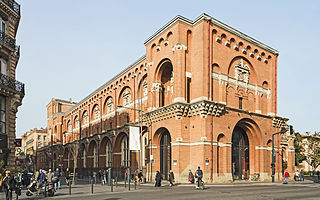
The Musée des Augustins de Toulouse is a fine arts museum in Toulouse, France which conserves a collection of sculpture and paintings from the Middle Ages to the early 20th century. The paintings are from throughout France, the sculptures representing Occitan culture of the region with a particularly rich assemblage of Romanesque sculpture.
Louis-Pierre Deseine (1749–1822) was a French sculptor, who was born and died in Paris. He is known above all for his portrait busts and imaginary portraits.
Charles-François Lebœuf, called Nanteuil was a French sculptor.

Pierre Félix Masseau, known professionally as Fix-Masseau. He was a noted French sculptor and father of poster artist Pierre Fix-Masseau with whom he is sometimes confused with.
The Museum of Fine Arts of Lyon is a municipal museum of fine arts in the French city of Lyon. Located near the Place des Terreaux, it is housed in a former Benedictine convent which was active during the 17th and 18th centuries. It was restored between 1988, and 1998, remaining open to visitors throughout this time despite the ongoing restoration works. Its collections range from ancient Egyptian antiquities to the Modern art period, making the museum one of the most important in Europe. It also hosts important exhibitions of art, for example the exhibitions of works by Georges Braque and Henri Laurens in the second half of 2005, and another on the work of Théodore Géricault from April to July 2006. It is one of the largest art museums in France.
Joseph-Hugues Fabisch was a French sculptor. He was professor at the École des Beaux-Arts de Lyon, and official sculptor to the diocese of Lyon.
Émile Jean Armel-Beaufils was a French sculptor born in Rennes in 1882 and who died in Saint-Briac in 1952.
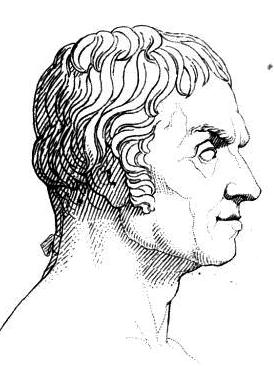
Jean-Guillaume Moitte was a French sculptor.
Jacques Le Chevallier was a French glassmaker, decorative artist, illustrator, and engraver. He was mobilized during World War I; after the war he became a master artisan in the studio of Louis Barillet, with whom he remained until 1945. His collaborators there included Théodore-Gérard Hanssen.
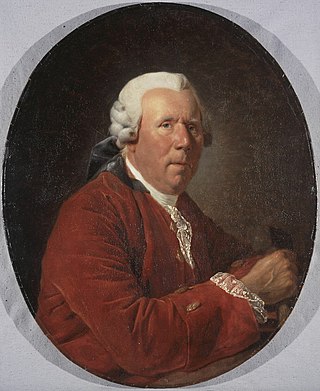
Nicolas-Sébastien Adam, also called "Adam the Younger", was a French sculptor working in the Neoclassical style. He was born in Nancy and died in Paris.

Émile Nestor Joseph Carlier, called Joseph Carlier, was a French sculptor.
Pierre-François Berruer was a French sculptor. He is known for the twelve statues that decorate the front of the Grand Théâtre de Bordeaux.
Élie-Jean Vézien was born in Marseille on 18 July 1890 and died in Marseille on 7 September 1982. He was a French sculptor, engraver and medallist.
Pierre Lenoir was a French sculptor.
André-César Vermare was a French sculptor, known for his war memorials and monuments.