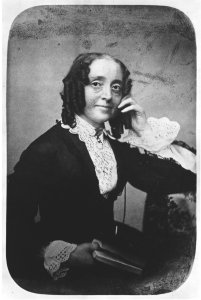
Ernestine Louise Rose was a suffragist, abolitionist, and freethinker who has been called the “first Jewish feminist.” Her career spanned from the 1830s to the 1870s, making her a contemporary to the more famous suffragists Elizabeth Cady Stanton and Susan B. Anthony. Largely forgotten in contemporary discussions of the American women's rights movement, she was one of its major intellectual forces in nineteenth-century America. The quote, "women's rights are human rights," was believed to be first coined by her. Her relationship with Judaism is a debated motivation for her advocacy. As a rabbi's daughter, Ernestine had received more education than other women her age. Although less well remembered than her fellow suffragists and abolitionists, in 1996, she was inducted into the National Women's Hall of Fame, and in 1998 the Ernestine Rose Society was founded to “revive the legacy of this important early nineteenth century reformer by recognizing her pioneering role in the first wave of feminism.”

Sage Hall was built in 1875 at Cornell University's Ithaca, New York campus. Originally designed as a residential building, it currently houses the Johnson Graduate School of Management.
Louise and Luise are, respectively, French and German feminine forms of the given name Louis. Louise has been regularly used as a female name in English speaking countries since the middle of the 19th century. It has ranked among the top 100 names given to girls in France, England, Ireland, Scotland, Sweden and Wales in recent years. It last ranked among the top 1,000 first names for girls born in the United States in 1991, but remains a more common middle name.
Willcox is a surname. Notable people with the surname include:

Marie Louise Bottineau Baldwin, was a Métis Turtle Mountain Band of Chippewa Indians attorney, Native American rights activist, and suffragist. In 1914, Baldwin was the first Native American student to graduate from the Washington College of Law. She worked in the United States Bureau of Indian Affairs, and was an officer in the Society of American Indians.
Duprey is a surname. Notable people with the surname include:

Mary Jane (Whitely) Coggeshall was an American suffragist known as the "mother of woman suffrage in Iowa". She was inducted into the Iowa Women's Hall of Fame in 1990.
The United Suffragists was a women's suffrage movement in the United Kingdom.
The Boston Women's Heritage Trail is a series of walking tours in Boston, Massachusetts, leading past sites important to Boston women's history. The tours wind through several neighborhoods, including the Back Bay and Beacon Hill, commemorating women such as Abigail Adams, Amelia Earhart, and Phillis Wheatley. The guidebook includes seven walks and introduces more than 200 Boston women.

Rise up, Women, also known as Our Emmeline, is a bronze sculpture of Emmeline Pankhurst in St Peter's Square, Manchester. Pankhurst was a British political activist and leader of the suffragette movement in the United Kingdom. Hazel Reeves sculpted the figure and designed the Meeting Circle that surrounds it.

The "Prison Special" was a train tour organized by suffragists who, as members of the Silent Sentinels and other demonstrations, had been jailed for picketing the White House in support of passage of the federal women's suffrage amendment. In February 1919, 26 members of the National Woman's Party boarded a chartered train they dubbed the "Democracy Limited" in Washington, D.C. They visited cities across the country where they spoke to large crowds about their experiences as political prisoners at Occoquan Workhouse, and were typically dressed in their prison uniforms. The tour, which concluded in March 1919, helped create support for the ratification effort that ended with the adoption of the Nineteenth Amendment on August 26, 1920.

Annie Louise Hall was an American suffragist and saleswoman. Hall worked as a teacher for many years, but after her experiences at a settlement house in New York City, she turned to suffrage work. Hall had experience working for women's suffrage in Connecticut, Massachusetts, New Hampshire, New York, Ohio, Pennsylvania, and Rhode Island. After her women's suffrage work, she went on to work as a saleswoman and eventually retired with her life partner to Ojai, California.

Women's suffrage began in North Dakota when it was still part of the Dakota Territory. During this time activists worked for women's suffrage, and in 1879, women gained the right to vote at school meetings. This was formalized in 1883 when the legislature passed a law where women would use separate ballots for their votes on school-related issues. When North Dakota was writing its state constitution, efforts were made to include equal suffrage for women, but women were only able to retain their right to vote for school issues. An abortive effort to provide equal suffrage happened in 1893, when the state legislature passed equal suffrage for women. However, the bill was "lost," never signed and eventually expunged from the record. Suffragists continued to hold conventions, raise awareness, and form organizations. The arrival of Sylvia Pankhurst in February 1912 stimulated the creation of more groups, including the statewide Votes for Women League. In 1914, there was a voter referendum on women's suffrage, but it did not pass. In 1917, limited suffrage bills for municipal and presidential suffrage were signed into law. On December 1, 1919, North Dakota became the twentieth state to ratify the Nineteenth Amendment.
Helen Bullock may refer to:

Sarah Louise Arnold was an American educator, author, and suffragist. She was better known in the schoolroom and among teachers than any other woman connected with education in her day. In 1902, she became the first dean of Simmons College. In 1925, she became the national president of the Girl Scouts. Arnold was also a writer of books for teachers and texts for schools.
