At the outset of World War II, Denmark declared itself neutral. For most of the war, the country was a protectorate, then an occupied territory of Germany. The decision to occupy Denmark was taken in Berlin on 17 December 1939. On 9 April 1940, Germany occupied Denmark in Operation Weserübung and the king and government functioned as normal in a de facto protectorate over the country until 29 August 1943, when Germany placed Denmark under direct military occupation, which lasted until the Allied victory on 5 May 1945. Contrary to the situation in other countries under German occupation, most Danish institutions continued to function relatively normally until 1945. Both the Danish government and king remained in the country in an uneasy relationship between a democratic and a totalitarian system until the Danish government stepped down in a protest against the German demands to institute the death penalty for sabotage.
Danes are a North Germanic ethnic group native to Denmark and a modern nation identified with the country of Denmark. This connection may be ancestral, legal, historical, or cultural.

The Danish resistance movements were an underground insurgency to resist the German occupation of Denmark during World War II. Due to the initially lenient arrangements, in which the Nazi occupation authority allowed the democratic government to stay in power, the resistance movement was slower to develop effective tactics on a wide scale than in some other countries.

The First Schleswig War or Three Years' War was the first round of military conflict in southern Denmark and northern Germany rooted in the Schleswig-Holstein Question, contesting the issue of who should control the Duchies of Schleswig and Holstein. The war, which lasted from 1848 to 1851, also involved troops from Prussia and Sweden. Ultimately, under international pressure, the Prussians had to withdraw their forces. As a result, the war ended in a Danish victory over the rebels and the signing of the London Protocol in 1852. A second conflict, the Second Schleswig War, erupted in 1864.

The Second Schleswig War was the second military conflict over the Schleswig-Holstein Question of the nineteenth century. The war began on 1 February 1864, when Prussian forces crossed the border into Schleswig. Denmark fought the Kingdom of Prussia and the Austrian Empire. Like the First Schleswig War (1848–52), it was fought for control of the duchies of Holstein and Lauenburg, due to the succession disputes concerning them when the Danish king died without an heir acceptable to the German Confederation. Controversy arose due to the passing of the November Constitution, which integrated the Duchy of Schleswig into the Danish kingdom in violation of the London Protocol. Reasons for the war were the ethnic controversy in Schleswig and the co-existence of conflicting political systems within the Danish unitary state.
The Danes were a North Germanic tribe inhabiting southern Scandinavia, including the area now comprising Denmark proper, and the Scanian provinces of modern southern Sweden, during the Nordic Iron Age and the Viking Age. They founded what became the Kingdom of Denmark. The name of their realm is believed to mean "Danish March", viz. "the march of the Danes" in Old Low German, referring to their southern border zone between the Eider and Schlei rivers, known as Danevirke.

The Battle of Heligoland was fought on 9 May 1864, during the Second Schleswig War, between a Danish squadron led by Commodore Edouard Suenson and a joint Austro-Prussian squadron commanded by the Austrian Commodore Wilhelm von Tegetthoff. The action came about as a result of the Danish blockade of German ports in the North Sea; the Austrians had sent two steam frigates, SMS Schwarzenberg and Radetzky, to reinforce the small Prussian Navy to help break the blockade. After arriving in the North Sea, Tegetthoff joined a Prussian aviso and a pair of gunboats. To oppose him, Suenson had available the steam frigates Niels Juel and Jylland and the corvette Hejmdal.
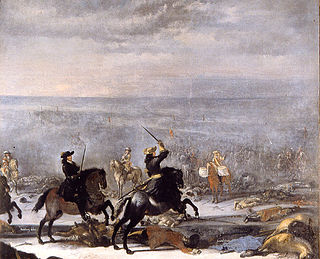
The Battle of Lund, part of the Scanian War, was fought on December 4, 1676, in an area north of the city of Lund in Scania in southern Sweden, between the invading Danish army and the army of Charles XI of Sweden. The Danish had an army of about 13,000 under the personal command of 31-year-old King Christian V of Denmark, aided by General Carl von Arensdorff. The Swedish army, which numbered about 8,000, was commanded by Field Marshal Simon Grundel-Helmfelt and the 21-year-old Swedish king Charles XI. It is one of the bloodiest battles in percent of casualties on both sides ever fought on European soil.

The Gunboat War was the naval conflict between Denmark–Norway and the British Navy during the Napoleonic Wars. The war's name is derived from the Danish tactic of employing small gunboats against the conventional Royal Navy. In Scandinavia it is seen as the later stage of the English Wars, whose commencement is accounted as the First Battle of Copenhagen in 1801.

The Battle of Fehmarn (1644) took place north-west of the island of Fehmarn, now part of Germany, in the Baltic Sea. A combined Swedish fleet, with a large element of hired Dutch ships, defeated a Danish fleet and took 1000 prisoners, including Ulfeldt, Grabov and von Jasmund. The Danish admiral Pros Mund was killed in the battle.

The National Socialist Workers' Party of Denmark was the largest Nazi Party in Denmark before and during the Second World War.

Free Corps Denmark was a Danish volunteer free corps created by the Danish Nazi Party (DNSAP) in cooperation with Nazi Germany, to fight the Soviet Union during the Second World War. On June 29, 1941, days after the German invasion of the Soviet Union, the DNSAP's newspaper Fædrelandet proclaimed the creation of the corps. Its formation was subsequently sanctioned by the democratically elected Danish government which authorized officers of the Danish Army to join the unit. The corps was disbanded in 1943. During the course of the war, approximately 6000 Danes joined the corps, including 77 officers of the Royal Danish Army.

The Landsverk L-180, L-181 and L-182 are a family of armored cars developed by the Swedish company AB Landsverk during the interwar years. They had a good international reputation for being fast, robust and reliable and were acquired in small numbers by Denmark, Estonia, Ireland and the Netherlands, among others.
Uhtred of Bebbanburg, also known as Osbert, Uhtred son of Uhtred and Uhtred Ragnarson is the main character of the best selling Saxon Stories novel series by Bernard Cornwell and the BBC / Netflix television adaptation, The Last Kingdom. Uhtred is in part based upon the historical Uhtred the Bold from the 11th century. However, the timeline of the fictional Uhtred fits better with Uhtred, an Ealdorman of Derbyshire who flourished in the 10th century, believed to have come from Northumbria.
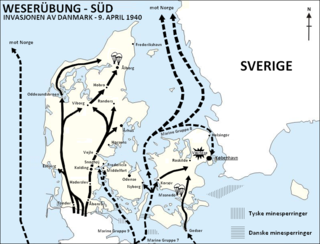
The German invasion of Denmark was the German attack on Denmark on 9 April, 1940, during the Second World War. The attack was a prelude to the main attack against Norway. The term Weserübung means Weser-exercise in English, named after the river Weser in northwestern Germany.

The Battle of Isted took place on 25 July 1850 near the village of Idstedt, in what is today Schleswig-Holstein, Germany. The battle was part of the First Schleswig War.

Death of Kings, published in 2011, is the sixth novel of Bernard Cornwell's Saxon Tales series. It continues the story of Saxon warlord Uhtred of Bebbanburg who keeps fighting against a new Danish invasion of Wessex and Mercia.

HDMS Niels Juel was a training ship built for the Royal Danish Navy between 1914 and 1923. Originally designed before World War I as a monitor, construction was slowed by the war and she was redesigned as a training cruiser. Completed in 1923 she made training cruises to the Black and Mediterranean Seas, South America and numerous shorter visits to ports in northern Europe. The ship often served as a flagship and occasionally was used as a royal yacht for visits to overseas possessions and other countries.

Operation Safari was a German military operation during World War II involving 9,000 German soldiers. Launched with the intention of disarming the Danish military, it led to the scuttling of the Royal Danish Navy, and internment of all Danish soldiers. On the Danish side it resulted in 23–26 dead, and around 40–50 injured. A total of 4,600 Danish personnel were captured. German losses were reported as one killed and eight wounded, although they may have been as high as 11 killed and 59 wounded.