This page is based on this
Wikipedia article Text is available under the
CC BY-SA 4.0 license; additional terms may apply.
Images, videos and audio are available under their respective licenses.
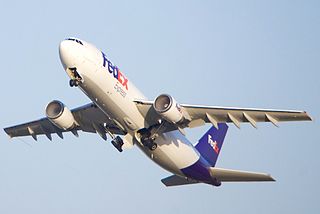
The Airbus A300 is a wide-body twin-engine jet airliner developed and manufactured by Airbus. Formally announced in 1969 and first flying in October 1972, it holds the distinction of being the world's first twin-engined widebody airliner; it was also the first product of Airbus Industrie, a consortium of European aerospace manufacturers, now known as Airbus. The A300 can typically seat 266 passengers in a two-class layout, with a maximum range of 4,070 nautical miles (7,540 km) when fully loaded, depending on model.

A wide-body aircraft, also known as a twin-aisle aircraft, is a jet airliner with a fuselage wide enough to accommodate two passenger aisles with seven or more seats abreast. The typical fuselage diameter is 5 to 6 m. In the typical wide-body economy cabin, passengers are seated seven to ten abreast, allowing a total capacity of 200 to 850 passengers. The largest wide-body aircraft are over 6 m (20 ft) wide, and can accommodate up to eleven passengers abreast in high-density configurations.
Société Aircalin, also known as Air Calédonie International, is a French airline and is the international airline of New Caledonia. It also operates domestic services in Wallis and Futuna. Including Wallis and Futuna, it operates scheduled services to twelve destinations in Oceania and Asia, including Japan. Its main base is La Tontouta International Airport. It is headquartered in Nouméa.

The Airbus CC-150 Polaris is the designation for the civilian Airbus A310-300s which have been converted for use as the primary long distance transport aircraft and mid-air refueler for the Royal Canadian Air Force.
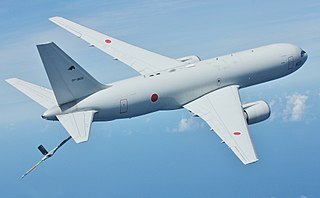
The Boeing KC-767 is a military aerial refueling and strategic transport aircraft developed from the Boeing 767-200ER. The tanker received the designation KC-767A, after being selected by the U.S. Air Force (USAF) initially to replace older KC-135Es. In December 2003, the contract was frozen and later canceled due to corruption allegations.

Airbus Military was a business unit of Airbus, which was part of EADS, during the period 2009–2013.

The General Electric CF6 is a family of high-bypass turbofan engines produced by GE Aviation. Based on the TF39, the first high-power high-bypass jet engine, the CF6 powers a wide variety of civilian airliners. The basic engine core also powers the LM2500, LM5000, and LM6000 marine and power generation turboshafts. The newer GEnx family has been introduced, intended to replace the CF6 family.

A cargo aircraft is a fixed-wing aircraft that is designed or converted for the carriage of cargo rather than passengers. Such aircraft usually do not incorporate passenger amenities and generally feature one or more large doors for loading cargo. Freighters may be operated by civil passenger or cargo airlines, by private individuals or by the armed forces of individual countries.
Airbus UK is a wholly owned subsidiary of Airbus which produces wings for Airbus aircraft. When Airbus was incorporated as a joint-stock company in 2001, BAE Systems transferred its UK Airbus facilities in return for a 20% share of the new company. These facilities became Airbus UK. The company has two main sites responsible for the design and manufacture of the high-technology wings for all Airbus models as well as overall design and supply of the fuel system. For most Airbus models, the company is responsible for overall design and supply of landing gear. The company employs around 13,000 people at two sites: Filton, where the engineering and design activity takes place along with some manufacturing, and Broughton, where other major wing component manufacturing and all wing assembly takes place.

The EADS/Northrop Grumman KC-45 was a proposed aerial refueling tanker aircraft based on the Airbus A330 MRTT. The United States Air Force (USAF) had ordered 179 KC-45As in the first stage of replacing the aging Boeing KC-135 Stratotanker tankers currently in service. However, the contest was reopened in July 2008, after Boeing's protest of the award was upheld. In response to the new contest, on 8 March 2010, Northrop Grumman announced it was abandoning its bid for the new contract, with its CEO stating that the revised bid requirement favoured Boeing. On 20 April 2010, EADS announced it was re-entering the competition and entered a bid with the KC-45. Eventually, the USAF selected the Boeing KC-46 Pegasus.
Elbe Flugzeugwerke GmbH is a subsidiary of Airbus (45%) and ST Aerospace (55%) in Dresden. It is located at Dresden Airport and concentrates on freighter and tanker aircraft conversion. It also supplies Airbus with fibre composite sheets for aircraft interiors.
Airbus Defence and Space is a division of Airbus responsible for defence and aerospace products and services. The division was formed in January 2014 during the corporate restructuring of European Aeronautic Defence and Space (EADS), and comprises the former Airbus Military, Astrium, and Cassidian divisions. It is the world's second largest space company after Boeing and one of the top ten defence companies in the world.

The Executive Transport Wing of the Federal Ministry of Defence is a flying formation of the German Air Force with a wide variety of tasks. Occasionally it is ambiguously listed as the Special Air Missions Wing in English language articles. The wing is based at Cologne Bonn Airport with Berlin Tegel Airport used as a location for its helicopters. It is planned to bring the two operating locations together at Berlin Brandenburg Airport once its construction is finished.