Ritu means "season" in different ancient Indian calendars used in India, Bangladesh, Nepal and Sri Lanka. There are six ritus or seasons. Seasons are different times of the year and there are 12 months in the year. Every month has its own special season. The word is derived from the Vedic Sanskrit word Ṛtú, a fixed or appointed time, especially the proper time for sacrifice (yajna) or ritual in Vedic religion; this in turn comes from the word Ṛta (ऋत), as used in Vedic Sanskrit literally means the "order or course of things". This word is used in nearly all Indian languages.

Makar(a) Sankranti, also referred to as Uttarayana, Makar, or simply Sankranti, is a Hindu observance and a festival. Usually falling on the date of 14 January annually, this occasion marks the transition of the sun from the zodiac of Sagittarius (dhanu) to Capricorn (makara). Since the sun has made this transition which vaguely coincides with moving from south to north, the festival is dedicated to the solar deity, Surya, and is observed to mark a new beginning. Many native multi-day festivals are organised on this occasion all over India.

Chaitra is a month of the Hindu calendar.

Magha is the eleventh month of the Hindu calendar, corresponding to January/February of the Gregorian calendar. In India's national civil calendar, Magha is also the eleventh month of the year, beginning on 20 January and ending on 18 February.

Ashvin or Ashwin or Ashwan, also known as Aswayuja, is the seventh month of the lunisolar Hindu calendar, the solar Tamil calendar, where it is known as Aippasi, and the solar Indian national calendar. It is the sixth month of the solar Bengali calendar and the seventh of the lunar Indian calendar of the Deccan Plateau. It falls in the season of Sharada, or autumn. In Hindu astrology, Ashvin begins with the Sun's enter into Virgo.
Nakshatra is the term for lunar mansion in Hindu astrology. A nakshatra is one of 27 sectors along the ecliptic. Their names are related to a prominent star or asterisms in or near the respective sectors. In essence, a nakshatra simply is a constellation. Every nakshatra is divided into four padas related to the Char Dham, a set of four pilgrimage sites in India.

Magh is the tenth month in the Bengali calendar. This is the last month of the two months of winter season.
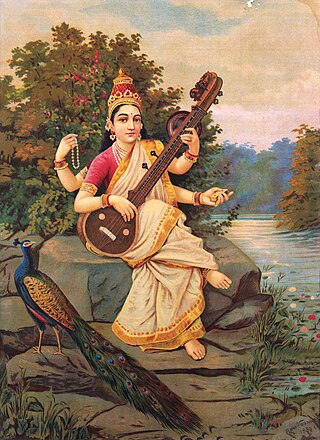
Vasant Panchami, also rendered Vasanta Panchami and Saraswati Puja in honour of the Hindu goddess Saraswati, is a festival that marks the preparation for the arrival of spring. The festival is celebrated in Indian religions in different ways depending on the region. Vasant Panchami also marks the start of preparation for Holika and Holi, which take place forty days later. The Vasant Utsava (festival) on Panchami is celebrated forty days before spring, because any season's transition period is 40 days, and after that, the season comes into full bloom.

Arasavalli is an outgrowth of Srikakulam municipality in Srikakulam district of the Indian state of Andhra Pradesh. It is located in Srikakulam mandal of Srikakulam revenue division. It is situated at a distance of about 1.6 km. from Srikakulam, the district headquarters and 17 km. from Srikakulam road, the railway station on Visakhapatnam-Howrah Line.

Maghe Sankranti is a Nepali festival observed on the first of Magh in the Vikram Sambat (B.S) or Yele calendar bringing an end to the winter solstice containing month of Poush. Tharu people celebrate this particular day as new year. It is also regarded as the major government declared annual festival of the Magar community. Maghe Sankranti is similar to solstice festivals in other religious traditions.

Kārtika is the eighth month of the Hindu calendar, which falls in October and November of the Gregorian calendar. In India's national civil calendar, Kartika is the seventh month of the year, beginning on 23 October and ending on 21 November.

Navaratri is an annual Hindu festival observed in honor of the goddess Durga, an aspect of Adi Parashakti, the supreme goddess. It spans over nine nights, first in the month of Chaitra, and again in the month of Ashvin (September–October). It is observed for different reasons and celebrated differently in various parts of the Hindu Indian cultural sphere. Theoretically, there are four seasonal Navaratri. However, in practice, it is the post-monsoon autumn festival called Sharada Navaratri. There are 2 Gupta Navaratris or "Secret Navaratris" as well, one starting on the Shukla Paksha Pratipada of the Magha Month and another starting in the Shukla Paksha Pratipada of Jyestha Month.

Kali Puja, also known as Shyama Puja or Mahanisha Puja, is a festival originating from the Indian subcontinent, dedicated to the Hindu goddess Kali. It is celebrated on the new moon day of the Hindu calendar month of Ashwayuja or Kartika. The festival is especially popular in the region of West Bengal, and other places like Mithila and Anga of Bihar, Jharkhand, Odisha, Assam, and Tripura, as well as the town of Titwala in Maharashtra, along with the neighbouring country of Bangladesh.
Navami is the Sanskrit word for "ninth", and is the ninth day in the lunar fortnight (Paksha) of the Hindu calendar. Each month has two Navami days, being the ninth day of the "bright" (Shukla) and of the "dark" (Krishna) fortnights respectively. Navami occurs on the ninth and the twenty-fourth day of each month.

Maghi is the regional name of the Hindu festival of Makar Sankranti celebrated in Punjab, Haryana Jammu division and Himachal Pradesh. In Himachal, the festival is also known as Maghi Saaji or Magha Ra Saza. In Bihar and Nepal it is also referred to as Maghi Parva or Maghi Sankranti. whereas it is known as Maghi Sangrand or Uttarain (Uttarayana) in Jammu and Sakrat in Haryana, Maghi is celebrated on first day of the month of Magh of Hindu Calendar. It follows on the heels of the mid-winter festival of Lohri which is marked by bonfires in North Indian fields and yards. The next morning Hindus see as an auspicious occasion for ritual bathing in ponds and rivers.
Tirhuta Panchang is a calendar followed by the Maithili community of India and Nepal. This calendar is one of the many Hindu calendars. It is a tropical solar Hindu calendar in which the year begins on the first day of Baishakh month i.e. Mesh Sankranti. Every year, this day falls on 13/14 April of the Gregorian Calendar

Vasanta, also referred to as Basant, refers to the Indian spring.

Silā is the fourth month in the Nepal Era calendar, the national lunar calendar of Nepal. The month corresponds to Magha (माघ) in the Hindu lunar calendar and February in the Gregorian calendar.
Ranna Puja is a traditional Hindu festival. It is mainly celebrated in different regions of West Bengal. The ritual of cooking foods the night before the puja and eating this stale food the next day is Arandhan.

