
Palazzo Farnese or Farnese Palace is one of the most important High Renaissance palaces in Rome. Owned by the Italian Republic, it was given to the French government in 1936 for a period of 99 years, and currently serves as the French embassy in Italy.
The properties of the Holy See are regulated by the 1929 Lateran Treaty signed with the Kingdom of Italy. Although part of Italian territory, some of them enjoy immunities, similar to those of foreign embassies.
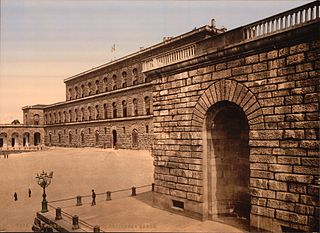
The Palazzo Pitti, in English sometimes called the Pitti Palace, is a vast, mainly Renaissance, palace in Florence, Italy. It is situated on the south side of the River Arno, a short distance from the Ponte Vecchio. The core of the present palazzo dates from 1458 and was originally the town residence of Luca Pitti, an ambitious Florentine banker.

Palazzo Pamphilj, also spelled Palazzo Pamphili, is a palace facing onto the Piazza Navona in Rome. It was built between 1644 and 1650.

The Palazzo della Cancelleria is a Renaissance palace in Rome, Italy, situated between the present Corso Vittorio Emanuele II and the Campo de' Fiori, in the rione of Parione. It was built 1489–1513 by Donato Bramante (1444–1514) as a palace for Cardinal Raffaele Riario, Camerlengo of the Holy Roman Church, and is regarded as the earliest Renaissance palace in Rome. The Palazzo houses the Papal Chancellery, is an extraterritorial property of the Holy See, and is designated as a World Heritage Site.

Palazzo Strozzi is a palace in Florence, Italy.

Piazza della Signoria is an L-shaped square in front of the Palazzo Vecchio in Florence, Italy. It was named after the Palazzo della Signoria, also called Palazzo Vecchio. It is the main point of the origin and history of the Florentine Republic and still maintains its reputation as the political focus of the city. It is the meeting place of Florentines as well as the numerous tourists, located near Palazzo Vecchio and Piazza del Duomo and gateway to Uffizi Gallery.

The Palazzo Medici, also called the Palazzo Medici Riccardi after the later family that acquired and expanded it, is a Renaissance palace located in Florence, Italy. It is the seat of the Metropolitan City of Florence and a museum.

The Palazzo Barberini is a 17th-century palace in Rome, facing the Piazza Barberini in Rione Trevi. Today it houses the Galleria Nazionale d'Arte Antica, the main national collection of older paintings in Rome.

The Palazzo Spada is a palace located on Piazza di Capo Ferro #13 in the rione Regola of Rome, Italy. Standing very close to the Palazzo Farnese, it has a garden facing towards the Tiber river.
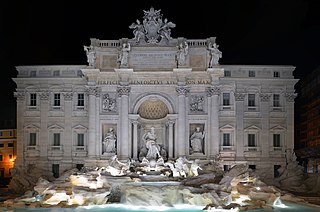
The Palazzo Poli is a palace in Rome, Italy, forming the backdrop to the famous Trevi Fountain. Luigi Vanvitelli gave it a monumental facade as a setting for the fountain. It was there that Princess Zinaida Volkonskaya threw her lavish parties in the 1830s. The central portion of the palace was demolished to provide room for the large fountain in 1730. The Palazzo Poli houses an important collection of copper engraving plates from the 16th century to the present. The Palazzo also houses the Istituto Nazionale per la Grafica.

The Palazzo Massimo alle Colonne is a Renaissance palace in Rome, Italy. The palace was designed by Baldassarre Peruzzi in 1532-1536 on a site of three contiguous palaces owned by the old Roman Massimo family and built after arson destroyed the earlier structures during the Sack of Rome (1527). In addition the curved façade was dictated by foundations built upon the stands for the stadium (odeon) of the emperor Domitian. It fronts the now-busy Corso Vittorio Emanuele II, a few hundred yards from the front of the church of Sant'Andrea della Valle.

Palazzo Madama in Rome is the seat of the Senate of the Italian Republic.

The Palazzo Chigi is a palace and former noble residence in Rome which is the official residence of the Prime Minister of Italy. Since 1 June 2018, the occupant of the Palazzo Chigi is Giuseppe Conte.

The Palazzo Corsini is a prominent late-baroque palace in Rome, erected for the Corsini family between 1730–1740 as an elaboration of the prior building on the site, a 15th-century villa of the Riario family, based on designs of Ferdinando Fuga. It is located in the Trastevere section of the city, and stands beside the Villa Farnesina. During 1659–1689, the former Riario palace had hosted the eccentric Christina, Queen of Sweden, who abdicated, converted, and moved to Rome. Under her patronage, this was the site for the first meetings of the Roman Accademia dell'Arcadia.

The Royal Palace of Milan was the seat of government in the Italian city of Milan for many centuries. Today, it serves as a cultural center and it is home to international art exhibitions. It spans through an area of 7,000 square meters and it regularly hosts modern and contemporary art works and famous collections in cooperation with notable museums and cultural institutions from across the world. More than 1,500 masterpieces are on display annually.

The Palazzo del Viminale is an historic palace in Rome (Italy), seat of the Prime Minister and of the Ministry of Interior since 1925; in 1961 the Prime Minister was transferred to Palazzo Chigi.

Piazza d'Aracoeli is a square of Rome (Italy), placed at the base of the Capitoline Hill, in the Rione X Campitelli.

Palazzo Ferreria, officially Palazzo Buttiġieġ-Francia, is a palace found near the entrance of Valletta, the capital city of Malta. It was built in the late 19th century. Designed by Architect Giuseppe Bonavia, it was the first building to introduce timber balconies on the islands. It is a grade 1 national monument.

Palazzo Parisio, sometimes known as Casa Parisio, is a palace in Valletta, Malta. It was built in the 1740s by Domenico Sceberras, and eventually passed into the hands of the Muscati and Parisio Muscati families. It was Napoleon's residence for six days in June 1798, during the early days of the French occupation of Malta. The palace was eventually acquired by the de Piro family, and was later purchased by the Government of Malta. It was used as the General Post Office from 1886 to 1973, then the Ministry for Agriculture, and it now houses the Ministry for Foreign Affairs.
