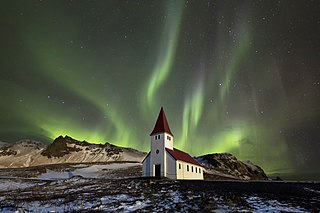
An aurora, also commonly known as the polar lights, is a natural light display in Earth's sky, predominantly seen in high-latitude regions. Auroras display dynamic patterns of brilliant lights that appear as curtains, rays, spirals, or dynamic flickers covering the entire sky.
Nemesis is a hypothetical red dwarf or brown dwarf, originally postulated in 1984 to be orbiting the Sun at a distance of about 95,000 AU, somewhat beyond the Oort cloud, to explain a perceived cycle of mass extinctions in the geological record, which seem to occur more often at intervals of 26 million years. In a 2017 paper, Sarah Sadavoy and Steven Stahler argued that the Sun was likely part of a binary system at the time of its formation, leading them to suggest "there probably was a Nemesis, a long time ago". Such a star would have separated from this binary system over four billion years ago, meaning it could not be responsible for the more recent perceived cycle of mass extinctions.

Catalina Sky Survey is an astronomical survey to discover comets and asteroids. It is conducted at the Steward Observatory's Catalina Station, located near Tucson, Arizona, in the United States.
Tess or TESS may refer to:

Balfour Stewart was a Scottish physicist and meteorologist.

Mawson's Huts are the collection of buildings located at Cape Denison, Commonwealth Bay, in the far eastern sector of the Australian Antarctic Territory, some 3000 km south of Hobart. The buildings were erected and occupied by the Australasian Antarctic Expedition (AAE) of 1911-1914, led by geologist and explorer Sir Douglas Mawson.
Magnetogram may refer to:

Hinode, formerly Solar-B, is a Japan Aerospace Exploration Agency Solar mission with United States and United Kingdom collaboration. It is the follow-up to the Yohkoh (Solar-A) mission and it was launched on the final flight of the M-V rocket from Uchinoura Space Center, Japan on 22 September 2006 at 21:36 UTC. Initial orbit was perigee height 280 km, apogee height 686 km, inclination 98.3 degrees. Then the satellite maneuvered to the quasi-circular sun-synchronous orbit over the day/night terminator, which allows near-continuous observation of the Sun. On 28 October 2006, the probe's instruments captured their first images.
A vector magnetograph is a type of imaging telescope that can estimate the 3-D vector of the magnetic field on a distant body with a resolved line spectrum. Magnetographs are useful for studying the Sun because the surface magnetic field is important to the creation and maintenance of the solar corona, and gives rise to the phenomena of solar flares and space weather.

Sami Khan Solanki is director of the Max Planck Institute for Solar System Research (MPS), director of the Sun-Heliosphere Department of MPS, a scientific member of the Max Planck Society, and a Chair of the International Max Planck Research School on Physical Processes in the Solar System and Beyond at the Universities of Braunschweig and Göttingen.

Sir Francis Ronalds FRS was an English scientist and inventor, and arguably the first electrical engineer. He was knighted for creating the first working electric telegraph over a substantial distance. In 1816 he laid an eight-mile length of iron wire between wooden frames in his mother's garden and sent pulses using electrostatic generators.

Solar power is the conversion of energy from sunlight into electricity, either directly using photovoltaics (PV) or indirectly using concentrated solar power. Photovoltaic cells convert light into an electric current using the photovoltaic effect. Concentrated solar power systems use lenses or mirrors and solar tracking systems to focus a large area of sunlight to a hot spot, often to drive a steam turbine.
The Sunrise balloon-borne solar observatory consists of a 1m aperture Gregory telescope, a UV filter imager, an imaging vector polarimeter, an image stabilization system and further infrastructure. The first science flight of Sunrise yielded high-quality data that reveal the structure, dynamics and evolution of solar convection, oscillations and magnetic fields at a resolution of around 100 km in the quiet Sun.

The Stonyhurst Observatory is a functioning observatory and weather station at Stonyhurst College in Lancashire, England. Built in 1866, it replaced a nearby earlier building, built in 1838, which is now used as the Typographia Collegii.
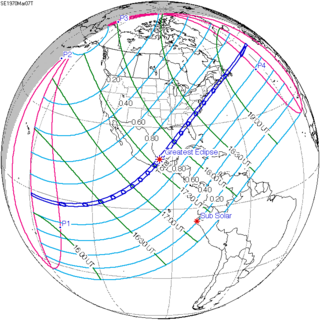
A total solar eclipse occurred on March 7, 1970, visible across most of North America and Central America.
Peadkurapadu railway station, is an Indian Railways station in Pedakurapadu of Guntur district in Andhra Pradesh. It lies on the Nallapadu–Pagidipalli section and is administered under Guntur railway division of South Central Railway zone. It is one of the railway stations to be a part of planned Amaravati–Sattenapalle–Narasaropet section for linking the state capital.
ESA Vigil, formerly known as Lagrange, is a planned solar weather mission by the European Space Agency. It envisions two spacecraft to be positioned at Lagrangian points L1 and L5.

In solar observation, a magnetogram is a pictorial representation of the spatial variations in strength of the solar magnetic field.

