
The Bodhi Tree, also called the Mahabodhi Tree, Bo Tree, is a large sacred fig tree located in Bodh Gaya, Bihar, India. Siddhartha Gautama, the spiritual teacher who became known as the Buddha, is said to have attained enlightenment or buddhahood circa 500 BCE under this tree. In religious iconography, the Bodhi Tree is recognizable by its heart-shaped leaves, which are usually prominently displayed.

Mahāvaṃsa (Sinhala: මහාවංශ, Pali: මහාවංස is the meticulously kept historical chronicle of Sri Lanka until the period of Mahasena of Anuradhapura. It was written in the style of an epic poem written in the Pali language. It relates the history of Sri Lanka from its legendary beginnings up to the reign of Mahasena of Anuradhapura covering the period between the arrival of Prince Vijaya from India in 543 BCE to his reign and later updated by different writers. It was first composed by a Buddhist monk at the Mahavihara temple in Anuradhapura in the 5th or 6th century CE.

Jaya Sri Maha Bodhi is a historical sacred bo tree in the Mahamewuna Garden in historical city of Anuradhapura, Sri Lanka. This is believed to be a tree grown from a cutting of the southern branch from the historical sacred bo tree, Sri Maha Bodhi, which was destroyed during the time of Emperor Ashoka the Great, at Buddha Gaya in India, under which Siddhartha Gautama (Buddha) attained Enlightenment. The Buddhist nun Sangamitta Maha Theri, a daughter of Indian Emperor Ashoka, in 288 BC, brought the tree cutting to Sri Lanka during the reign of Sinhalese King Devanampiya Tissa.[1] At more than 2,300 years old, it is the oldest living human-planted tree in the world with a known planting date. The Mahavamsa, or the great chronicle of the Sinhalese, provides an elaborate account of the establishment of the Jaya Siri Maha Bodhi on the Island and the subsequent development of the site as a major Buddhist pilgrimage site.
The Bodhi-Vamsa, or Mahabodhivamsa, is a prose poem in elaborate Sanskritized Pali that recounts the story of the Bodhi tree of Bodh Gaya and Anuradhapura. It is attributed to a monk called Upatissa who lived during the reign of Mahinda IV of Sri Lanka, and believed to have been composed in the 10th Century AD. It is written in the kavya style.

Tissa, later Devanampiya Tissa, was one of the earliest kings of Sri Lanka based at the ancient capital of Anuradhapura. According to the traditional chronology, he ruled from 307 BC to 267 BC, but the modified chronology adopted by modern scholars such as Wilhelm Geiger assigns his reign to 247 BC to 207 BC. His reign was notable for the arrival of Buddhism in Sri Lanka under the aegis of the Mauryan Emperor Ashoka the Great. The primary source for his reign is the Mahavamsa, which in turn is based on the more ancient Dipavamsa.
The Dīpavaṃsa is the oldest historical record of Sri Lanka. The chronicle is believed to be compiled from Atthakatha and other sources around the 3rd to 4th century CE. Together with the Mahāvaṃsa, it is the source of many accounts of the ancient history of Sri Lanka and India. Its importance resides not only as a source of history and legend but also as an important early work in Buddhist and Pali literature.
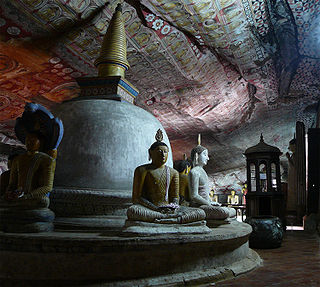
Dambulla cave temple also known as the Golden Temple of Dambulla is a World Heritage Site (1991) in Sri Lanka, situated in the central part of the country. This site is situated 148 kilometres (92 mi) east of Colombo, 72 kilometres (45 mi) north of Kandy and 43 km (27 mi) north of Matale.
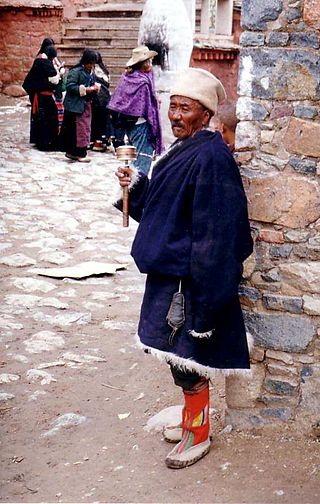
The most important places in Buddhism are located in the Indo-Gangetic Plain of southern Nepal and northern India. This is the area where Gautama Buddha was born, lived, and taught, and the main sites connected to his life are now important places of pilgrimage for both Buddhists and Hindus. Many countries that are or were predominantly Buddhist have shrines and places which can be visited as a pilgrimage.
Dhatusena was a king of Sri Lanka who reigned from 455 to 473 AD. He was the first king of the Moriyan dynasty. In some records, he is also identified as Dasenkeli. Dhatusena reunited the country under his rule after twenty six years of anarchy, defeating the six Dravidians that were ruling the country at that time. Dhatusena built large reservoirs and canals to augment the agriculture in the country.
Upatissa is a Pali and Sinhala name. It may refer to:
Sinhalese Buddhist nationalism is a Sri Lankan political ideology which combines a focus upon Sinhalese culture and ethnicity (nationalism) with an emphasis upon Theravada Buddhism, which is the majority belief system of most of the Sinhalese in Sri Lanka. It mostly revived in reaction to the colonisation of Sri Lanka by the British Empire and became increasingly assertive in the years following the independence of the country.
The Deva are a mythical people of Sri Lanka according to the Sanskrit epics. According to the Mahavamsa and Ramayana they lived among the Naga, Yakkha and Raskha. They ousted their arch enemies the Raskha from Sri Lanka, with the help of Vishnu. They were then subsequently conquered by King Ravana of the Raskha. After the Yakkhas had left to live in the mountains and remote dense forests, they met Gautama Buddha who converted them to Buddhism.
According to the Mahavamsa and Ramayana they lived among the Naga, Yakkha and Raskha. They ousted their arch enemies the Raskha from Sri Lanka, with the help of Lord Vishnu. They were then subsequently conquered by King Ravana of the Raskha. After the Yakkhas had left to live in the mountains and remote dense forests, they met Gautama Buddha who converted them to Buddhism.

Ridi Viharaya or Silver Temple is a 2nd-century BCE Theravada Buddhist temple in the village of Ridigama, Sri Lanka. Built during the reign of Dutthagamani of Anuradhapura, the temple is considered as the place where the silver ore, which provided silver to complete Ruwanwelisaya; one of the largest stupa in Sri Lanka, was discovered. According to the chronicles Mahavamsa and Thupavamsa, the Ridi Viharaya complex was built in gratitude for helping him cherish his dream of completing Ruwanwelisaya.
Sirimeghavanna, also known as Kirthi Sri Meghavarna and Kithsirimevan was King of Anuradhapura in the 4th century. According to the traditional chronology, he ruled during 304–332 CE; the modified chronology adopted by modern scholars such as Wilhelm Geiger assigns his reign to 352–379 CE.
Upatissa I was King of Anuradhapura in the 4th century, whose reign lasted from 370 to 412. He succeeded his father Buddhadasa as King of Anuradhapura and was succeeded by his brother Mahanama.
Mahanama was King of Anuradhapura in the 5th century, whose reign lasted from 412 to 434. He succeeded his brother Upatissa I as King of Anuradhapura and was succeeded by his son Soththisena.
Soththisena was King of Anuradhapura in the 5th century, whose reign lasted the year 434. He succeeded his father Mahanama as King of Anuradhapura and was succeeded by his step sister's husband Chattagahaka Jantu. According to the great history of Sri Lanka, King Soththisena, the shortest reigning king of Sri Lanka, ascended the throne in the morning and was assassinated that evening in a palace conspiracy.

The Pre-Anuradhapura period of Sri Lankan history begins with the gradual onset of historical records in the final centuries of the prehistoric period and ending in 437 BC. According to the Mahavamsa, the original inhabitants of Sri Lanka are the Yakshas and northern Naga tribes. Sinhalese history traditionally starts in 543 BC at the arrival of Prince Vijaya, a semi-legendary king who was banished from the Indian subcontinent with his 700 followers, and is recorded in the Mahavamsa chronicle. This period was succeeded by the Anuradhapura period.
Sri Lankan Forest Monks' Tradition claims a long history. As the oldest Theravada Buddhist country in the world, several forest traditions and lineages have existed, disappeared and re-emerged circularly in Sri Lanka. The current forest traditions and lineages in Sri Lanka have been influenced by the Burmese and Thai traditions which descend from the ancient Indian and Sri Lankan traditions.

