
Look up sa:महापुराण in Wiktionary, the free dictionary.
Mahapurana may refer to:
- Mahapurana (Hinduism), the 18 great Puranas of Hinduism, especially the Bhagavata Purana and Vishnu Purana
- Mahapurana (Jainism), a major Jain text by Jinasena
Mahapurana may refer to:

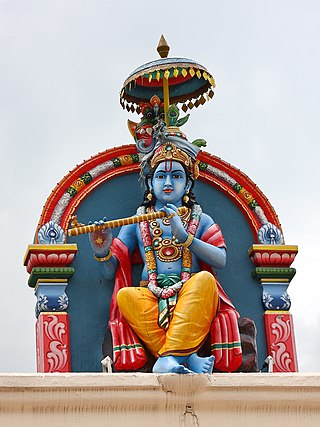
Krishna is a major deity in Hinduism. He is worshipped as the eighth avatar of Vishnu and also as the Supreme God in his own right. He is the god of protection, compassion, tenderness, and love; and is widely revered among Hindu divinities. Krishna's birthday is celebrated every year by Hindus on Krishna Janmashtami according to the lunisolar Hindu calendar, which falls in late August or early September of the Gregorian calendar.

Naraka is the realm of hell in Indian religions. According to some schools of Hinduism, Jainism and Buddhism, Naraka is a place of torment. The word Neraka in Indonesian and Malaysian has also been used to describe the Islamic concept of Hell.

Puranas are a vast genre of Hindu literature about a wide range of topics, particularly about legends and other traditional lore. The Puranas are known for the intricate layers of symbolism depicted within their stories. Composed originally in Sanskrit and in other Indian languages, several of these texts are named after major Hindu gods such as Vishnu, Shiva, Brahma, and Adi Shakti. The Puranic genre of literature is found in both Hinduism and Jainism.
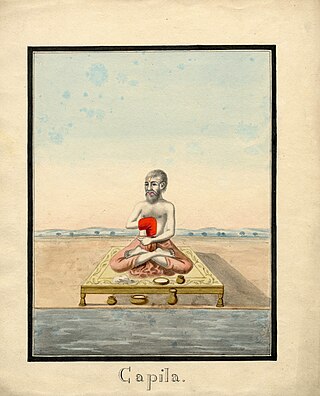
Kapila, also referred to as Cakradhanus, is a sage in Hindu tradition. According to Bhagavata Purana, he is the son of the sage Kardama and Devahuti, the daughter of the Svayambhuva Manu. Kardama had nine daughters, who were very learned and went ahead to marry Marici, as well as other great sages. When he came of age, Kapila is most well-known as the founder of the Samkhya school of Hindu philosophy. Kapila of Samkhya fame is considered a Vedic sage, estimated to have lived in the 6th-century BCE, or the 7th-century BCE.^ His influence on Buddha and Buddhism have long been the subject of scholarly studies.

The Bhagavata Purana, also known as the Srimad Bhagavatam, Srimad Bhagavata Mahapurana or simply Bhagavata (Bhāgavata), is one of Hinduism's eighteen great Puranas (Mahapuranas). Composed in Sanskrit and traditionally attributed to Veda Vyasa, it promotes bhakti (devotion) towards Krishna, an avatar of Vishnu, integrating themes from the Advaita (monism) philosophy of Adi Shankara, the Vishishtadvaita of Ramanujacharya and the Dvaita (dualism) of Madhvacharya. It is widely available in almost all Indian languages.

Dattatreya, Dattā or Dattaguru, is a paradigmatic Sannyasi (monk) and one of the lords of yoga, venerated as a Hindu god. He is considered to be an avatar and combined form of the three Hindu gods Brahma, Vishnu, and Shiva, who are also collectively known as the Trimurti, and as the manifestation of Parabrahma, the supreme being, in texts such as the Bhagavata Purana, the Markandeya Purana, and the Brahmanda Purana, though stories about his birth and origin vary from text to text. Several Upanishads are dedicated to him, as are texts of the Vedanta-Yoga tradition in Hinduism. One of the most important texts of Hinduism, namely Avadhuta Gita is attributed to Dattatreya. Over time, Dattatreya has inspired many monastic movements in Shaivism, Vaishnavism, and Shaktism, particularly in the Deccan region of India, Maharashtra, Gujarat, Madhya Pradesh, Rajasthan and Himalayan regions where Shaivism is prevalent. His pursuit of simple life, kindness to all, sharing of his knowledge and the meaning of life during his travels is reverentially mentioned in the poems by Tukaram, a saint-poet of the Bhakti movement.

The Shrivatsa is an ancient symbol, considered auspicious in Hinduism and other Indian religious traditions. It is said that the Shrivatsa symbol appears on the chest of an avatar of Vishnu when he is chosen to be Vishnu's incarnation

Jinasena was a monk and scholar in the Digambara tradition of Jainism. He was patronized by the Rashtrakuta Emperor Amoghavarsha I. He was the author of Adipurana and Mahapurana.
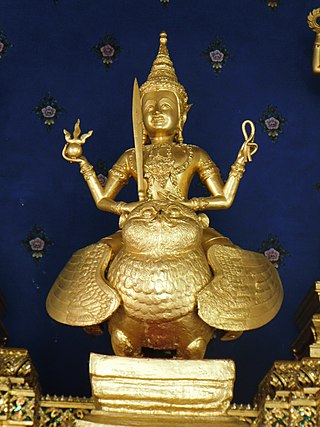
Kala is a Sanskrit term that means 'time' or 'death'. As time personified, destroying all things, Kala is a god of death, and often used as one of the epithets of Yama. In Shaivism, Kala is known as the fiery avatar of Shiva Kala Bhairava or Kalagni Rudra; and in Vaishnavism Kala is also associated with Narasimha and Pralaya. As applied to gods and goddesses, Kālá is not always distinguishable from kāla, meaning 'black'.

The Brahmavaivarta Purana is a voluminous Sanskrit text and a major Purana (Maha-purana) of Hinduism. It is an important Vaishnava text. This Purana majorly centers around the Hindu deities Radha and Krishna.

In Hinduism, Rishabha is one of the twenty-four avatars of Vishnu in the Bhagavata Purana. Some scholars identify this avatar to be the same as the first tirthankara of Jainism, Rishabhanatha. Shaiva texts like the Linga Purana regard Rishabha to be among the 28 avatars of Shiva. Rishabha is also found in Vedic literature, where it means the "bull" and is an epithet for Rudra (Shiva).
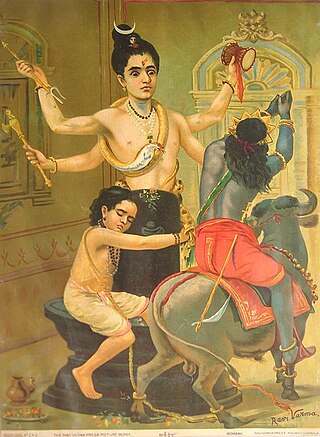
Markandeya is a rishi (sage) featured in Hindu literature. He is the son of the sage Mrikanda and his wife, Manasvini. The Markandeya Purana, attributed to the sage, comprises a dialogue between Markandeya and a sage called Jaimini. A number of chapters in the Bhagavata Purana are dedicated to his conversations and prayers. He is also mentioned in the Mahabharata. Markandeya is venerated within all mainstream Hindu traditions.
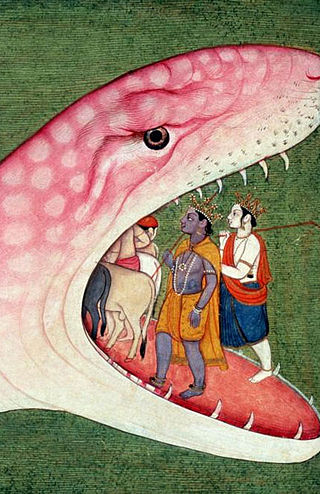
Aghasura is an asura featured in Hindu literature, most notably in the Bhagavata Purana. He was one of Kamsa's generals, and the elder brother of the demoness Putana and Bakasura.

The Buddha is considered the ninth avatar among the ten major avatars of the god Vishnu, according to the Vaishnava tradition of Hinduism.

Mahapurana (महापुराण) or Trishashthilkshana Mahapurana is a major Jain text composed largely by Acharya Jinasena during the rule of Rashtrakuta ruler Amoghavarsha and completed by his pupil Gunabhadra in the 9th century CE. Mahapurana consists of two parts. The first part is Ādi purāṇa written by Acharya Jinasena in Sanskrit. The second part is Uttarapurana which is the section composed by Gunabhadra in Apabhraṃśa.

The Devi Bhagavata Purana, also known as the Srimad Devi Bhagavatam, Srimad Bhagavatam, Bhagavata Purana or simply Devi Bhagavatam, is one of the eighteen Mahapuranas of Hinduism. Composed in Sanskrit by Veda Vyasa, the text is considered a major purana for Devi worshippers (Shaktas). It promotes bhakti (devotion) towards Mahadevi, integrating themes from the Shaktadvaitavada tradition. While this is generally regarded as a Shakta Purana, some scholars such as Dowson have also interpreted this Purana as a Shaiva Purana.
Puran or Purana and similar word Purna can mean:
Bhagwat may refer to:
Gunabhadra was a Digambara monk in India. He co-authored Mahapurana along with Jinasena.
There are two Bhagavatas in Hindu Puranic literature: