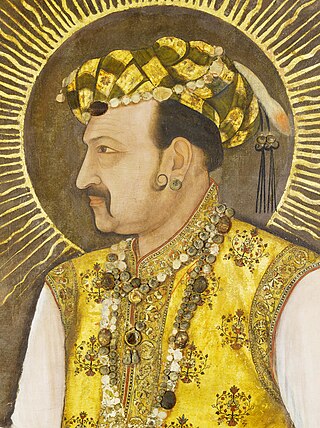
Nur-ud-Din Muhammad Salim, known by his imperial name Jahangir, was the fourth Mughal emperor, who ruled from 1605 until his death in 1627. He was the third and only surviving son of Akbar and his chief empress, Mariam-uz-Zamani, born to them in the year 1569. He was named after the Indian Sufi saint, Salim Chishti.

Mirza Shahab-ud-Din Baig Muhammad Khan Khurram, also known as Shah Jahan I, was the fifth Mughal emperor, reigning from 1628 until 1658. Under his emperorship, the Mughals reached the peak of their architectural achievements and cultural glory.

The Taj Mahal is an ivory-white marble mausoleum on the right bank of the river Yamuna in Agra, Uttar Pradesh, India. It was commissioned in 1631 by the fifth Mughal emperor, Shah Jahan to house the tomb of his beloved wife, Mumtaz Mahal; it also houses the tomb of Shah Jahan himself. The tomb is the centrepiece of a 17-hectare (42-acre) complex, which includes a mosque and a guest house, and is set in formal gardens bounded on three sides by a crenellated wall.
A queen consort is the wife of a reigning king, and usually shares her spouse's social rank and status. She holds the feminine equivalent of the king's monarchical titles and may be crowned and anointed, but historically she does not formally share the king's political and military powers, unless on occasion acting as regent.

Mumtaz Mahal was the empress consort of Mughal Empire from 1628 to 1631 as the chief consort of the fifth Mughal emperor, Shah Jahan. The Taj Mahal in Agra, often cited as one of the Wonders of the World, was commissioned by her husband to act as her tomb.
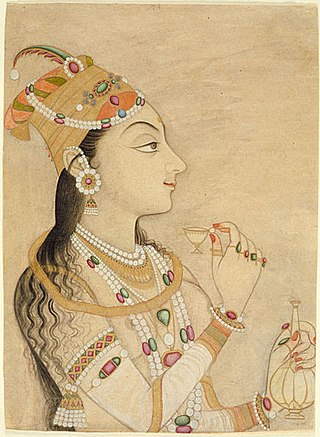
Nur Jahan, born Mehr-un-Nissa was the twentieth wife and chief consort of the Mughal emperor Jahangir.

Mughal architecture is the type of Indo-Islamic architecture developed by the Mughals in the 16th, 17th and 18th centuries throughout the ever-changing extent of their empire in the Indian subcontinent. It developed from the architectural styles of earlier Muslim dynasties in India and from Iranian and Central Asian architectural traditions, particularly Timurid architecture. It also further incorporated and syncretized influences from wider Indian architecture, especially during the reign of Akbar. Mughal buildings have a uniform pattern of structure and character, including large bulbous domes, slender minarets at the corners, massive halls, large vaulted gateways, and delicate ornamentation; examples of the style can be found in modern-day Afghanistan, Bangladesh, India and Pakistan.
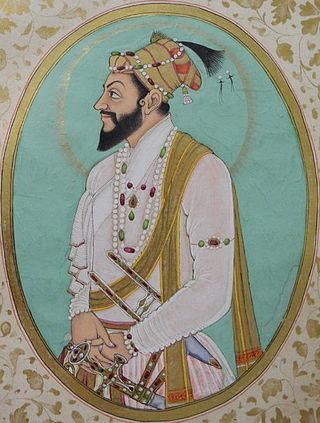
Mirza Shah Shuja was the second son of the Mughal Emperor Shah Jahan and Empress Mumtaz Mahal. He was the governor of Bengal and Odisha and had his capital at Dhaka, in present day Bangladesh.

Mirza Ghiyas Beg, also known by his title of I'timad-ud-Daulah, was an important Persian official in the Mughal empire, whose children served as wives, mothers, and generals of the Mughal emperors.
Gohar and Gauhar are given names and surnames. Gawhar is a given name. Bearers of the name include:

Ustad Ahmad Lahori (c.1580–1649) also known as Ahmad Ma'mar Lahori was the chief Mughal architect during the reign of emperor Shah Jahan. He was responsible for the construction of several of the Mughal monuments, including the Taj Mahal in Agra and the Red fort in Delhi; both of which are World Heritage sites. He also designed the Jama Mosque in Delhi.
Begum is a female title which is also used in Mirza families/lineages, Daughter of Beg or Wife of Beg, a given name and surname.

Abu'l-Hasan entitled by the Mughal emperor Jahangir as Asaf Khan, was the Grand Vizier of the fifth Mughal emperor Shah Jahan. He previously served as the vakil of Jahangir. Asaf Khan is perhaps best known for being the father of Arjumand Banu Begum, the chief consort of Shah Jahan and the older brother of Empress Nur Jahan, the chief consort of Jahangir.
Manavati Bai, also spelled Manvati Bai,, better known by her title, Jagat Gosain, was the second wife and the empress consort of the fourth Mughal emperor Jahangir and the mother of his successor, Shah Jahan.
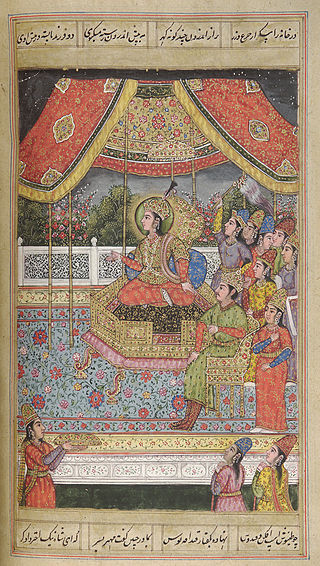
Badshah Begum was Empress consort of the Mughal Empire from 8 December 1721 to 6 April 1748 as the first wife and chief consort of the Mughal emperor Muhammad Shah. She is popularly known by her title Malika-uz-Zamani which was conferred upon her by her husband, immediately after their marriage.

Lal Bangla are two imperial late-Mughal mausoleums located in Delhi, India, that are that protected monument under the Archaeological Survey of India.
Padshah Begum was a superlative imperial title conferred upon the empress consort or 'First Lady' of the Mughal Empire and was considered to be the most important title in the Mughal harem or zenana. This title can be equivalent with "empress" in English, but in only approximate terms in the Mughal context.

Persian Inscriptions on Indian Monuments is a book written in Persian by Dr Ali Asghar Hekmat E Shirazi and published in 1956 and 1958 and 2013. New edition contains the Persian texts of more than 200 epigraphical inscriptions found on historical monuments in India, many of which are currently listed as national heritage sites or registered as UNESCO world heritage, published in Persian; an English edition is also being printed.
Khvajeh Mohammad-Sharif was a Persian statesman, who occupied the post of vizier of several Safavid provinces. He was also a poet, who wrote under the pen name Hejri (هجری).
