Ramanathapuram, also known as Ramnad, is a city and a municipality in Ramanathapuram district in the Indian state of Tamil Nadu. It is the administrative headquarters of Ramanathapuram district and the second largest town in Ramanathapuram district. Soon the Ramanathapuram Civic body to be upgraded as Municipal Corporation, after merging with nearby panchayats.

The Thanjavur Nayakdynasty were the rulers of Thanjavur in the 15th and 17th centuries. The Nayaks, who belonged to the Telugu-speaking Balija social group were originally appointed as provincial governors by the Vijayanagara Emperor in the 15th century, who divided the territory into Nayak kingdoms which were Madurai, Tanjore, Gingee and Kalahasthi. In the mid-15th century they became an independent kingdom, although they continued their alliance with the Vijayanagara Empire. The Thanjavur Nayaks were notable for their patronage of literature and the arts.

Sankagiri Fort is a historical fort maintained by the Archaeological Survey of India. It is located 22 km from the city of Erode and 38 km from Salem. Sankari or Sankagiri is the town located around this place. The fort is 707 meters high and covers an area of 558.58 acres.
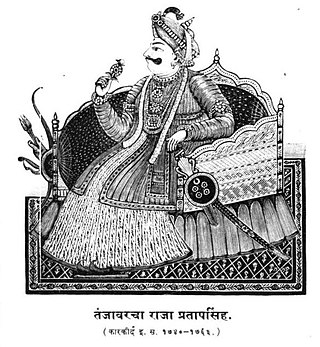
Pratap Singh Bhonsle or Pratapsinha was the Maratha ruler of Thanjavur of the Bhonsle dynasty from 1739 to 1763. His rise to power followed three years of anarchy and civil war and restored the state to its previous greatness. His reign witnessed the Carnatic Wars and the Seven Years' War.
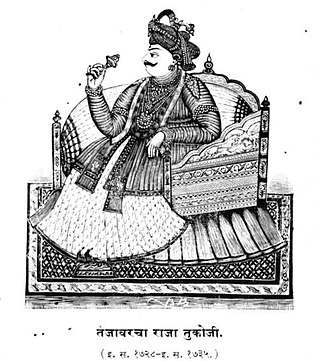
Tukkoji Bhonsle (1677–1736) was the fourth Maratha ruler of Thanjavur, located in South India. He was from the Bhonsle dynasty and was the son of Ekoji I as well as the younger brother of Shahuji I and Serfoji I. Tukkoji ruled Thanjavur from 1728 to 1736.

Serfoji I Bhonsle (1675–1728), also spelt as Sarabhoji I Bhonsle, was the son of the Maratha ruler of Thanjavur Ekoji I and the Raja of Thanjavur from 1712 to 1728. He was the third Raja of the Bhonsle dynasty of Thanjavur. He consolidated the hold of Marathas over Thanjavur and patronised arts and literature.
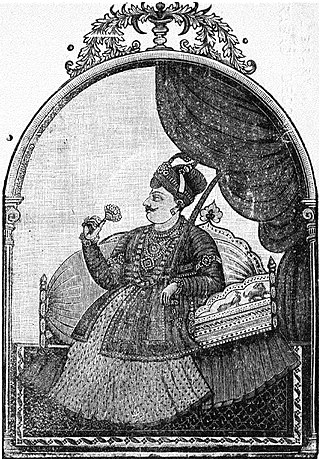
Shahuji I Bhonsle (b.1672) also called Shahji of the Bhonsle dynasty was the second Maratha ruler of Thanjavur. He was the eldest son of Ekoji I, who was a half brother of Shivaji, the first Maratha ruler of Thanjavur. He reigned from 1684 to 1712.

Vyankojirajah Bhonsle or Ekojirajah I Bhonsle was the younger half-brother of Chhatrapati Shivaji Maharaj and founder of Maratha rule in Thanjavur in modern day Tamil Nadu. He was the progenitor of the junior branch of the Bhonsle family which ruled Thanjavur until the formal annexation of the kingdom by the British East India Company in 1855.

The Thanjavur Maratha kingdom ruled by the Bhonsle dynasty was a principality of Tamil Nadu between the 17th and 19th centuries. Their native language was Thanjavur Marathi. Venkoji was the founder of the dynasty.
Sriman Hiranyagarbha Ravikula Raja Muthu Vijaya Raghunatha Raja Raghunatha Deva Kilavan Setupati was the first king of Ramnad Kingdom which is also known "Maravar Kingdom". He ruled from 1673 to 1708 and oversaw the growth of the feudal chieftainship of Ramnad into a powerful "Ramnad Kingdom" which is known as "Maravar Kingdom". He rescued the Nayak of Madurai from the tyranny of Rustam Khan and also successfully campaigned against the King of Thanjavur, who later ceded all his territories. It is recorded in the Sethupati copper plates that he belonged to the Surya kulam and Kashyap gothram.

The Thondaimans are chieftains who ruled the region in and around Pudukottai from the 17th to 20th century. The Pudukkottai Thondaiman dynasty was founded by Raghunatha Thondaiman, the brother-in-law of the then Raja of Ramnad, RaghunathaKilavan Setupati. The Pudukottai Samasthanam was under Thondaiman dynasty for one year even after Indian Independence. The Thondaiman dynasty had a special Valari regiment.

The Kingdom of Ramnad or Ramnad estate was a permanently settled kingdom and later zamindari estate that existed in the Ramnad subdivision of the Madurai district and later Ramnad district of the erstwhile Madras Presidency in British India from 1601. It was ruled by the rajas also had the title of Sethupathi. Madurai Nayaks ruled the Ramnad area with the appointed chieftains between 14th to 16th century CE, and in 17th century CE the appointed governors expanded their power to establish "Ramnad Kingdom" which was also called as "Maravar Kingdom" by the British. In 1795 CE, after an heir dispute, they were reduced to the status of zamidari by the East India Company. After the independence of India in 1947 the estates were merged in the Union of India and in 1949 all rulers lost the ruling rights, privy purse was also finally abolished in 1971.
Raja Sri Vijaya Raghunatha Tondaiman Bahadur was the ruler of the pudukottai kingdom from 30 December 1789 to 1 February 1807.
Ramaiyan, Ramayyan or Ramappaiyyan was a general who served under the Madurai Nayak king Tirumala Nayaka. He is the subject of the Tamil ballad Ramayyan Ammanai.

The Sethupathis are a Tamil clan of the Maravar community native to the Ramanathapuram and Sivaganga district of Tamil Nadu, India. They were from the 12th century considered independent kings in 16th century who ruled the Ramnad kingdom, also known as Maravar country. The male rulers of Ramnathapuram also bore the title of "Sethupathi" or "protector of the bridge", the bridge here referring to the legendary sacred Rama's Bridge, while female rulers bore the title "Nachiyar". Among the 72 poligars of the region, the Sethupathi stood first. This special position was conferred not based upon the revenue that his kingdom generated but because of his military prowess. Back in the beginning of the 18th century, the Sethupathi ruler could mobilize a considerable army, about 30,000 to 40,000 strong at short notice.
Anandarayar Sahib was a poet and administrator who served as a minister in the courts of the Thanjavur Maratha kings Shahuji I, Serfoji I and Tukkoji. He was given the honorific title "Peshwa".
Vijaya Raghunatha Raya Tondaiman I was the second independent ruler of the Pudukkottai kingdom. He reigned from April 1730 to 28 December 1769. His reign was marked with incessant wars with the Thanjavur Maratha kingdom and against the French East India Company and Chanda Sahib.
Raja Sri Raghunatha Raya Tondaiman (1641–1730) was the ruler of the Pudukkottai kingdom from 1686 to 1730. A feudatory chieftain of the Sethupathi of Ramnad, in 1686, Raghunatha Raya Tondaiman was recognised as the independent ruler of Pudukkottai by the Sethupathi for the services he had rendered him.

Vijayaraghunatha Sethupathi I ruled from 1713 to 1725 the "Ramnad Kingdom", also known as "Maravar Kingdom". He was an adopted son of Raghunatha Kilavan, the founder of the "Ramnad Kingdom". Sethupathi was the title granted by Thanjavur Nayaks to his adoptive father Raghunatha Kilavan, and this title was retained by his descendants.
Achuthappa Nayak was the Nayaka of Thanjavur under the Vijayanagara Empire from 1560 to 1614. From 1560 to 1580, he was co-Nayaka along with his father and from 1580 to 1614, he ruled on his own. His reign was eventful and its later years were marked by conflict.
