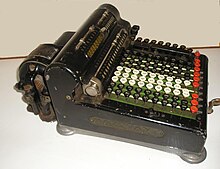
Last updated Marchant XLA calculator, based on Friden's design
The Marchant Calculating Machine Company was founded in 1911 by Rodney and Alfred Marchant in Oakland, California.
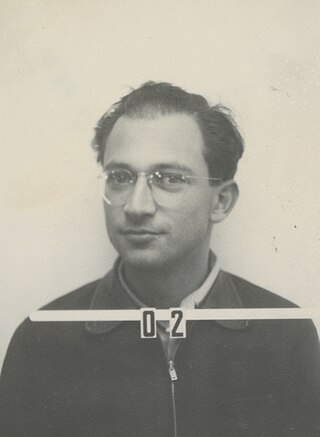
The company built mechanical, and then electromechanical calculators which had a reputation for reliability. First models were similar to the Odhner arithmometer. In 1918, employee Carl Friden designed a new model in response to patent challenges. It was a great success, and Friden became the chief designer until he left in 1934 to found his own company. In 1958 the company was acquired by the Smith Coronatypewriter company in a diversification move that proved unsound; the company, which was now known as SCM, tried to stay competitive by introducing the SCM Cogito 240SR electronic calculator (designed by Manhattan Project veteran Stan Frankel) in 1965. Within a few years a tidal wave of cheaper electronic calculators had devastated their business, and by the mid-1980s, SCM's typewriter business, too, had been ruined by the advent of inexpensive personal computers used as word processors.
Calculator design
1920s EB-9 Marchant calculator
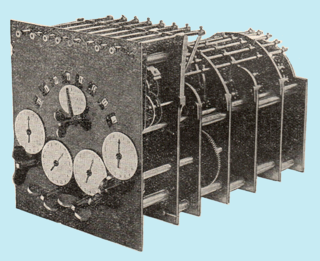
The first Marchant calculators differed greatly from their later Silent Speed Proportional Gears machines, which were by far the fastest of their type, running at 1,300 cycles per minute. These machines are of considerable technical interest, and are far better known than the earliest ones. Their mechanical design was very unusual in that their result dials (sums, differences, and products) moved at speeds proportional to the digit in the corresponding column of the keyboard. A '1' in the keyboard caused its dial to move the slowest, while a '9', the fastest. Probably the only other such machine was the European Mercedes Euklid, which had a very different (and apparently much simpler) design.
Silent Speed 8D
Carrying to the next higher order was done (effectively) by a 10:1 gear ratio, rather like traditional watthour-meter dials. This was probably unique in a calculator. While running consecutive 'add' cycles to develop a product in multiplication, much of the mechanism was running at constant speeds. All other mechanical calculators had result dials that moved only at one speed, but for different amounts of time, naturally for longer times when larger digits were to be entered. They started quickly, ran at one speed, and stopped quickly. (They also had mechanisms to prevent overshoot (known as coasting) when they stopped.)
Figurematic (1950-52)
In the Marchant, each column had its own mechanism that might be described as a nine-speed pre-selector transmission. Once engaged, that was what made the dials move at speeds proportional to the digit in that column. This meant that the machine contained, in all, several hundred individual gears.
Carries from lower-order digits came in via one planetary differential per dial. If one held down the + bar, in neighboring columns to the left (with zeros for them in the keyboard), one could see two or maybe three higher-order dials moving at the speeds one would expect.
Watthour meter dials, like the hour hand of a clock, make no attempt to point to the correct digit, if the dial to the right is between, for example, 3 and 7, or so. Such misalignment would be intolerable in a calculator's dials, so each of the Marchant's dials had a constant-lead ("snail") cam attached. Omitting important details, this cam determined the amount of movement needed to realign the result dials. That correction was applied by a second spur-gear differential, again, one per dial.
Some calculators that had been serviced had dials that were mispositioned by (probably) 3.6 degrees; the gears weren't quite meshed correctly when reassembled.
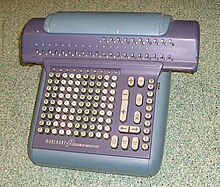
1960s SCM Marchant calculator
The calculator was very complicated compared to, for example the Friden STW, a machine notable for its relative internal simplicity. Much of the Marchant's control mechanism was beneath the keys, and had about 25 "layers" of levers, linkages, latches, and such. It had three driveshafts, extending across the mechanism. Most other calculators had only one.
Most mechanical calculators capable of fully automatic division (and there were many), subtracted until the accumulator went into overdraft ("subtracted one time too many"), then added once to restore the value in the accumulator. The Marchant, however, contained a chain of analog comparators to anticipate the overdraft, and prepare for the next quotient digit.
The Marchant mechanism, internally, differed profoundly in many respects from other makes of calculators of the same general variety. By virtue of sophistication (and complexity), it gained a considerable speed advantage, compared to other designs.
A teleprinter is an electromechanical device that can be used to send and receive typed messages through various communications channels, in both point-to-point and point-to-multipoint configurations.
An adding machine is a class of mechanical calculator, usually specialized for bookkeeping calculations. In the United States, the earliest adding machines were usually built to read in dollars and cents. Adding machines were ubiquitous office equipment until they were phased out in favor of calculators in the 1970s and by personal computers beginning in about 1985. The older adding machines were rarely seen in American office settings by the year 2000.
The ANITA Mark VII and ANITA Mark VIII calculators were launched simultaneously in late 1961 as the world's first all-electronic desktop calculators. Designed and built by the Bell Punch Co. in Britain, and marketed through its Sumlock Comptometer division, they used vacuum tubes and cold-cathode switching tubes in their logic circuits and nixie tubes for their numerical displays.
A telephone keypad is a keypad installed on a push-button telephone or similar telecommunication device for dialing a telephone number. It was standardized when the dual-tone multi-frequency signaling (DTMF) system was developed in the Bell System in the United States in the 1960s that replaced rotary dialing originally developed in electromechanical switching systems. Because of the installed abundance of rotary dial equipment well into the 1990s, many telephone keypads were also designed to produce loop-disconnect pulses electronically, and some could be optionally switched to produce either DTMF or pulses.
Wilhelm Schickard was a German professor of Hebrew and astronomy who became famous in the second part of the 20th century after Franz Hammer, a biographer of Johannes Kepler, claimed that the drawings of a calculating clock, predating the public release of Pascal's calculator by twenty years, had been discovered in two unknown letters written by Schickard to Johannes Kepler in 1623 and 1624.
The Comptometer was the first commercially successful key-driven mechanical calculator, patented in the United States by Dorr Felt in 1887.
A mechanical calculator, or calculating machine, is a mechanical device used to perform the basic operations of arithmetic automatically, or (historically) a simulation such as an analog computer or a slide rule. Most mechanical calculators were comparable in size to small desktop computers and have been rendered obsolete by the advent of the electronic calculator and the digital computer.
The Friden Flexowriter produced by the Friden Calculating Machine Company, was a teleprinter, a heavy-duty electric typewriter capable of being driven not only by a human typing, but also automatically by several methods, including direct attachment to a computer and by use of paper tape.
The arithmometer was the first digital mechanical calculator strong enough and reliable enough to be used daily in an office environment. This calculator could add and subtract two numbers directly and could perform long multiplications and divisions effectively by using a movable accumulator for the result.
In elementary arithmetic, a carry is a digit that is transferred from one column of digits to another column of more significant digits. It is part of the standard algorithm to add numbers together by starting with the rightmost digits and working to the left. For example, when 6 and 7 are added to make 13, the "3" is written to the same column and the "1" is carried to the left. When used in subtraction the operation is called a borrow.
Pascal's calculator is a mechanical calculator invented by Blaise Pascal in 1642. Pascal was led to develop a calculator by the laborious arithmetical calculations required by his father's work as the supervisor of taxes in Rouen. He designed the machine to add and subtract two numbers directly and to perform multiplication and division through repeated addition or subtraction.
The stepped reckoner or Leibniz calculator was a mechanical calculator invented by the German mathematician Gottfried Wilhelm Leibniz around 1672 and completed in 1694. The name comes from the translation of the German term for its operating mechanism, Staffelwalze, meaning "stepped drum". It was the first calculator that could perform all four basic arithmetic operations.
Smith Corona is an American manufacturer of thermal labels, direct thermal labels, and thermal ribbons used in warehouses for primarily barcode labels. Once a large U.S. typewriter and mechanical calculator manufacturer, it expanded aggressively during the 1960s to become a broad-based industrial conglomerate whose products extended to paints, foods, and paper. The mechanical calculator sector was wiped out in the early 1970s by the production of cheap electronic calculators, and the typewriter business collapsed in the mid-1980s due to the introduction of PC-based word processing.
Friden Calculating Machine Company was an American manufacturer of typewriters and mechanical, later electronic calculators. It was founded by Carl Friden in San Leandro, California, in 1934.
Carl Friden was a Swedish-born, American mechanical engineer and businessman who founded the Friden Calculating Machine Company.
Stanley Phillips Frankel was an American computer scientist. He worked in the Manhattan Project and developed various computers as a consultant.
A mechanical computer is a computer built from mechanical components such as levers and gears rather than electronic components. The most common examples are adding machines and mechanical counters, which use the turning of gears to increment output displays. More complex examples could carry out multiplication and division—Friden used a moving head which paused at each column—and even differential analysis. One model, the Ascota 170 accounting machine sold in the 1960s calculated square roots.
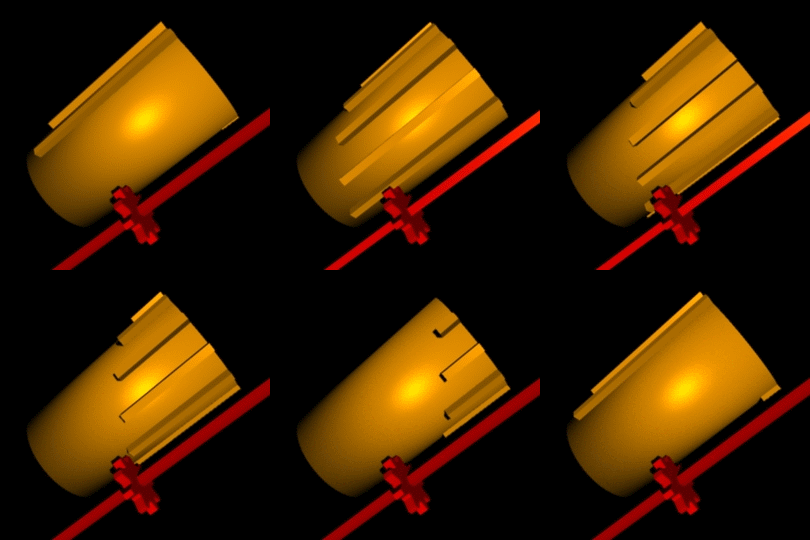
A Leibniz wheel or stepped drum is a cylinder with a set of teeth of incremental lengths which, when coupled to a counting wheel, can be used in the calculating engine of a class of mechanical calculators. Invented by Leibniz in 1673, it was used for three centuries until the advent of the electronic calculator in the mid-1970s.
The IBM Selectric was a highly successful line of electric typewriters introduced by IBM on 31 July 1961.
The Arithmaurel was a mechanical calculator that had a very intuitive user interface, especially for multiplying and dividing numbers because the result was displayed as soon as the operands were entered. It was first patented in France by Timoleon Maurel, in 1842. It received a gold medal at the French national show in Paris in 1849. Its complexity and the fragility of its design prevented it from being manufactured.
This page is based on this Wikipedia article Text is available under the CC BY-SA 4.0 license; additional terms may apply. Images, videos and audio are available under their respective licenses.