
Quintus Fabius Maximus Verrucosus, surnamed Cunctator, was a Roman statesman and general of the third century BC. He was consul five times and was appointed dictator in 221 and 217 BC. He was censor in 230 BC. His agnomen, Cunctator, usually translated as "the delayer", refers to the strategy that he employed against Hannibal's forces during the Second Punic War. Facing an outstanding commander with superior numbers, he pursued a then-novel strategy of targeting the enemy's supply lines, and accepting only smaller engagements on favourable ground, rather than risking his entire army on direct confrontation with Hannibal himself. As a result, he is regarded as the originator of many tactics used in guerrilla warfare.
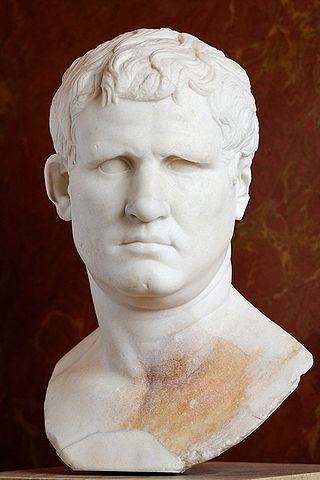
Marcus Vipsanius Agrippa was a Roman general, statesman and architect who was a close friend, son-in-law and lieutenant to the Roman emperor Augustus. Agrippa is well known for his important military victories, notably the Battle of Actium in 31 BC against the forces of Mark Antony and Cleopatra. He was also responsible for the construction of some of the most notable buildings of his era, including the original Pantheon.

Gnaeus Pompeius Magnus, known in English as Pompey or Pompey the Great, was a general and statesman of the Roman Republic. He played a significant role in the transformation of Rome from republic to empire. Early in his career, he was a partisan and protégé of the Roman general and dictator Sulla; later, he became the political ally, and finally the enemy, of Julius Caesar.

Marcus Licinius Crassus was a Roman general and statesman who played a key role in the transformation of the Roman Republic into the Roman Empire. He is often called "the richest man in Rome".

The Battle of Philippi was the final battle in the Liberators' civil war between the forces of Mark Antony and Octavian and the leaders of Julius Caesar's assassination, Brutus and Cassius, in 42 BC, at Philippi in Macedonia. The Second Triumvirate declared the civil war ostensibly to avenge Julius Caesar's assassination in 44 BC, but the underlying cause was a long-brewing conflict between the so-called Optimates and the so-called Populares.

Marcus Claudius Marcellus, five times elected as consul of the Roman Republic, was an important Roman military leader during the Gallic War of 225 BC and the Second Punic War. Marcellus gained the most prestigious award a Roman general could earn, the spolia opima, for killing the Gallic military leader and king Viridomarus in single combat in 222 BC at the Battle of Clastidium. Furthermore, he is noted for having conquered the fortified city of Syracuse in a protracted siege during which Archimedes, the famous mathematician, scientist, and inventor, was killed, despite Marcellus ordering the soldiers under his command not to harm him. Marcus Claudius Marcellus died in battle in 208 BC, leaving behind a legacy of military conquests and a reinvigorated Roman legend of the spolia opima.
Marcus Valerius Corvus, also sometimes known as Corvinus, was a military commander and politician who served in the early-to-middle period of the Roman Republic. During his career he was elected consul six times, beginning at the age of twenty-three. He was appointed dictator twice and led the armies of the Republic in the First Samnite War. He occupied the curule chair twenty-one times throughout his career. According to legend, he lived to the age of one hundred.
From its origin as a city-state on the peninsula of Italy in the 8th century BC, to its rise as an empire covering much of Southern Europe, Western Europe, Near East and North Africa to its fall in the 5th century AD, the political history of Ancient Rome was closely entwined with its military history. The core of the campaign history of the Roman military is an aggregate of different accounts of the Roman military's land battles, from its initial defense against and subsequent conquest of the city's hilltop neighbors on the Italian peninsula, to the ultimate struggle of the Western Roman Empire for its existence against invading Huns, Vandals and Germanic tribes. These accounts were written by various authors throughout and after the history of the Empire. Following the First Punic War, naval battles were less significant than land battles to the military history of Rome due to its encompassment of lands of the periphery and its unchallenged dominance of the Mediterranean Sea.

The Battle of Oudenarde, also known as the Battle of Oudenaarde, was a major engagement of the War of the Spanish Succession, pitting a Grand Alliance force consisting of eighty thousand men under the command of the Duke of Marlborough and Prince Eugene of Savoy against a French force of eighty-five thousand men under the command of the Duc de Bourgogne and the Duc de Vendôme, the battle resulting in a great victory for the Grand Alliance. The battle was fought near the city of Oudenaarde, at the time part of the Spanish Netherlands, on 11 July 1708. With this victory, the Grand Alliance ensured the fall of various French territories, giving them a significant strategic and tactical advantage during this stage of the war. The battle was fought in the later years of the war, a conflict that had come about as a result of English, Dutch and Habsburg apprehension at the possibility of a Bourbon succeeding the deceased King of Spain, Charles II, and combining their two nations and empires into one.
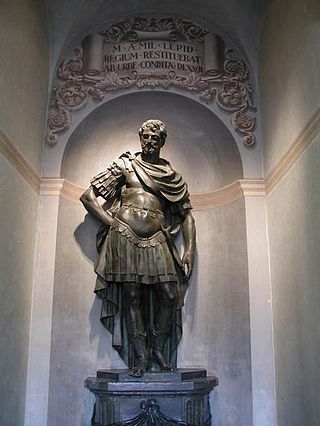
Marcus Aemilius Lepidus was a Roman consul, Pontifex Maximus, Censor and Princeps Senatus. A scion of the ancient Patrician gens Aemilia, he was most likely the son of Marcus Aemilius Lepidus, with his brothers being Lucius and Quintus.
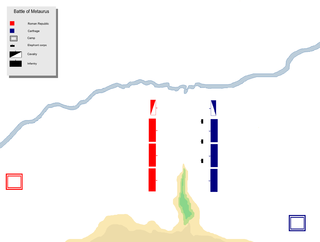
The Battle of the Metaurus was a pivotal battle in the Second Punic War between Rome and Carthage, fought in 207 BC near the Metauro River in Italy. The Carthaginians were led by Hasdrubal Barca, brother of Hannibal, who was to have brought siege equipment and reinforcements for Hannibal. The Roman armies were led by the consuls Marcus Livius, who was later nicknamed the Salinator, and Gaius Claudius Nero.
Prosthetics, the artificial replacement of organic limbs or organs, often play a role in fiction, particularly science fiction, as either plot points or to give a character a beyond normal appearance. Numerous works of literature, television, and films feature characters who have prosthetics attached.

The Third Mithridatic War, the last and longest of the three Mithridatic Wars, was fought between Mithridates VI of Pontus and the Roman Republic. Both sides were joined by a great number of allies, dragging the entire east of the Mediterranean and large parts of Asia into the war. The conflict ended in defeat for Mithridates; it ended the Pontic Kingdom and the Seleucid Empire, and also resulted in the Kingdom of Armenia becoming an allied client state of Rome.

Caesar's civil war was a civil war during the late Roman Republic between two factions led by Gaius Julius Caesar and Gnaeus Pompeius Magnus (Pompey), respectively. The main cause of the war was political tensions relating to Caesar's place in the republic on his expected return to Rome on the expiration of his governorship in Gaul.

The Roman Republic conquered and occupied territories in the Iberian Peninsula that were previously under the control of native Celtic, Iberian, Celtiberian and Aquitanian tribes and the Carthaginian Empire. The Carthaginian territories in the south and east of the peninsula were conquered in 206 BC during the Second Punic War. Control was gradually extended over most of the Iberian Peninsula without annexations. It was completed after the end of the Roman Republic, by Augustus, the first Roman emperor, who annexed the whole of the peninsula to the Roman Empire in 19 BC.

The Bellum Siculum was an Ancient Roman civil war waged between 42 BC and 36 BC by the forces of the Second Triumvirate and Sextus Pompey, the last surviving son of Pompey the Great and the last leader of the Optimate faction. The war consisted of mostly a number of naval engagements throughout the Mediterranean Sea and a land campaign primarily in Sicily that eventually ended in a victory for the Triumvirate and Sextus Pompey's death. The conflict is notable as the last stand of any organised opposition to the Triumvirate.
The gens Decia was a plebeian family of high antiquity, which became illustrious in Roman history by the example of its members sacrificing themselves for the preservation of their country. The first of the family known to history was Marcus Decius, chosen as a representative of the plebeians during the secession of 495 BC.

The gens Sergia was a patrician family at ancient Rome, which held the highest offices of the Roman state from the first century of the Republic until imperial times. The first of the Sergii to obtain the consulship was Lucius Sergius Fidenas in 437 BC. Despite long and distinguished service, toward the end of the Republic the reputation of this gens suffered as a result of the conspiracy of Catiline.
Lucius Furius Medullinus, of the patrician gens Furia, was a politician and general of the Roman Republic who was consul twice and Consular Tribune seven times.
Gaius Sulpicius Peticus was a prominent 4th-century BC Roman politician and general who served as consul five times and as dictator once. Sulpicius was a member of the gens Sulpicia, a prominent patrician family which had attained the consular dignity a great number of times following the foundation of the republic. However, the familial relationship between Sulpicius and other known contemporary members of the gens is unknown, with the only information about his heritage being that his father was named Marcus and his grandfather was named Quintus.


