Maria Christina may refer to:
Margaret of Austria may refer to:

Leszczyński was a prominent Polish noble family. They were magnates in the Polish–Lithuanian Commonwealth.

Ferdinand was the Duke of Parma, Piacenza and Guastalla from his father's death on 18 July 1765 until he ceded the duchy to France by the Treaty of Aranjuez on 20 March 1801. He was a member of the Spanish House of Bourbon.

Maria Amalia of Saxony was a princess of Poland and Saxony, Queen consort of Naples and Sicily from 1738 till 1759 and then Queen consort of Spain by marriage to Charles III of Spain, from 1759 until her death in 1760. The arranged marriage produced many children who survived into adulthood, including Charles IV of Spain. She was the daughter of Augustus III of Poland and his wife Maria Josepha.

Maria Amalia was the Duchess of Parma, Piacenza and Guastalla by marriage. Maria Amalia was a daughter of Empress Maria Theresa and Emperor Francis I. She was thus younger sister to Joseph II, Holy Roman Emperor and older sister to Leopold II, Holy Roman Emperor, Maria Carolina, Queen of Naples and Marie Antoinette, Queen of France.

Infanta Maria Luisa of Spain was Holy Roman Empress, German Queen, Queen of Hungary and Bohemia, and Grand Duchess of Tuscany as the spouse of Leopold II, Holy Roman Emperor.
Maria of Portugal is the name of several Portuguese queens, queens consort, princesses and infantas, some of whom reigned as Queen of Spain or other lands:
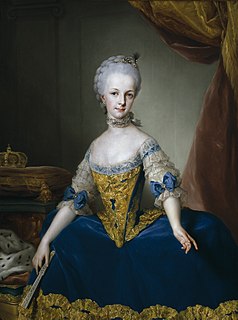
Archduchess Maria Josepha of Austria. She was the daughter of Francis I, Holy Roman Emperor (1708–1765) and Maria Theresa of Austria, Holy Roman Empress (1717–1780). She died of smallpox at the age of 16 and was buried in the Imperial Crypt, Vienna, Austria.
Archduchess Maria may refer to a number of historical noblewomen of Austria:

Maria Clementina of Austria was an Austrian archduchess and the tenth child and third daughter of Leopold II, Holy Roman Emperor and Maria Luisa of Spain. In 1797 she married her first cousin Prince Francis, Duke of Calabria, heir to the kingdoms of Naples and Sicily. She was modest, well educated and kind, becoming popular in her adoptive country. Afflicted with frail health, she died of tuberculosis, age twenty four. Her only surviving child was Princess Caroline, Duchess of Berry.

Amalia is a female given name, derived from the Germanic word amal, meaning "work, activity", specifically the woman's name Amalberga. Its popularity is attributed to the Belgian Saint Amalberga of Maubeuge. The origins of the name Amalia have often been associated with those of Emilia and Emily, both of which in fact originate from the Latin nomen Aemilia, or with Amalthea, which originated from the Greek name "tender goddess". In Greece, the name is celebrated on 10 July in honour of Saint Amalia.
Maria Theresa (1717–1780) was Queen of Hungary and Bohemia, Archduchess of Austria and ruler of the rest of the Habsburg Monarchy (1740-1780).
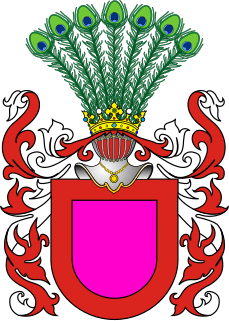
Sobieski was a prominent magnate family of Polish nobility in the 16th and 17th centuries from which the King of Poland and Grand Duke of Lithuania Jan III Sobieski originated. The family used the Janina coat of arms.
Maria Antonia is a feminine Portuguese given name from the root names Miriam and Antonius. Notable people referred to by this name include the following:

The descendants of Charles III of Spain, the third surviving son of the first Bourbon King of Spain are numerous. Growing up in Madrid till he was 16, he was sent to the Italian Sovereign Duchy of Parma and Piacenza which, through his mother Elisabeth of Parma, was considered his birthright. Charles married only once, to the cultured Princess Maria Amalia of Saxony, with whom he had 13 children; 8 of these reached adulthood and only 4 of these had issue.
Princess Amalia or Princess Amalie may refer to:

Princess Maria Isabelle of Naples and Sicily was a member of the House of Bourbon.
This page is based on this
Wikipedia article Text is available under the
CC BY-SA 4.0 license; additional terms may apply.
Images, videos and audio are available under their respective licenses.
