Related Research Articles

Plankton are the diverse collection of organisms that drift in water but are unable to actively propel themselves against currents. The individual organisms constituting plankton are called plankters. In the ocean, they provide a crucial source of food to many small and large aquatic organisms, such as bivalves, fish, and baleen whales.

Zooplankton are the heterotrophic component of the planktonic community, having to consume other organisms to thrive. Plankton are aquatic organisms that are unable to swim effectively against currents. Consequently, they drift or are carried along by currents in the ocean, or by currents in seas, lakes or rivers.

Copepods are a group of small crustaceans found in nearly every freshwater and saltwater habitat. Some species are planktonic, some are benthic, several species have parasitic phases, and some continental species may live in limnoterrestrial habitats and other wet terrestrial places, such as swamps, under leaf fall in wet forests, bogs, springs, ephemeral ponds, puddles, damp moss, or water-filled recesses of plants (phytotelmata) such as bromeliads and pitcher plants. Many live underground in marine and freshwater caves, sinkholes, or stream beds. Copepods are sometimes used as biodiversity indicators.
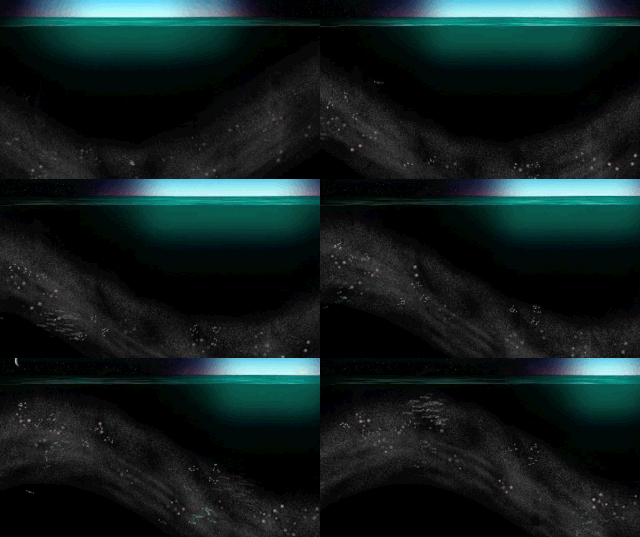
Diel vertical migration (DVM), also known as diurnal vertical migration, is a pattern of movement used by some organisms, such as copepods, living in the ocean and in lakes. The adjective "diel" comes from Latin: diēs, lit. 'day', and refers to a 24-hour period. The migration occurs when organisms move up to the uppermost layer of the water at night and return to the bottom of the daylight zone of the oceans or to the dense, bottom layer of lakes during the day. DVM is important to the functioning of deep-sea food webs and the biologically-driven sequestration of carbon.
Martin Wiggo Johnson, was an American oceanographer at Scripps Institution of Oceanography. He is known as an author of the landmark reference work The Oceans: Their Physics, Chemistry and General Biology ; for explaining the deep scattering layer (DSL) as a result of what is now called the diel vertical migration; and for studies of zooplankton that revealed that the physics of water movement was an important influence on population biology and community diversity.
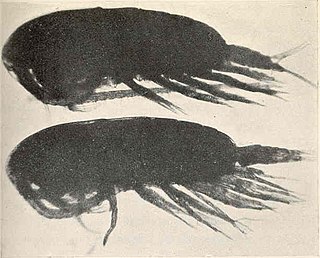
Calanus finmarchicus is a species of copepod and a component of the zooplankton, which is found in enormous amounts in the northern Atlantic Ocean.

Neuston, also called pleuston, are organisms that live at the surface of a body of water, such as an ocean, estuary, lake, river, wetland or pond. Neuston can live on top of the water surface or submersed just below the water surface. In addition, microorganisms can exist in the surface microlayer that forms between the top- and the under-side of the water surface. Neuston has been defined as "organisms living at the air/water interface of freshwater, estuarine, and marine habitats or referring to the biota on or directly below the water’s surface layer."
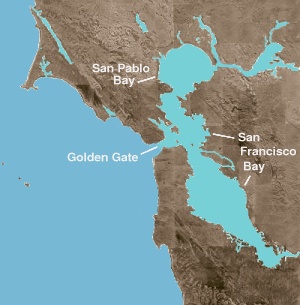
The San Francisco Estuary together with the Sacramento–San Joaquin River Delta represents a highly altered ecosystem. The region has been heavily re-engineered to accommodate the needs of water delivery, shipping, agriculture, and most recently, suburban development. These needs have wrought direct changes in the movement of water and the nature of the landscape, and indirect changes from the introduction of non-native species. New species have altered the architecture of the food web as surely as levees have altered the landscape of islands and channels that form the complex system known as the Delta.
Acartia hudsonica is a species of marine copepod belonging to the family Acartiidae. Acartia hudsonica is a coastal, cold water species that can be found along the northwest Atlantic coast.

Phaennidae is a family of planktonic copepods, found in pelagic or benthopelagic waters. It contains the following genera:
Acartia tonsa is a species of marine copepod in the family Acartiidae.

Alan Reece Longhurst was a British-born Canadian oceanographer who invented the Longhurst-Hardy Plankton Recorder, and is widely known for his contributions to the primary scientific literature, together with his numerous monographs, most notably the "Ecological Geography of the Sea". He led an effort that produced the first estimate of global primary production in the oceans using satellite imagery, and also quantified vertical carbon flux through the planktonic ecosystem via the biological pump. In later life he offered several critical reviews of several aspects of fishery management science and climate change science.
Karen Frances Wishner is an American oceanographer currently at University of Rhode Island and an elected fellow of the American Association for the Advancement of Science. Her interests include coastal shelf and zooplankton behavior and environment, and has published her findings.

Calanoides acutus is a copepod found in Antarctica and the surrounding waters.
Neocalanus plumchrus is a large species of copepod found in the Pacific and Arctic Oceans. It was described in 1921 H. by Marukawa. N. flemingeri was formerly considered as conspecific, likely as a form, until it was split in 1988 by Charles B. Miller.
Pseudocalanus newmani is a copepod found in Arctic and northern Pacific waters. It was described by Frost in 1989. It is found in the Arctic and surrounding waters. There are multiple generations. Unlike some copepods, P. newmani undergoes reverse diel vertical migration, descending during the night, and ascending during the day, although it may undergo normal or no migration at all depending on predation. This copepod is primarily herbivorous.

The lipid pump sequesters carbon from the ocean's surface to deeper waters via lipids associated with overwintering vertically migratory zooplankton. Lipids are a class of hydrocarbon rich, nitrogen and phosphorus deficient compounds essential for cellular structures. This lipid carbon enters the deep ocean as carbon dioxide produced by respiration of lipid reserves and as organic matter from the mortality of zooplankton.
Pseudocalanus minutus is a small copepod found in the Arctic Ocean and surrounding waters.

Janet Mary Grieve, also known as Janet Bradford-Grieve and Janet Bradford, is a New Zealand biological oceanographer, born in 1940. She is researcher emerita at the National Institute of Water and Atmospheric Research in Wellington. She has researched extensively on marine taxonomy and biological productivity. She was president of both the New Zealand Association of Scientists (1998–2000) and the World Association of Copepodologists (2008–11).

Ann Bucklin is Professor Emeritus of Marine Sciences at the University of Connecticut known for her work using molecular tools to study zooplankton. Bucklin was elected a fellow of the American Association for the Advancement of Science in 1995.
References
Markhaseva EL (2012) Xancithrix gen.n. (Copepoda: Calanoida), a new benthopelagic genus of Clausocalanoidea from deep Atlantic waters. Arthropoda Selecta 21: 295-306
Bradford-Grieve JM, Blanco-Bercial L, Boxshall GA (2017) Revision of family Megacalanidae (Copepoda: Calanoida). Zootaxa 4229: 1-183

  | This biography of an American academic is a stub. You can help Wikipedia by expanding it. |