
González is a Spanish surname of Germanic origin, the second most common in Spain, as well as one of the five most common surnames in Argentina, Chile, Mexico, Paraguay, and Venezuela, and one of the most common surnames in the entire Spanish-speaking world. As of 2017, it is the 13th most common surname in the United States.

María de los Dolores Asúnsolo y López Negrete, known professionally as Dolores del Río, was a Mexican actress. With a career spanning more than 50 years, she is regarded as the first major female Latin American crossover star in Hollywood. Along with a notable career in American cinema during the 1920s and 1930s, she was also considered one of the most important female figures in the Golden Age of Mexican cinema, and one of the most beautiful actresses of her era.

Sabine Reyes Ulibarrí was an American poet. He was also a teacher, a writer, a critic, and a statesman. Ulibarrí was born in Tierra Amarilla, New Mexico.

Chicanismo emerged as the cultural consciousness behind the Chicano Movement. The central aspect of Chicanismo is the identification of Chicanos with their Indigenous American roots to create an affinity with the notion that they are native to the land rather than immigrants. Chicanismo brought a new sense of nationalism for Chicanos that extended the notion of family to all Chicano people. Barrios, or working-class neighborhoods, became the cultural hubs for the people. It created a symbolic connection to the ancestral ties of Mesoamerica and the Nahuatl language through the situating of Aztlán, the ancestral home of the Aztecs, in the southwestern United States. Chicanismo also rejected Americanization and assimilation as a form of cultural destruction of the Chicano people, fostering notions of Brown Pride. Xicanisma has been referred to as an extension of Chicanismo.

María Dolores Fernández PraderaOAXS, MMT was a Spanish melodic singer and actress, and one of the most famous voices in Spain and Latin America.
Dolores de la Colina Flores is a singer and songwriter from the 1970s based in Mexico. She has written songs for Manoella Torres, Lupita D'Alessio, Sophy, José José, José Luis Rodríguez "El Puma", Daniela Romo, Arianna, Stephanie Salas, Raphael, Moncho, Manolo Muñoz, Vikki Carr, Trigo Limpio, Ana Gabriel, Raquel Olmedo, María Dolores Pradera, Olga Guillott, Gloria Lasso, Bebo y Cigala, Emmanuel, Estela Núñez, María Jiménez, Pedro Fernández, Verónica Castro, Manuel Mijares, Lucero, Yuri, Kika Edgar, Roberto Blades, Pepe Aguilar, Chavela Vargas, La Lupe, Marco Antonio Muñiz, Ernesto D'alessio and many other singers in different music styles. In 1974, she was discovered while in Puerto Rico by Tico/Alegre's Joe Cain and signed to the label.

Lola is a feminine given name and nickname in the Romance languages, and other language groups.

María Candelaria is a 1943 Mexican romantic film written and directed by Emilio Fernández and starring Dolores del Río and Pedro Armendáriz. It was the first Mexican film to be screened at the Cannes International Film Festival where it won the Grand Prix becoming the first Latin American film to do so. María Candelaria would later win a Silver Ariel award for Best Cinematography.
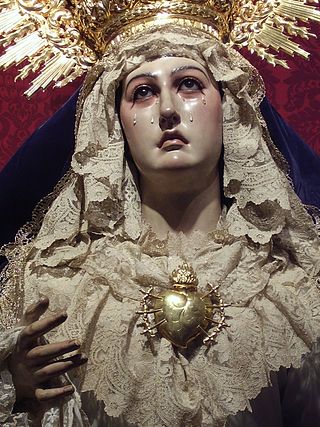
Dolores is a feminine given name of Spanish origin.
Amalia Mesa-Bains, is a Chicana curator, author, visual artist, and educator. She is best known for her large-scale installations that reference home altars and ofrendas. Her work engages in a conceptual exploration of Mexican American women's spiritual practices that addresses colonial and imperial histories of display, the recovery of cultural memory, and their roles in identity formation.

The Hispanos of New Mexico, also known as Neomexicanos or Nuevomexicanos, are Hispanic residents originating in the historical region of Santa Fe de Nuevo México, today the US state of New Mexico, southern Colorado, and other parts of the Southwestern United States including Arizona, Nevada, Texas, and Utah. They are descended from Oasisamerica groups and the settlers of the Viceroyalty of New Spain, the First Mexican Empire and Republic, the Centralist Republic of Mexico, and the New Mexico Territory.
Óscar González, Oscar González or Oscar Gonzáles may refer to:

Laura Méndez de Cuenca, was a Mexican writer and poet.
South of the Rio Grande is a 1945 American western film. Released on September 15, it was the third of three Cisco Kid films made that year with Duncan Renaldo as Cisco and Martin Garralaga as Pancho.
Dolores Consuelo Barcelo Gonzales was a Mexican–American fashion designer based in Tucson, Arizona. She is best known for blending Native American and Mexican clothing traditions to create distinctive southwest resort wear dresses known as patio dresses, the fiesta dresses,. She founded the company Dolores Resort Wear that manufactured dresses for the American market, selling in upscale department stores across the country. The iconic design was appropriated and copied by other designers throughout the southwest becoming synonymous with mid-twentieth century regionalist fashion of the American Southwest. The dress design became the official dress of the American Square-dancing movement.
Maria Dolores is short for La Virgen María de los Dolores in Spanish.
Cristina Farfán was an educator and writer who promoted women's education and was involved in the emergence of the first wave feminist movement in Mexico. She was one of the founders of women's literary journalism in Mexico.
María Dolores Gonzáles (1917-1975), known more popularly by her middle name Dolores, was an educator in New Mexico who was on the forefront of bilingual educator for Spanish language education programs. She was called "La Doctora" after receiving her PhD.
María Dolores Gonzales is a Mexican-American author and educator, and advocate for bilingual education in the US. She is a scholar in the realm of bilingual studies and linguistic history of the American Southwest. She taught at University of New Mexico for 12 years as a professor and was head of the Sabine Ulibarrí Spanish Heritage Program, and after retiring established the Spanish immersion program, Bilingual Strategies. Her programs advocate for the revitalization of New Mexican Spanish and dialectical awareness to connect Spanish speakers with their heritage, in order to reverse the damage of Spanish and US colonialism.
