Indian or Indians may refer to:
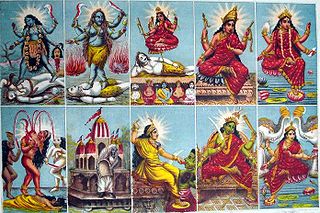
The Mahavidya are a group of ten Hindu Tantric goddesses. The 10 Mahavidyas are usually named in the following sequence: Kali, Tara, Tripura Sundari, Bhuvaneshvari, Bhairavi, Chhinnamasta, Dhumavati, Bagalamukhi, Matangi and Kamalatmika. Nevertheless, the formation of this group encompass divergent and varied religious traditions that include yogini worship, Saivism, Vaishnavism, and Vajrayana Buddhism.

Matangi is a Hindu goddess. She is one of the Mahavidyas, ten Tantric goddesses and an aspect of the Hindu Divine Mother. She is considered to be the Tantric form of Sarasvati, the goddess of music and learning. Matangi governs speech, music, knowledge and the arts. Her worship is prescribed to acquire supernatural powers, especially gaining control over enemies, attracting people to oneself, acquiring mastery over the arts and gaining supreme knowledge.
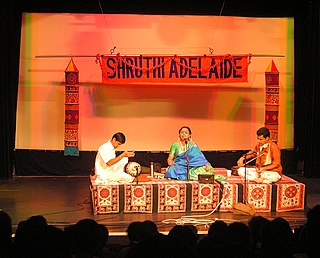
The shruti or śruti is the smallest interval of pitch that the human ear can detect and a singer or musical instrument can produce. The concept is found in ancient and medieval Sanskrit texts such as the Natya Shastra, the Dattilam, the Brihaddeshi, and the Sangita Ratnakara. Chandogya Upanishad speaks of the division of the octave in 22 parts.
Karmageddon may refer to:
Brihaddeshi is a Classical Sanskrit text, dated ca. 6th to 8th century CE, on Indian classical music, attributed to Mataṅga Muni. It is the first text to speak directly of the raga and to distinguish marga ("classical") from desi ("folk") music. It also introduced sargam solfège, the singing of the first syllable of the names of the musical notes, as an aid to learning and performance.
Punjabi, or Panjabi, most often refers to:

Kambhoji or Kambodhi is a popular Raga in Carnatic Music. It is classified as a derived raga from 28th Melakartha, Harikambhoji, and has existed since the 7th century.

Satya Harishchandra is a 1965 Indian Telugu-language Hindu mythological film, based on the life of Harishchandra, produced and directed by K. V. Reddy under the Vijaya Productions banner. It stars N. T. Rama Rao and S. Varalakshmi, with music composed by Pendyala Nageswara Rao.

Kasyapa Matanga or Jia Yemoteng 迦葉摩騰 was an Indian Buddhist monk who is traditionally believed to have first introduced Buddhism to China in the 1st century CE.

The Tongan Maritime Force is the naval arm of His Majesty's Armed Forces of Tonga.

Matangi is the fourth studio album by British recording artist M.I.A. It was released on 1 November 2013 through N.E.E.T. Recordings and Interscope. M.I.A.'s longtime collaborator Switch primarily handled Matangi's production; Hit-Boy, Doc McKinney, Danja, Surkin, and The Partysquad provided additional contributions. The album was recorded in various locations around the world and featured uncredited input from WikiLeaks founder Julian Assange. Its title is a variant of M.I.A.'s real first name and references the Hindu goddess Matangi. The lyrics feature themes related to Hinduism, including reincarnation and karma, and the music blends Western and Eastern styles.

The Gaj class offshore tugboats are a series of two auxiliary watercraft built by Garden Reach Shipbuilders & Engineers Ltd., Kolkata, for the Indian Navy. The vessels in the class are Indian Navy's biggest tugboats and can be used for towing aircraft carriers.

"Bring the Noize" is a hip-hop song by British recording artist M.I.A. from her fourth studio album, Matangi (2013). The track was written by Maya "M.I.A." Arulpragasam, Surkin, Switch, Para One and Hugues Rey, and produced by Switch and Surkin. It references Public Enemy's 1987 song "Bring the Noise" and Janis Joplin's track "Me and Bobby McGee".
Matangi is a Hindu goddess.

"Double Bubble Trouble" is a song by recording artist M.I.A. from her fourth studio album, Matangi (2013). It is written by Maya "M.I.A." Arulpragasam, Ruben Fernhout, Jerry Leembruggen, and produced by DJ Punish. The track references Shampoo's 1994 hit song "Trouble", and incorporates such musical styles as reggae, trap and kuduro. "Double Bubble Trouble" was released as a promotional single in the Netherlands in 2013 and Sweden, before becoming the fifth and final official single from Matangi in 2014. The song was performed on Late Night with Seth Meyers on 13 May 2014 as well as on the 2014 Matangi Tour. The song is on the soundtrack of the 2023 movie The Marvels.

"Sexodus" is a song by English rapper M.I.A. from her fourth studio album, Matangi (2013). It is written by M.I.A. alongside British record producer Switch, Doc McKinney, Illangelo, and the Weeknd are also credited due to a sample of the Weeknd's song "Lonely Star" from his mixtape Thursday. The album version of the song was noted for its "striking" similarities to a different song from the album, "Exodus". However, the single version features War Syntaire and was labelled as being "Re-Loaded With War". Before the track was recorded by M.I.A., she offered the song to Madonna.
Matang is a mukim in Perak, Malaysia.

Matangi/Maya/M.I.A. is a 2018 biographical documentary film about English rapper and artist M.I.A. Directed by Steve Loveridge, the film follows 22 years in the rapper's life, her rise to fame and her perspective on the controversies sparked over her music, public appearances and political activism.

