In Polynesian mythology, Hawaiki is the original home of the Polynesians, before dispersal across Polynesia. It also features as the underworld in many Māori stories.

Isla de la Juventud is the second-largest Cuban island and the seventh-largest island in the West Indies. The island was called the Isle of Pines until 1978. It has an area 2,200 km2 (850 sq mi) and is 50 km (31 mi) south of the island of Cuba, across the Gulf of Batabanó. The island lies almost directly south of Havana and Pinar del Río and is a Special Municipality, not part of any province and is therefore administered directly by the central government of Cuba. The island has only one municipality, also named Isla de la Juventud.

Ground spiders comprise Gnaphosidae, the seventh largest spider family with nearly 2,000 described species in over 100 genera distributed worldwide. There are 105 species known to central Europe, and common genera include Gnaphosa, Drassodes, Micaria, Cesonia, Zelotes and many others. They are closely related to Clubionidae. At present, no ground spiders are known to be seriously venomous to humans.
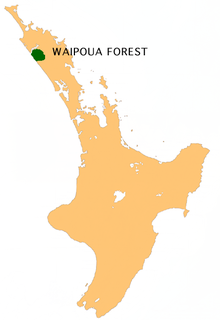
Waipoua Forest is a forest, on the west coast of the Northland Region of New Zealand's North Island. It preserves some of the best examples of kauri forest remaining in New Zealand. It is notable for having two of the largest living kauri trees, Tāne Mahuta and Te Matua Ngahere.

Baracoa is a municipality and city in Guantánamo Province near the eastern tip of Cuba. It was visited by Admiral Christopher Columbus on November 27, 1492, and then founded by the first governor of Cuba, the Spanish conquistador Diego Velázquez de Cuéllar on August 15, 1511. It is the oldest Spanish settlement in Cuba and was its first capital.

Tāne Mahuta, also called God of the Forest, is a giant kauri tree in the Waipoua Forest of Northland Region, New Zealand. Its age is unknown but is estimated to be between 1,250 and 2,500 years. It is the largest kauri known to stand today. It is named for the Māori god of forests and of birds.

Te Matua Ngahere is a giant kauri coniferous tree in the Waipoua Forest of Northland Region, New Zealand. The tree's Maori name means "Father of the Forest". Although not as massive or tall as its neighbour Tāne Mahuta, Te Matua Ngahere is stouter, with a girth just over 16 metres (52 ft). It is believed to be the second largest living kauri tree, and to have the biggest girth of any kauri in the country. According to The New Zealand Herald, it has the biggest girth of any tree in New Zealand.

Masantol, officially the Municipality of Masantol, is a 2nd class municipality in the province of Pampanga, Philippines. According to the 2015 census, it has a population of 57,063 people.
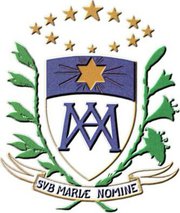
The Society of Mary (Marists), commonly known as simply the Marist Fathers, is an international Roman Catholic religious congregation, founded by Father Jean-Claude Colin and a group of other seminarians in Lyon, France, in 1816. The society's name derives from the Blessed Virgin Mary, whom the members attempt to imitate in their spirituality and daily work.
Arawa was one of the great ocean-going, voyaging canoes in Māori traditions that was used in the migrations that settled New Zealand.
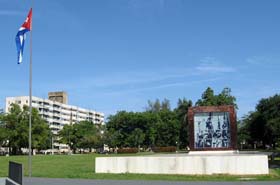
Artemisa is a municipality and city in Cuba, formerly part of La Habana Province. According to a law approved by the Cuban National Assembly in August 2010, Artemisa became the capital city of the newly formed Artemisa Province, which comprises eight municipalities of the former La Habana Province and three from Pinar del Río.
Mahanga-atua-matua is a canoe mentioned in a letter by Uma-kau-oho-mata-kamokamo, a Māori chief from the Tauranga district, New Zealand, quoted in White (1887-1891). Claiming that this canoe did not bring any food plants to New Zealand because it was too sacred to carry such items, and was manned by priests and chiefs, Uma-kau-oho-mata-kamokamo said that Mahanga-atua-matua was the first canoe to land in New Zealand, and that he or his people still possessed the priests who built the canoe and the adzes that they used.
Ngāti Tahu - Ngāti Whaoa is a Māori iwi of New Zealand who are the descendants of Tahu Matua.

Kura Kaupapa Māori are Māori-language immersion schools (kura) in New Zealand where the philosophy and practice reflect Māori cultural values with the aim of revitalising Māori language, knowledge and culture. The term Kaupapa Māori is used popularly by Māori to mean any particular plan of action created by Māori to express Māori aspirations, values and principles.

Ikamatua is a small village on the West Coast of the South Island in New Zealand. Its name translates literally as ika (fish) and matua (mature/parent). It may be a contraction of Te Ika-a-matua, fish of my ancestor.
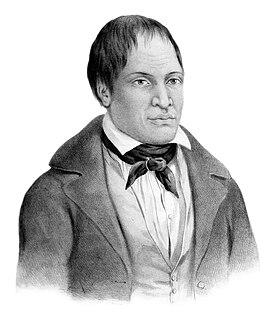
Te Maputeoa was a monarch of the Polynesian island of Mangareva and the other Gambier Islands. He was the King or ʻAkariki, as well as the penultimate king of the island of Mangareva, and other Gambier Islands including Akamaru, Aukena, Taravai and Temoe. He reigned from 1830 until his death in 1857.

Matua was the High Priest of the island of Mangareva. He served as one of the regents for his nephew Maputeoa and was instrumental in the conversion of Mangareva and the Gambier Islands to Roman Catholicism. His name is often written as Matoua.
Matua is a genus of South Pacific ground spiders that was first described by Raymond Robert Forster in 1979. As of May 2019 it contains only two species, both found in New Zealand: M. festiva and M. valida.

