
Bagpipes are a woodwind instrument using enclosed reeds fed from a constant reservoir of air in the form of a bag. The Scottish Great Highland bagpipes are the best known examples in the Anglophone world; however, people have played bagpipes for centuries, and they occur throughout large parts of Europe, northern Africa, and western Asia, including Anatolia, the Caucasus, and around the Persian Gulf. The term bagpipe is equally correct in the singular or plural, though pipers usually refer to the bagpipes as "the pipes", "a set of pipes" or "a stand of pipes".

The Moselle is a river that flows through France, Luxembourg, and Germany. It is a left tributary of the Rhine, which it joins at Koblenz. A small part of Belgium is also drained by the Moselle through the Sauer and the Our.

Inverness is a cathedral city in the Scottish Highlands. It is the administrative centre for The Highland Council and is regarded as the capital of the Highlands. Historically it served as the county town of the county of Inverness-shire. Inverness lies near two important battle sites: the 11th-century battle of Blàr nam Fèinne against Norway which took place on the Aird, and the 18th century Battle of Culloden which took place on Culloden Moor. It is the northernmost city in the United Kingdom and lies within the Great Glen at its northeastern extremity where the River Ness enters the Moray Firth. At the latest, a settlement was established by the 6th century with the first royal charter being granted by Dabíd mac Maíl Choluim in the 12th century. The Gaelic king Mac Bethad Mac Findláich (MacBeth) whose 11th-century killing of King Duncan was immortalised in Shakespeare's largely fictionalized play Macbeth, held a castle within the city where he ruled as Mormaer of Moray and Ross.
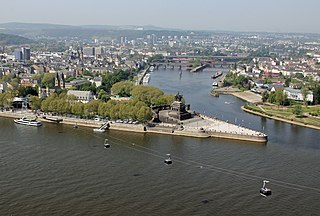
Koblenz, spelled Coblenz before 1926, is a German city situated on both banks of the Rhine where it is joined by the Moselle.

The Castle of Mey is located in Caithness, on the north coast of Scotland, about 6 miles (10 km) west of John o' Groats. In fine weather there are views from the castle north to the Orkney Islands.

Reinhard Friedrich Michael Mey is a German "Liedermacher". In France he is known as Frédérik Mey.
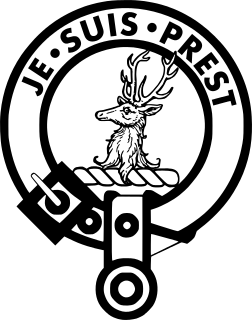
Clan Fraser of Lovat is a Highland Scottish clan. The Clan Fraser of Lovat has been strongly associated with Inverness and the surrounding area since the Clan's founder gained lands there in the 13th century, but Lovat is in fact a junior branch of the Clan Fraser who were based in the Aberdeenshire area. Both the Clan Fraser and the Clan Fraser of Lovat have their own separate clan chiefs who are recognized by the Lord Lyon King of Arms under Scottish law. The Clan Fraser of Lovat in Inverness-shire has historically dominated local politics and been active in every major military conflict involving Scotland. It has also played a considerable role in most major political turmoils. "Fraser" remains the most prominent family name within the Inverness area.
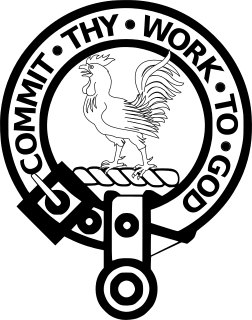
Clan Sinclair is a Highland Scottish clan who held lands in Caithness, the Orkney Islands, and the Lothians. The chiefs of the clan were the Barons of Roslin and later the Earls of Orkney and Earls of Caithness. The Sinclairs are believed to have come from Normandy to England during the Norman conquest of England, before arriving in Scotland in the 11th century. The Sinclairs supported the Scottish Crown during the Scottish–Norwegian War and the Wars of Scottish Independence. The chiefs were originally Barons of Roslin, Midlothian and William Sinclair, 1st Earl of Caithness and Baron of Roslin founded the famous Rosslyn Chapel in the 15th century. He split the family lands, disinheriting his eldest son from his first marriage, William, who later became the second Lord Sinclair, instead giving the lands of Caithness to the second son from his second marriage, William Sinclair, 2nd Earl of Caithness, in 1476, and the lands at Roslin to his eldest son from his second marriage, Sir Oliver Sinclair. In the 16th century the Sinclairs fought against England during the Anglo-Scottish Wars and also feuded with their neighbors the Clan Sutherland. During the Jacobite rising of 1715 the Sinclairs supported the Jacobite cause, but during the Jacobite rising of 1745, while the clan largely had Jacobite sympathies, their chief, the Earl of Caithness, supported the British-Hanoverian Government. The current chief is Malcolm Sinclair, 20th Earl of Caithness.

Mei is a romanized spelling of a Chinese surname, transcribed in the Mandarin dialect. In Hong Kong and other Cantonese-speaking regions, the name may be transliterated as Mui or Moy. In Vietnam, this surname is spelled Mai. In romanized Korean, it is spelled Mae. The name literally translates in English to the plum fruit. The progenitor of the Méi clan, Méi Bo, originated from near a mountain in ancient China that was lined at its base with plum trees.

Dombasle-sur-Meurthe is a commune in the Meurthe-et-Moselle department in north-eastern France, close to the city of Nancy.

Mey is a commune in the Moselle department in Grand Est in north-eastern France.

The Mey is a double-reed aerophone used in Turkish folk music.
The College of Piping was founded in Glasgow, Scotland, in 1944 by Seumas MacNeill and Thomas Pearston to pass on the art of the Great Highland Bagpipe to all who wanted to learn Scotland's national instrument. As well as teaching, the College's aims were/are to preserve the heritage of the bagpipe by collecting piping artefacts, manuscripts and memorabilia and by providing a focal point for pipers the world over. College lessons are subsidised by profits from the College Shop which sells instruments, music, Highland wear and bagpipe accessories. A charity, the College often teaches students of low means for free.

Mey is a remote village, located on the north coast of Scotland in Caithness, Scottish Highlands and is in the Scottish council area of Highland.
James Sinclair, 12th Earl of Caithness was a Scottish noble and chief of the Clan Sinclair, a Highland Scottish clan.

The arrondissement of Metz is an arrondissement of France in the Moselle department in the Grand Est region. It has 139 communes. Its population is 344,203 (2016), and its area is 1,088.7 km2 (420.3 sq mi).
Events from the year 1757 in Scotland.
George Sinclair, 4th Earl of Caithness was a Scottish nobleman and chief of the Clan Sinclair, a Highland Scottish clan in Caithness, Scotland.

