
Look up mien in Wiktionary, the free dictionary.
Mien is an ethnonym for the Yao people of China or the Dao people of Vietnam.
Contents
Mien may also refer to:
Mien is an ethnonym for the Yao people of China or the Dao people of Vietnam.
Mien may also refer to:

Do, DO or D.O. may refer to:
The Sán Dìu are a Yao ethnic group in northern Vietnam who speak Yue Chinese (Cantonese), a Sinitic language. They are believed to have migrated from Guangdong, China around 1600.
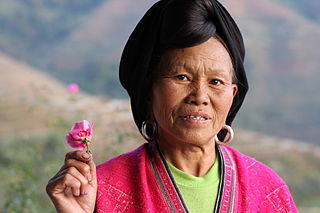
The Yao people is a government classification for various minorities in China and Vietnam. They are one of the 55 officially recognized ethnic minorities in China and reside in the mountainous terrain of the southwest and south. They also form one of the 54 ethnic groups officially recognized by Vietnam. They numbered 2,796,003 in the 2010 Chinese census and 891,151 in the 2019 Vietnamese census. In the United States, about 60,000 Yao of the Iu Mien branch reside mostly in the Western coastal states.

The Hmong–Mien languages are a highly tonal language family of southern China and northern Southeast Asia. They are spoken in mountainous areas of southern China, including Guizhou, Hunan, Yunnan, Sichuan, Guangxi, and Hubei provinces; the speakers of these languages are predominantly "hill people", in contrast to the neighboring Han Chinese, who have settled the more fertile river valleys.
Dao, Dão or DAO may refer to:

The culture of Vietnam are the customs and traditions of the Kinh people and the other ethnic groups of Vietnam. Vietnam is part of Southeast Asia and the Sinosphere due to the influence of Chinese culture on Vietnamese culture.
Iu Mien Americans are primarily former refugees of the Secret War in Laos and the Vietnam War. While some Iu Mien families were granted political asylum and the opportunity to resettle in the United States prior to 1980, the great majority of Iu Mien immigrants to the U.S. arrived following the Refugee Act of 1980. Between the late 1970s to the early 1990s, thousands of Mien immigrants resettled mainly on the West Coast of the U.S. Today, the Iu Mien American population is estimated to be at 50,000 - 70,000.
Kim Mun is a Mienic language spoken by 200,000 of the Yao people in the Chinese provinces of Guangxi, Hunan and Yunnan, with about 61,000 of the speakers in Hainan Province. There are also speakers in Vietnam, Laos, and Thailand.

Cài is a Chinese-language surname that derives from the name of the ancient Cai state. In 2019 it was the 38th most common surname in China, but the 9th most common in Taiwan, where it is usually romanized as "Tsai", "Tsay", or "Chai" and the 8th most common in Singapore, where it is usually romanized as "Chua", which is based on its Teochew and Hokkien pronunciation. Koreans use Chinese-derived family names and in Korean, Cai is 채 in Hangul, "Chae" in Revised Romanization, It is also a common name in Hong Kong where it is romanized as "Choy", "Choi" or "Tsoi". In Macau, it is spelled as "Choi". In Malaysia, it is romanized as "Choi" from the Cantonese pronunciation, and "Chua" or "Chuah" from the Hokkien or Teochew pronunciation. It is romanized in the Philippines as "Chua" or "Chuah", and in Thailand as "Chuo" (ฉั่ว). Moreover, it is also romanized in Cambodia as either "Chhay" or "Chhor" among people of full Chinese descent living in Cambodia and as “Tjhai”, "Tjoa" or "Chua" in Indonesia.
The Iu Mien language is the language spoken by the Iu Mien people in China, Laos, Vietnam, Thailand and, more recently, the United States in diaspora. Like other Mien languages, it is tonal and monosyllabic.
Bạch Long Vĩ island is located in the Gulf of Tonkin, about halfway between Haiphong (Vietnam) and Hainan Island (China). The island is an offshore district of Haiphong city. Fishing comprises the majority of economic activity in the Gulf of Tonkin, and Bạch Long Vĩ is a major nursery and harvesting area for fish eggs. More than 50 species of commercial fish are abundant in the area.
Sino-Vietnamese is often used to mean:
Tao is the pinyin romanization of the Chinese surname 陶 (Táo). It listed 31st in the Song-era Hundred Family Surnames poem.
Ná-Meo is a language of northern Vietnam, spoken by the Mieu people. Nguyen (2007) believes Na Meo may be a Hmongic language closest to Qiandong Miao.
Ria is a feminine given name. In the West, it is often a short form of Maria. Ria is also an Indonesian name meaning joy or hilarity. People with the name include:

Nguyễn Phúc Miên Thẩm, courtesy name Trọng Uyên (仲淵), pseudonym Bạch Hào Tử (白毫子), was a prince of Nguyễn dynasty, Vietnam.

Nguyễn Phúc Miên Trinh, born Nguyễn Phúc Thư (阮福書), was a prince of Nguyễn dynasty, Vietnam.

The Vietnam national badminton team represents Vietnam in international badminton team competitions. The national team is controlled by the Vietnam Badminton Federation, the governing body for badminton in Vietnam. The Vietnamese team competes in the biennial Southeast Asian Games and have made several achievements in badminton at the games.

Mai Thuc was a Vietnamese writer and journalist, who was most known for her works on Vietnam history, its people, and culture. She was the Editor-in-chief of Hanoi Women's Newspaper (1995–2003) and later in her retirement years a part-time lecturer in Hanoi Culturology at Thang Long University, Hanoi.
Dao Minh Quan is a Vietnamese-American politician. He is the 3rd President of the Third Republic of Vietnam, a claimed government in exile. He is known for starting the Vietnam New Democratic Movement.