The most distinctive music of Uruguay is to be found in the tango and candombe; both genres have been recognized by UNESCO as an Intangible Cultural Heritage of Humanity. Uruguayan music includes a number of local musical forms such as murga, a form of musical theatre, and milonga, a folk guitar and song form deriving from Spanish traditions and related to similar forms found in many Hispanic-American countries.

Milonga is a musical genre that originated in the Río de la Plata areas of Argentina, Uruguay and the Brazilian state of Rio Grande do Sul. It was derived from an earlier style of singing known as the payada de contrapunto. The song was set to a lively 2
4 time signature, as are most milongas.

Tango is a style of music in 2
4 or 4
4 time that originated among European immigrant populations of Argentina and Uruguay. It is traditionally played on a solo guitar, guitar duo, or an ensemble, known as the orquesta típica, which includes at least two violins, flute, piano, double bass, and at least two bandoneóns. Sometimes guitars and a clarinet join the ensemble. Tango may be purely instrumental or may include a vocalist. Tango music and dance have become popular throughout the world.

Candombe is a style of music and dance that immigrated to Uruguay with enslaved Africans. In 2009, the United Nations Educational, Scientific and Cultural Organization (UNESCO) inscribed candombe in its Representative List of the Intangible Cultural Heritage of Humanity.

Argentine tango is a musical genre and accompanying social dance originating at the end of the 19th century in the suburbs of Buenos Aires and Montevideo. It typically has a 2
4 or 4
4 rhythmic time signature, and two or three parts repeating in patterns such as ABAB or ABCAC. Its lyrics are marked by nostalgia, sadness, and laments for lost love. The typical orchestra has several melodic instruments and is given a distinctive air by the small button accordion called the bandoneon. It has continued to grow in popularity and spread internationally, adding modern elements without replacing the older ones. Among its leading figures are the singer and songwriter Carlos Gardel and composers/performers Francisco Canaro, Juan D'Arienzo, Carlos Di Sarli, Osvaldo Pugliese, and Ástor Piazzolla.
A tanda is a turn of dancing in a milonga, and by association, a set of pieces of music, usually between three and five, that is played for one turn. The most common style is to play four pieces in the tango tandas, three in the milonga tandas, and three or four in the vals tandas.
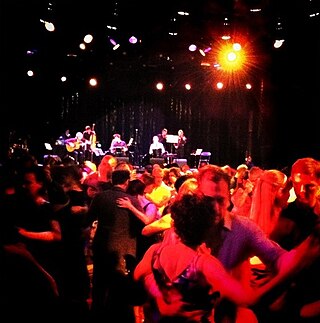
Milonga is an event where Argentine tango is danced. The venue dedicated to milongas may also be called "milonga". People who frequently go to milongas may be called milongueros.

Tango, a distinctive tango dance and the corresponding musical style of tango music, began in the working-class port neighborhoods of Buenos Aires (Argentina) and Montevideo (Uruguay); on both sides of the Rio de la Plata.

A palo or cante is the name given in flamenco for the different traditional musical forms.
Neotango is a distinct genre of tango which goes beyond it both in music and in dance. It is a global movement in which the music includes tracks from all over the world, instrumental and vocal, distinct from the tango in that it includes only modern music recorded in the last 30-40 years, and can be danced using the tango's biomechanics. As a dance form it is still evolving. It is a 'living' globalized tango dance form of the 21st century.
Otros Aires is an Argentine XXI century Tango music project, founded in 2003 in Barcelona by Argentine musician/architect Miguel Di Genova.
A cortina (curtain) is a short piece of music that is played between tandas at a milonga. The cortina lets the dancers know that the tanda has ended. The partners can then thank each other and return to their own tables, to find a new dance partner at the next tanda. Cortinas are used at many of the milongas in Argentina and Uruguay and increasingly elsewhere.
Práctica is a term for an informal event where Argentine tango or Salsa is danced. It is similar to a Milonga. However while a Milonga is rather a formal event where dancers socialise, while at a Práctica dancers focus on practicing the dance.
David Derman was an Argentine tango dancer who kept a record of the women with whom he danced in the milongas in a checkbook register. He danced with approximately 7,600 women. The card he would give to each woman he danced with would have the following note:
"You are now registered in my heart forever. You will not be for me just a name or a number. Please accept this souvenir from somebody who is deeply grateful for the dance we shared, a few minutes where we escaped from the world to enter into the kingdom of emotion and happiness that is tango. Thank you for dancing with me."
Chamarrita can refer to two different types of music and dance, one from the Azores in Portugal and one from the Rio de la Plata littoral region in northern Argentina, Uruguay, and southern Brazil.
Bailando por un Sueño 2 was the second Argentinean season of Bailando por un Sueño.

Milonguero is a style of close-embrace tango dancing, the name coined by Susana Miller and Oscar "Cacho" Dante from the Argentine word "milonguero". Milonguero is a term for a skillful and respectful tango dancer who holds a reverence for the type of traditional social tango that is danced at milongas in Buenos Aires, Argentina. The two uses of the term do not coincide: many dancers who are considered to be milongueros do not dance milonguero-style tango.

A milonguero is a person who spends time dancing social tango. The word comes from the term milonga referring to a tango dance event.
Milonga dance is dancing to milonga music.
This page is based on this
Wikipedia article Text is available under the
CC BY-SA 4.0 license; additional terms may apply.
Images, videos and audio are available under their respective licenses.
