
A steel roller coaster is a roller coaster that is defined by having a track made of steel. Steel coasters have earned immense popularity in the past 50 years throughout the world. Incorporating tubular steel track and polyurethane-coated wheels, the steel roller coasters can provide a taller, smoother, and faster ride with more inversions than a traditional wooden roller coaster.

A stand-up roller coaster is a roller coaster designed to have the passengers stand through the course of the ride.

Six Flags Over Georgia is a 290-acre (1.2 km2) theme park located in Mableton, Georgia. Opened in 1967, it is the second park in the Six Flags chain following the original Six Flags Over Texas, which opened in 1961.
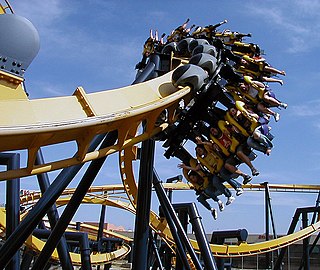
Bolliger & Mabillard, officially Bolliger & Mabillard Consulting Engineers, Inc. and often abbreviated B&M, is a roller coaster design consultancy based in Monthey, Switzerland. The company was founded in 1988 by Walter Bolliger and Claude Mabillard, both of whom had worked for Giovanola.

Arrow Dynamics was an American manufacturing and engineering company that specialized in designing and building amusement park rides, especially roller coasters. Based in Clearfield, Utah, the company was the successor to Arrow Development (1946–1981) and Arrow Huss (1981–1986), which were responsible for several influential advancements in the amusement and theme park industries. Among the most significant was tubular steel track, which provided a smoother ride than the railroad style rails commonly used prior to the 1960s on wooden roller coasters. The Matterhorn Bobsleds at Disneyland, built in 1959, was Arrow's first roller coaster project.

Batman: The Ride is an inverted roller coaster based on the DC Comics character Batman and found at seven Six Flags theme parks in the United States. Built by consulting engineers Bolliger & Mabillard, it rises to a height of between 100 and 105 feet and reaches top speeds of 50 mph (80 km/h). The original roller coaster at Six Flags Great America was partially devised by the park's general manager Jim Wintrode. Batman: The Ride was the world's first inverted roller coaster when it opened in 1992, and has since been awarded Coaster Landmark status by the American Coaster Enthusiasts. Clones of the ride exist at amusement parks around the world.
Ronald Valentine Toomer was an American roller coaster designer credited for designing 93 roller coasters around the world. He graduated from the University of Nevada, Reno in 1961 with a degree in mechanical engineering and was a part of the design team responsible for the Apollo spacecraft heat shield.

A Giant Inverted Boomerang is a type of steel shuttle roller coaster manufactured by the Dutch firm Vekoma. The ride is a larger, inverted version of Vekoma's popular Boomerang sit down roller coasters. As of January 2023, four installations of the model are operating, with another one under construction.
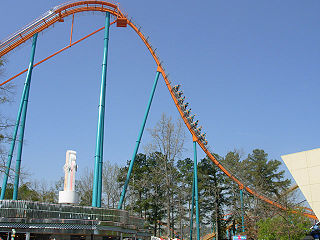
Goliath is a steel roller coaster located at the Six Flags Over Georgia amusement park in Cobb County, Georgia. The Hyper Coaster model manufactured by Bolliger & Mabillard climbs to a height of 200 feet (61 m) and reaches a maximum speed of 70 mph (110 km/h). Prior to its construction, the Great Gasp and Looping Starship attractions were removed to make room for Goliath, which opened to the public on April 1, 2006. It ranked as the fourth-best new ride of 2006 in the annual Golden Ticket Awards publication from Amusement Today and the ninth-best steel roller coaster overall, with its peak ranking of fourth occurring in 2009 and 2011.
Runaway Mine Train may refer to:

The Dahlonega Mine Train is a steel roller coaster located at Six Flags Over Georgia in Austell, Georgia, 12 miles (19 km) west of downtown Atlanta, Georgia. The ride has three lift hills with brief elements between each that wind through a wooded, hilly landscape. This is a family coaster that is named after Dahlonega, Georgia, a village in northern Georgia that was a center of the gold rush of 1828, the first gold rush in the United States of America.

Runaway Mine Train is a steel roller coaster located in the Boomtown section of Six Flags Over Texas in Arlington, Texas. Built in 1966, Runaway Mine Train is the oldest roller coaster in the park.

New Texas Giant is a steel roller coaster located at Six Flags Over Texas in Arlington, Texas. It originally opened as Texas Giant, which was the tallest wooden roller coaster in the world when it debuted in 1990. Manufactured by Dinn Corporation and designed by Curtis D. Summers, Texas Giant operated for nearly two decades and was ranked in Amusement Today magazine's annual Golden Ticket Awards as the best roller coaster in 1998 and 1999. The ride's popularity declined as it gained a negative reputation for its increasing roughness.
The National Roller Coaster Museum and Archives (NRCMA) is a United States 501(c)(3) nonprofit organization dedicated to the protection and preservation of historic roller coasters and amusement park artifacts and memorabilia.

A mine train roller coaster is a steel roller coaster whose trains often depict a set of mine carts, with the forward-most car or portions of it sometimes resembling a small steam locomotive. Most mine train roller coasters are themed in the style of a mine, a Western scene, or simply a mountain range.

Dare Devil Dive is a steel roller coaster at Six Flags Over Georgia. Designed by German company Gerstlauer, Dare Devil Dive is based on the company's Euro-Fighter model, and features a 95-foot (29 m)-tall vertical lift hill, a 95° first drop, three inversions and a top speed of 52 miles per hour (84 km/h). It is also the first Euro-Fighter to debut a new lap-bar restraint system, replacing the more common over-the-shoulder harnesses.

Rocky Mountain Construction, often abbreviated as RMC, is a manufacturing and construction company based in Hayden, Idaho, United States. The company is best known for its I-Box track and Topper Track for wooden roller coasters.
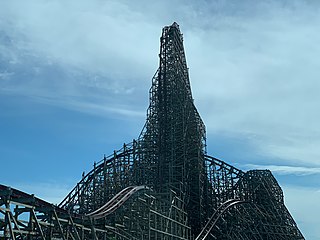
A hybrid roller coaster is a category of roller coasters that is defined as having the track made out of steel, while the support structure is made from wood. Though less common, this can also be flipped around, with the track made of wood with a steel running plate, and a support structure that is made of steel. An example of this is The Voyage at Holiday World. The wooden frame-steel track design of roller coaster is mostly known to be utilized by Rocky Mountain Construction in their I-Box track design, and Arrow Dynamic's Mine Train style roller coasters.
