
Blackface is a form of theatrical makeup used predominantly by non-Black people to portray a caricature of a Black person.
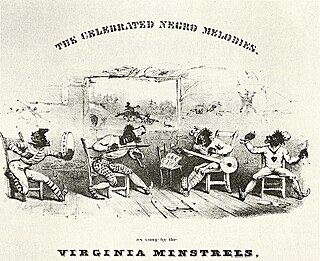
The minstrel show, also called minstrelsy, was an American form of racist theatrical entertainment developed in the early 19th century. Each show consisted of comic skits, variety acts, dancing, and music performances that depicted people specifically of African descent. The shows were performed by mostly white people wearing blackface make-up for the purpose of playing the role of black people. There were also some African-American performers and black-only minstrel groups that formed and toured. Minstrel shows caricatured black people as dim-witted, lazy, buffoonish, cowardly, superstitious, and happy-go-lucky.

A minstrel was an entertainer, initially in medieval Europe. It originally described any type of entertainer such as a musician, juggler, acrobat, singer or fool; later, from the sixteenth century, it came to mean a specialist entertainer who sang songs and played musical instruments.

Master Juba was an African-American dancer active in the 1840s. He was one of the first black performers in the United States to play onstage for white audiences and the only one of the era to tour with a white minstrel group. His real name was believed to be William Henry Lane, and he was also known as "Boz's Juba" following Dickens's graphic description of him in American Notes.
The Virginia Minstrels or Virginia Serenaders was a group of 19th-century American entertainers who helped invent the entertainment form known as the minstrel show. Led by Dan Emmett, the original lineup consisted of Emmett, Billy Whitlock, Dick Pelham, and Frank Brower.

"Old Dan Tucker," also known as "Ole Dan Tucker," "Dan Tucker," and other variants, is an American popular song. Its origins remain obscure; the tune may have come from oral tradition, and the words may have been written by songwriter and performer Dan Emmett. The blackface troupe the Virginia Minstrels popularized "Old Dan Tucker" in 1843, and it quickly became a minstrel hit, behind only "Miss Lucy Long" and "Mary Blane" in popularity during the antebellum period. "Old Dan Tucker" entered the folk vernacular around the same time. Today it is a bluegrass and country music standard. It is no. 390 in the Roud Folk Song Index.

Christopher Haverly (1837–1901), better known as J. H. Haverly or John H. "Jack" Haverly, was an American theatre manager and promoter of blackface minstrel shows. During the 1870s and 1880s, he created an entertainment empire centered on his minstrel troupes, particularly Haverly's United Mastodon Minstrels and Haverly's Colored Minstrels. Under his guidance, these troupes grew to impressive sizes and featured elaborate sets and costumes. They toured widely, enlarging minstrelsy's audience to encompass the entire United States as well as England. Haverly's methods sparked a revolution in minstrelsy as other troupes scrambled to compete. As the costs of minstrelsy increased, many troupes went out of business.

Primrose and West was an American blackface song-and-dance team made up of partners George Primrose and William H. "Billy" West. They later went into the business of minstrel troupe ownership with a refined, high-class approach that signaled the final stage in the development of minstrelsy as a distinct form of entertainment.
Bryant's Minstrels was a blackface minstrel troupe that performed in the mid-19th century, primarily in New York City. The troupe was led by the O'Neill brothers from upstate New York, who took the stage name Bryant.
"Clare de Kitchen" is an American song from the blackface minstrel tradition. It dates to 1832, when blackface performers such as George Nichols, Thomas D. Rice, and George Washington Dixon began to sing it. These performers and American writers such as T. Allston Brown traced the song's origins to black riverboatsmen. "Clare de Kitchen" became very popular, and performers sometimes sang the lyrics of "Blue Tail Fly" to its tune.
Hokum is a particular song type of American blues music—a humorous song which uses extended analogies or euphemistic terms to make sexual innuendos. This trope goes back to early blues recordings and is used from time to time in modern American blues and blues rock.
The stump speech was a comic monologue from blackface minstrelsy. A typical stump speech consisted of malapropisms, nonsense sentences, and puns delivered in a parodied version of Black Vernacular English. The stump speaker wore blackface makeup and moved about like a clown. Topics varied from pure nonsense to parodies of politics, science, and social issues. Although both the topic itself and the black character's inability to comprehend it served as sources of comedy to white people, minstrels used such speeches to deliver racist social commentary. The stump speech was a precursor to modern stand-up comedy.
"Miss Lucy Long", also known as "Lucy Long" as well as by other variants, is an American song that was popularized in the blackface minstrel show.

Francis Marion Brower was an American blackface performer active in the mid-19th century. Brower began performing blackface song-and-dance acts in circuses and variety shows when he was 13. He eventually introduced the bones to his act, helping to popularize it as a blackface instrument. Brower teamed with various other performers, forming his longest association with banjoist Dan Emmett beginning in 1841. Brower earned a reputation as a gifted dancer. In 1842, Brower and Emmett moved to New York City. They were out of work by January 1843, when they teamed up with Billy Whitlock and Richard Pelham to form the Virginia Minstrels. The group was the first to perform a full minstrel show as a complete evening's entertainment. Brower pioneered the role of the endman.
George H. Coes was an American minstrel music performer. He appeared in numerous minstrel shows in California and throughout the Northeastern United States.
Aaron White is an American actor and director, his most notable work for The Dance: The History of American Minstrelsy, which he co-wrote and co-directed with Jason Christophe White. He is also an independent music producer, and the owner and founder of Slingshot Media.
The Dance: The History of American Minstrelsy is an American stage play written by Jason Christophe White and co-directed by Aaron White, which opened in 2005 in the KAOS Cinefreestyle Theatre in Los Angeles. The play follows two characters as they relay the history of American Minstrelsy, as both main characters perform in blackface.
Jason Christophe White is an NAACP Theater Award-winning American playwright, his one produced play being The Dance: The History of American Minstrelsy, which he co-wrote and co-directed with Aaron White. Jason White is also the co-owner of In Tha Cut Productions.
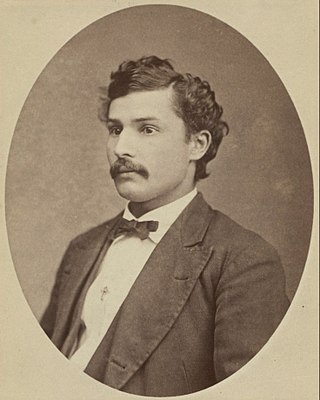
Frank Dumont was an American minstrel show performer and manager.

Racist music is music that expresses racism. Throughout history, music has been used as a propaganda tool in order to promote a variety of political ideologies and ideas, including racism.
