
In ancient Greek religion and Greek mythology, Minthe is an Underworld Naiad nymph associated with the river Cocytus. She was beloved by Hades, the King of the Underworld, and became his mistress, but she was transformed into a mint plant by either his wife Persephone or his sister and mother-in-law Demeter. The plant was also called by some as Hedyosmos (ἡδύοσμος), which means "sweet-smelling".

Elis or Ilia is a historic region in the western part of the Peloponnese peninsula of Greece. It is administered as a regional unit of the modern region of Western Greece. Its capital is Pyrgos. Until 2011 it was Elis Prefecture, covering the same territory.
Pyrgos or Pyrgus may refer to:
Kyllini, Cyllene or Kyllene may refer to:
Erymanthus or Erymanthos may refer to:
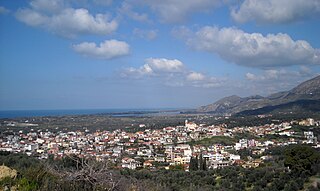
Zacharo is a town and municipality in western Peloponnese, Greece. Administratively, it belongs to the regional unit of Elis in West Greece. Zacharo is situated on the coast of the Gulf of Kyparissia, a part of the Ionian Sea. The mountain Lapithas is to the north, and the Minthi is to the east. Northwest of the town, between mount Lapithas and the sea, is the Kaiafas Lake. Zacharo is 18 km south of Olympia, 28 km southeast of Pyrgos, 65 km northwest of Kalamata and 65 km west of Tripoli. The town is crossed by the Greek National Road 9/E55, that links Patras with Kalamata.
Kentro may refer to several places in Greece:
Giannitsochori is a village in the municipality of Zacharo, southern Elis, Greece. It is situated in the narrow coastal plains along the Ionian Sea, 2 km north of the mouth of the river Neda, at the foot of the western extensions of the mountain Minthi. It is a known beach resort. It is 2 km north of Elaia, 5 km southeast of Neochori and 11 km southeast of Zacharo. The Greek National Road 9/E55 and the railway from Pyrgos to Kalamata pass through the village.
Karatoula or Karatoulas may refer to the following places in Greece:
Elis is a regional unit of Greece.
Armou is a village in the Paphos District of Cyprus, located 4 kilometres (2.5 mi) south-east of Mesogi. It has a panoramic view of Paphos. Armou is located 363m above sea level. The area has been inhabited since pre-Christian times, according to the findings now exhibited at the Archaeological Museum of Paphos. The name of the community emerged from its first settler called Armos, while another version speaks of the “armos “ because of its location. A third version refers to the “arma ” of the goddess Aphrodite, which the goddess used in order to visit these places. Due to the village's location and environment, the village has attracted many Cypriot and foreign residents.
The Minthi is a mountain located in southern Elis in the western Peloponnese, Greece. The mountain is named after the nymph Minthe. It is about 15 km long, and about 10 km wide. Its highest summit is 1,345 m. It is situated between the towns Zacharo in the west and Andritsaina in the east. The valley of the river Neda forms its southern border. The sacred mountain Lykaion lies east of the Minthi. The forests on Minthi suffered great damage from the 2007 Greek forest fires.
Chalcis is a city on the Euripus Strait between the island of Euboea and the Greek mainland.
The Anigrides were in Greek mythology the nymphs—that is, the potamides—of the river Anigrus in Elis. On the coast of Elis, not far from the mouth of the river, there was a grotto sacred to them near modern Samiko, which was visited by persons afflicted with skin diseases. They were supposedly cured here by prayers and sacrifices to the nymphs, and by bathing in the river. The earliest known attestation of the cult of these nymphs was from the poet Moero in the 3rd century BCE.
The Acheron was a small river of Triphylia in ancient Elis, flowing northward from the Minthe Mountains and joining the Alpheius River as a tributary.
Pylus or Pylos was a town in Triphylia in ancient Elis, mentioned only by Strabo, and surnamed by him Τριφυλιακός, Ἀρκαδικός, and Λεπρεατικός. He describes it as situated 30 stadia from the sea, on the rivers Mamathus and Arcadicus, west of the mountain Minthe and north of Lepreum. Upon the conquest of the Triphylian towns by the Eleians, Pylus was annexed to Lepreum. Strabo also contended that this Pylus was the homeland of Nestor because in its vicinity passed the Alpheus, territory where the kingdom of Nestor was supposed to extend and because, according to him, it was the only one of the three cities called Pylus - see Pylus (Elis) and Pylus (Messenia) for the otherse - that was far from the coast, which corresponded to the story of Telemachus's visit to Pylus in the Odyssey.
This page is based on this
Wikipedia article Text is available under the
CC BY-SA 4.0 license; additional terms may apply.
Images, videos and audio are available under their respective licenses.
