
Emilie Juliane was a German countess and hymn writer.

Heinrich Gersmeier known as Schäfer Heinrich is a German farmer, who was looking for a woman in the German TV show Bauer sucht Frau. He sang a song about his life as shepherd.

Am kürzeren Ende der Sonnenallee is the third novel by author Thomas Brussig. The novel is set in East Berlin in the real-life street of Sonnenallee sometime in the late 1970s or early 1980s. The film Sonnenallee, also written by Brussig, is based on the same characters but depicts a significantly different storyline. Unusual is the fact that the screenplay for Sonnenallee served as the basis for the novel, rather than the other way around.
Media vita in morte sumus is a Gregorian chant, known by its incipit, written in the form of a response, and known as "Antiphona pro Peccatis" or "de Morte". The most accepted source is a New Year's Eve religious service in the 1300s. Reference has been made to a source originating in a battle song of the year 912 by Notker the Stammerer, a monk of the Abbey of Saint Gall: however, the Synod of Cologne declared in 1316 no one should sing this without prior permission of the residing bishop.
Mitten im Leben is a German pseudo-documentary drama-reality television series.
Geusenfriedhof is a cemetery in Cologne, Germany. It is the oldest Protestant cemetery in the Rhineland, established around 1584.
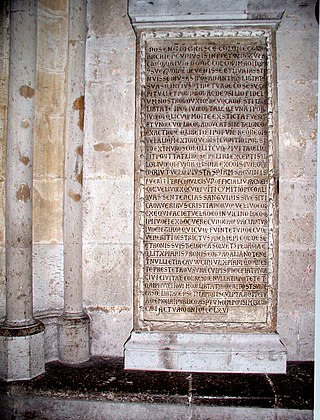
Judenbüchel is a Jewish cemetery in Cologne, Germany.

Jüdischer Friedhof Deutz is a cemetery in Cologne, Germany. Founded in 1695, it is the oldest Jewish cemetery in the district of Cologne. Last burial took place during the Second World War in 1941.
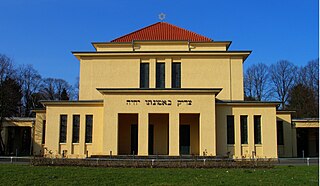
Jüdischer Friedhof Köln-Bocklemünd is a cemetery in Cologne, Germany. A Jewish burial site since 1918, many of its tombstones are noted for their extravagant artistic designs.

Katholischer Friedhof Köln-Mülheim is a cemetery in Cologne, Germany. The oldest gravestone dates to 1841.

Mülheimer Friedhof is a cemetery in Cologne, Germany. It was established on 30 September 1904.

Nordfriedhof is a cemetery in Cologne, Germany. Opened on 18 May 1896 and after the Second World War the cemetery was significantly expanded. German actress Trude Herr (1927–1991) is buried there.

Ostfriedhof is a cemetery in Cologne, Germany. It was established in 1946.

Friedhof Trenkebergstraße is a cemetery in Cologne, Germany. The cemetery is 4,600 m2 and offers space for 790 graves. Furthermore, there are 16 graves in this cemetery for German victims of the Second World War.

Westfriedhof is a cemetery in Cologne, Germany. With an area of 52 hectares, it is amongst the largest of the cemeteries in the city.
David Schnell is an internationally exhibited German painter. From 1995 until 2000 he studied painting at the Hochschule für Grafik und Buchkunst in Leipzig and then from 2000 to 2002 he was a student in the master class of Arno Rink, with whom Neo Rauch had previously studied. He is associated with the New Leipzig School.

"Mitten wir im Leben sind mit dem Tod umfangen" is a Lutheran hymn, with words written by Martin Luther based on the Latin antiphon "Media vita in morte sumus". The hymn in three stanzas was first published in 1524. The hymn inspired composers from the Renaissance to contemporary to write chorale preludes and vocal compositions. Catherine Winkworth translated Luther's song to English in 1862. It has appeared in hymnals of various denominations.
"Manchmal feiern wir mitten im Tag" is a Christian hymn written in 1974 with German text by Alois Albrecht and a melody by Peter Janssens. The song, of the genre Neues Geistliches Lied (NGL), is part of German hymnals, including Gotteslob, and songbooks including ecumenical collections and books for young people. It begins: "Manchmal feiern wir mitten im Tag ein Fest der Auferstehung".
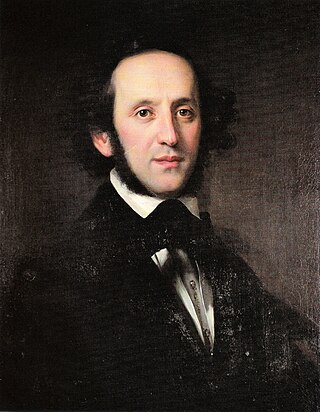
Mitten wir im Leben sind a motet by Felix Mendelssohn as the third and final part of his Kirchenmusik, Op. 23, described as a "small choral work", for SSAATTBB choir, a cappella in the key of C minor in cut time. The text was written by Martin Luther, based on the Latin antiphon "Media vita in morte sumus". The motet was published in 1830.
This page is based on this
Wikipedia article Text is available under the
CC BY-SA 4.0 license; additional terms may apply.
Images, videos and audio are available under their respective licenses.
