
The Muscat family of grapes includes over 200 grape varieties belonging to the Vitis vinifera species that have been used in wine production and as raisin and table grapes around the globe for many centuries. Their colors range from white, to yellow, to pink to near black. Muscat grapes and wines almost always have a pronounced sweet floral aroma. The breadth and number of varieties of Muscat suggest that it is perhaps the oldest domesticated grape variety, and there are theories that most families within the Vitis vinifera grape variety are descended from the Muscat variety.

Verdicchio is a white Italian wine grape variety grown primarily in the Marche region of central Italy. The name Verdicchio derives from verde and refers to the slight green/yellow hue that wines made from the grape can have.

Italian wine is produced in every region of Italy, home to some of the oldest wine-producing regions in the world. Italy is the world's largest producer of wine, with an area of 702,000 hectares under vineyard cultivation, and contributing a 2013–2017 annual average of 48.3 million hl of wine. In 2018 Italy accounted for 19 percent of global production, ahead of France and Spain. Italian wine is both exported around the world and popular domestically among Italians, who consume an average of 42 litres per capita, ranking fifth in world wine consumption.

Asti is a sparkling white Italian wine that is produced throughout southeastern Piedmont but is particularly focused around the towns of Asti and Alba. Since 1993 the wine has been classified as a Denominazione di Origine Controllata e Garantita (DOCG) and as of 2004 was Italy's largest producing appellation. On an average vintage more than ten times as much Asti is produced in Piedmont than the more well-known Piedmontese red wine Barolo.

Castel San Lorenzo is a town and comune in the province of Salerno in the Campania region of south-western Italy.

Costigliole d'Asti is a small Italian town in the Province of Asti, southern Piedmont. It lies about 13 kilometres south of the city of Asti in the Alto Monferrato, on the edge of the Langhe, in the alluvial plain of the river Tanaro southwards into the hills. The name derives from the Latin Corte Costeliolae.

Black Muscat is a red Vitis vinifera grape variety derived from the crossing of the Schiava Grossa and Muscat of Alexandria by Seward Snow, Head Gardener to Earl de Grey at Wrest Park Bedfordshire England in 1850 according to the Vitis International Variety Catalogue. It is known under a variety of local names such as Golden Hamburg, and Black Hamburg in the US; Muscat de Hambourg in France; Moscato di Amburgo in Italy; and Muscat Gamburgskiy in Russia and former Soviet Union countries. Confusingly, Black Hamburg is also used as a synonym for its maternal parent. It is commonly produced as table wine but in California's Central Valley it has been used in the production of dessert wine. As a dessert wine it can be highly aromatic with a rich coloring. In the US it is grown in wine appellations in California, Virginia, Oregon, Texas, and Washington. In Canada, it is also found on Vancouver Island.
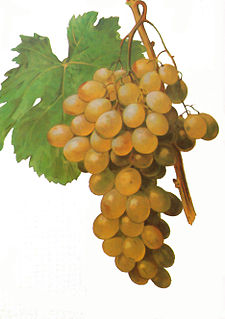
Muscat of Alexandria is a white wine grape that is a member of the Muscat family of Vitis vinifera. It is considered an "ancient vine", and wine experts believe it is one of the oldest genetically unmodified vines still in existence. The grape originated in North Africa, and the name is probably derived from its association with Ancient Egyptians who used the grape for wine making. It is also a table grape used for eating and raisins.

Muscat Blanc à Petits Grains is a white wine grape of Greek origin that is a member of the Muscat family of Vitis vinifera. Its name comes from its characteristic small berry size and tight clusters. It is known under a variety of local names such as Moscato bianco, Muscat blanc, Muscat Canelli, Muscat de Frontignan, Muscat de Lunel, Muscat d'Alsace, Muskateller, Moscatel de Grano Menudo, Moscatel rosé and Sárgamuskotály.

Moscato d'Asti is a DOCG sparkling white wine made from the Moscato bianco grape and produced mainly in the province of Asti, northwest Italy, and in smaller nearby regions in the provinces of Alessandria and Cuneo. The wine is sweet and low in alcohol, and is considered a dessert wine. A related wine, Asti, is produced in the same area from the same grape.
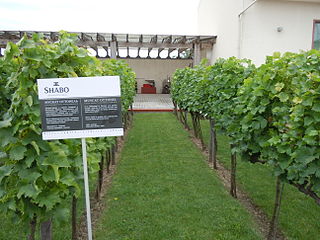
Muscat Ottonel or Muskat-Ottonel is a white wine grape variety that is a member of the Muscat family of Vitis vinifera. It is most notable for its use in dessert wines from Austria, Bulgaria, Romania, Croatia and Serbia as well as dry wines from Alsace and Hungary. In Alsace, the varietal designation Muscat d'Alsace is allowed for the varieties Muscat Ottonel, Muscat blanc à petit grains and Muscat rose à petit grains blended in any combination -or not-, and blends between these are not allowed for most Alsace Grands Crus.

Straw wine, or raisin wine, is a wine made from grapes that have been dried to concentrate their juice. The result is similar to that of the ice wine process, but is a much older process and suitable for warm climates. The technique dates back to pre-Classical times with wines becoming fashionable in Roman times and in late Medieval/Renaissance Europe when wines such as Malmsey and Candia were highly sought after. Traditionally, most production of these wines has been in Greece, the islands off Sicily, Cyprus, Northern Italy and the French Alps. However producers in other areas are now using with the method too.
Venetian wine is produced in Veneto, a highly productive wine region in north-eastern Italy. Veneto wine region is located in north-eastern Italy and it is the 8th largest region of the country. The regions boards Lombardy, Friuli-Venezia Giulia, Emilia-Romagna, and Trentino-Alto Adige/Südtirol.

Piemonte wine is the range of Italian wines made in the region of Piedmont in the northwestern corner of Italy. The best-known wines from the region include Barolo and Barbaresco. They are made from the Nebbiolo grape. These wines are ideal for storage and a well-aged Barolo for instance may leave a feeling of drinking velvet because the tannins are polished and integrated more and more into the wine. As the wine matures the colour becomes more brownish and rust-red.
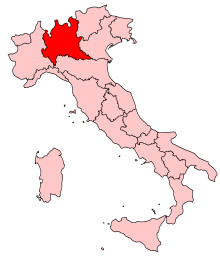
Lombardia (Lombardy) wine is the Italian wine produced in the Lombardy region of north central Italy. The region is known particularly for its sparkling wines made in the Franciacorta and Oltrepò Pavese areas. Lombardy also produces still red, white and rosé wines made from a variety of local and international grapes, including Nebbiolo wines in the Valtellina region and Trebbiano di Lugana white wines produced with the Chiaretto style rosé along the shores of Lake Garda. The wine region currently has 15 Denominazione di origine controllata (DOC), 3 Denominazione di Origine Controllata e Garantita (DOCG) and 13 Indicazione Geografica Tipica (IGT) designations. The main cities of the region are Milan, Bergamo and Brescia. The region annually produces around 1.3 million hectolitres of wine, more than the regions of Friuli-Venezia Giulia, Marche, Trentino-Alto Adige/Südtirol and Umbria.

Moscato Giallo or Yellow Muscat is a white Italian wine grape variety that is a member of the Muscat family of grapes. Known for its large deep cluster of loose, deep-yellow berries and golden colored wine, Moscato Giallo is grown mostly in northern Italy where it is most often used to produce passito style dessert wines. The grape is also planted in Croatia where it is known as Muškat žuti.
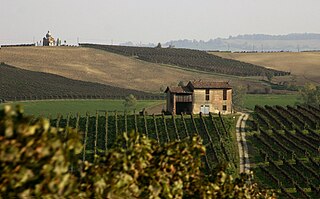
The Colli Piacentini is an Italian wine region located at the western end of Emilia-Romagna. In 1967, it was given the Denominazione di origine controllata (DOC) quality designation. Within its boundaries are several smaller DOCs including Colli Piacentini Gutturnio, Monterosso Val D'Arda DOC, Trebbianino Val Trebbia DOC and Val Nur del Colli Piacentini DOC. The region has a long history of winemaking with fossilized vine roots and grape seeds excavated from the region showing viticulture taking place as early as 2000 BC. In Roman times, Julius Caesar's father-in-law Lucius Calpurnius Piso Caesoninus, grew grapes in the Piacenza hills.

Incrocio Manzoni or Manzoni grapes is a family of grape varieties named after Professor Luigi Manzoni (1888-1968) of Italy's oldest school of oenology located in Conegliano, in the Veneto region. Manzoni created the new grape varieties by selecting, crossing and grafting vines from various vineyards during the 1920s and 1930s. The family includes both white and red grape varieties. Although most Manzonis are grown in northeastern Italy, they are mainly grown in the Piave area of Province of Treviso and are only now starting to be sold commercially in Europe and the United States.
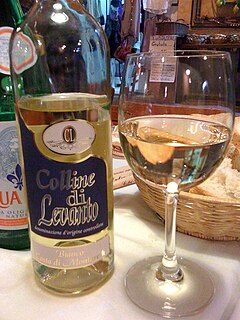
Liguria is an Italian wine region located in the northwest region of Italy along the Italian Riviera. It is bordered by the Piedmont wine region to the north, the Alps and French wine region of Provence to the west, the Apennine Mountains and the Emilia-Romagna wine region to the east with a small border shared with Tuscany in the south-east along the Ligurian sea.
Addoraca is a white Italian wine grape variety that is grown in the Calabria region of southern Italy where it is blended with Coda di Volpe bianca, Malvasia bianca di Candia and Muscat blanc à Petits Grains in the passito dessert wine Moscato di Saracena.
