External links
 | This biographical article related to the military of China is a stub. You can help Wikipedia by expanding it. |
Mu Pai Nai was a Jianzhou Jurchen leader who invaded the north of Joseon, but was defeated by Yi Sun-sin and his army in 1583. Right after his capture, he was executed by Yi Sun-sin.
| | This biographical article related to the military of China is a stub. You can help Wikipedia by expanding it. |

Yi Sun-sin was a Korean admiral and military general famed for his victories against the Japanese navy during the Imjin war in the Joseon Dynasty.

Lee, I, or Yi is the second-most-common surname in Korea, behind Kim (김). As of the South Korean census of 2015, there were 7,306,828 people by this name in South Korea or 14.7% of the population.

The Japanese invasions of Korea, commonly known as the Imjin War, involved two separate yet linked invasions: an initial invasion in 1592, a brief truce in 1596, and a second invasion in 1597. The conflict ended in 1598 with the withdrawal of Japanese forces from the Korean Peninsula after a military stalemate in Korea's southern provinces.
A turtle ship was a type of warship that was used by the Korean Joseon Navy from the early 15th century up until the 19th century. They were used alongside the panokseon warships in the fight against invading Japanese fleets. The ship's name derives from its covering that was said to resemble a turtle shell. Some historians have described it as a very early type of ironclad though the historical evidence for this is uncertain.

In the Battle of Myeongnyang, on October 26, 1597, the Korean Joseon Kingdom's navy, led by Admiral Yi Sun-sin, fought the Japanese navy in the Myeongnyang Strait, near Jindo Island, off the southwest corner of the Korean peninsula.
The Battle of Okpo was a military engagement which took place during the Japanese invasions of Korea (1592–98), also known as the Imjin War. Korean commanders Yi Sun-sin and Won Gyun's fleet destroyed a group of anchored Japanese transport ships. It was the first naval battle of the Imjin War, and the first victory of Admiral Yi against the Japanese naval fleet of Todo Takatora. A day later, after destroying an additional 18 Japanese transport vessels in nearby waters, Yi Sun-sin and Won Gyun parted ways and returned to their home ports after receiving news of the fall of Hanseong. The Battle of Okpo caused anxiety and nervousness among the Japanese, because afterward Yi began to deploy his navy to attack Japanese supply and carrier vessels.
The Joseon naval campaigns of 1592 were naval campaigns conducted by Korean admiral Yi Sun-sin during Japanese invasions of Korea (1592-1598) against the Japanese forces of Toyotomi Hideyoshi. These campaigns made Yi a legendary figure in Korean history on par with, if not surpassing, the great general Eulji Mundeok. The campaigns of Yi were vital in halting the Japanese invasion, which had the ultimate aim of conquering not just Korea, but Ming China as well. Yi was able to severely impair Japanese logistics and reinforcements for the land forces in Korea.

Hou Yi is a mythological Chinese archer. He was also known as Shen Yi and simply as Yi (羿). He is also typically given the title of "Lord Archer". He is sometimes portrayed as a god of archery or a xian descended from heaven to aid mankind. Other times, he is portrayed as either simply half-divine or fully mortal. His wife, Chang'e, is one of the lunar deity.

The Battle of Hansan Island and following engagement at Angolpo took place on 8 July 1592. In two naval encounters, Korean Admiral Yi Sun-sin's fleet managed to destroy roughly 100 Japanese ships and halted Japanese naval operations along the southern coast.
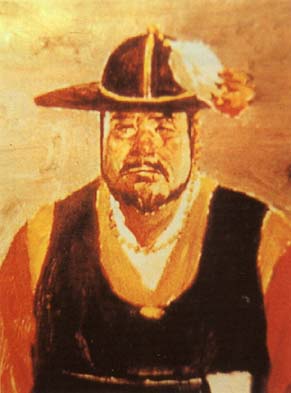
Won Gyun was a Korean general and admiral during the Joseon Dynasty. He is best known for his campaigns against the Japanese during Hideyoshi's invasions of Korea. Won was a member of Wonju Won clan, which was well known for its members' military accomplishments. He was born in 1540 near Pyeongtaek and demonstrated his skill as warrior at a young age. He was qualified as a military officer and was first assigned to the northern border to defend against the Jurchens, who frequently raided Korean villages. Won led many successful campaigns with Yi Il and Yi Sun-sin against the Jurchens. After considerable accomplishments on the northern frontier, he was promoted to admiral in 1592 and sent to the southern coast of Gyeongsang Province to command the province's Western Fleet, along with Yi Sun-sin, who became admiral before Won and took command of Jeolla Province's Eastern Fleet. At the time, Won and Yi were cavalry leaders who had no experience with naval warfare.
Yi Eok-gi was the commander of the Eastern Jeolla Fleet and later came to be the commander of the Western Jeolla Fleet. At age 32, despite being 15 years younger than Supreme Naval Commander Yi Sun-sin, Yi Eok-gi became his most trusted commander and companion during the Seven Year War. Yi Eok-gi was eventually killed in the devastating Battle of Chilcheollyang Strait while assisting Won Gyun, the Naval Commander of the entire Korean navy at that time.
The Battle of Happo was a naval engagement on May 7, 1592, one of the three Joseon naval campaigns of 1592 conducted by Korean admiral Yi Sun-sin during Japanese invasions of Korea (1592-1598) against the Japanese forces of Toyotomi Hideyoshi. These campaigns made Yi a legendary figure in Korean history. The campaigns of Yi were vital in halting the Japanese invasion.
Nanjung ilgi (Korean: 난중일기) or the War Diary of Yi Sun-sin is the personal diary of Admiral Yi Sun-sin, a Korean naval commander who lived during the Joseon Dynasty. It was written between January 1, 1592, and November 17, 1598, a first person narrative of the admiral's perspective on the Japanese invasions of Korea in the late 16th century.


Immortal Admiral Yi Sun-sin is a South Korean television series based on the life of Yi Sun-sin, starring Kim Myung-min in the title role. It aired on KBS1 on Saturdays and Sundays at 21:45 from September 4, 2004 to August 28, 2005 for 104 episodes.

Parliamentary elections were held in North Korea on 25 August 1948 to elect the members of the 1st Supreme People's Assembly. Organised by the People's Committee of North Korea, the elections saw 572 deputies elected, of which 212 were from North Korea and 360 from South Korea.
Parliamentary elections were held in North Korea on 8 October 1962 to elect the members of the 3rd Supreme People's Assembly. Only one candidate was presented in each constituency, all of which were selected by the Workers' Party of Korea, although some ran under the banner of other parties or state organisations to give the illusion of democracy. Voter turnout was reported to be 100%, with all reportedly voting in favour of the candidates presented.

ROKS Chungmugong Yi Sun-sin (DDH-975) is a Chungmugong Yi Sun-sin-class destroyer in the Republic of Korea Navy. She is named after the Joseon Korean admiral Yi Sun-sin with his posthumous name, Chungmugong, literally “Lord of Loyal Valor”.
Kim Takhwan is a South Korean novelist and literary critic. He left the security of a tenured professorship to focus on his writing career.
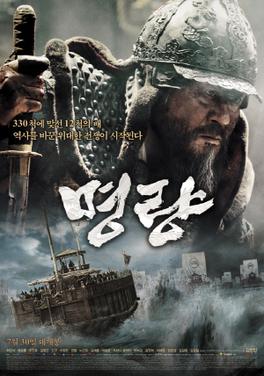
The Admiral: Roaring Currents (Korean: 명량), or simply The Admiral, is a 2014 South Korean epic action-war film directed and co-written by Kim Han-min. Based on the historical Battle of Myeongnyang, it stars an ensemble cast led by Choi Min-sik as the Korean naval commander Yi Sun-sin. The film was released theatrically in South Korea on July 30, 2014.