Sancho Garcés VI, called the Wise was King of Navarre from 1150 until his death in 1194. He was the first monarch to officially drop the title of King of Pamplona in favour of King of Navarre, thus changing the designation of his kingdom. Sancho Garcés was responsible for bringing his kingdom into the political orbit of Europe. He was the eldest son of García Ramírez, the Restorer and Margaret of L'Aigle.

The Battle of Río Salado, also known as the Battle of Tarifa was a battle of the armies of King Afonso IV of Portugal and King Alfonso XI of Castile against those of sultan Abu al-Hasan 'Ali of the Marinid dynasty and Yusuf I of Granada.
This is a timeline of notable events during the period of Muslim presence in Iberia, starting with the Umayyad conquest in the 8th century.
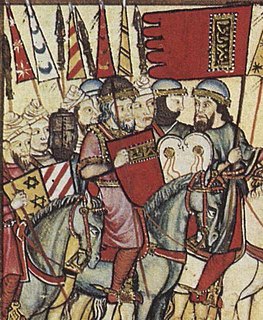
Abu Abdullah Muhammad ibn Yusuf ibn Nasr, also known as Ibn al-Aḥmar and by his epithet al-Ghalib billah, was the first ruler of the Emirate of Granada, the last independent Muslim state on the Iberian Peninsula, and the founder of its ruling Nasrid dynasty. He lived during a time when Iberia's Christian kingdoms—especially Portugal, Castile and Aragon—were expanding at the expense of the Islamic territory in Iberia, called Al-Andalus. Muhammad ibn Yusuf took power in his native Arjona in 1232 when he rebelled against the de facto leader of Al-Andalus, Ibn Hud. During this rebellion, he was able to take control of Córdoba and Seville briefly, before he lost both cities to Ibn Hud. Forced to acknowledge Ibn Hud's suzerainty, Muhammad was able to retain Arjona and Jaén. In 1236, he betrayed Ibn Hud by helping Ferdinand III of Castile take Córdoba. In the years that followed, Muhammad was able to gain control over the southern cities, including Granada (1237), Almería (1238) and Málaga (1239). In 1244, he lost Arjona to Castile. Two years later, in 1246, he agreed to surrender Jaén and accept Ferdinand's overlordship in exchange for peace.
Muhammed II was the second Nasrid ruler of the Emirate of Granada in Al-Andalus on the Iberian Peninsula, succeeding his father Muhammad I. Already experienced in matters of state when he ascended the throne, he continued his father's policy of maintaining independence in the face of Granada's larger neighbours, Castile and Marinid Morocco, and an internal rebellion by his family's former allies, the Banu Ashqilula.
Muhammed III was a son of Muhammed II al-Faqih and the third Nasrid ruler of the Emirate of Granada in Al-Andalus on the Iberian Peninsula. On April 8, 1302 he ascended the Granadan Sultan's throne after the death of his father Muhammed II al-Faqih. During the first few weeks of his reign, Muhammed III negotiated peace treaties with the kingdoms of Castile and Aragon.
Nasr, full name Abu al-Juyush Nasr ibn Muhammad, was a son of Muhammed II al-Faqih and the fourth Nasrid ruler of the Moorish Emirate of Granada in Al-Andalus on the Iberian Peninsula. On March 14, 1309, he ascended the throne after his brother Muhammed III was dethroned in a palace revolution. At his accession, Granada was in a very dangerous three-front war against Castile, Aragon and the Marinid Sultanate, due to his predecessor's disastrous foreign policy. In the first year of his rule he made peace with Granada's three enemies. He lost Ceuta as well as yielded Algeciras and Ronda to the Marinids in exchange for peace in September 1309. Granada lost Gibraltar to a Castilian siege in September, but successfully defended Algeciras until peace was agreed in January 1310.

The Granada War was a series of military campaigns between 1482 and 1491, during the reign of the Catholic Monarchs Isabella I of Castile and Ferdinand II of Aragon, against the Nasrid dynasty's Emirate of Granada. It ended with the defeat of Granada and its annexation by Castile, ending all Islamic rule on the Iberian peninsula.

Muhammed IX (1396–1454) was the fifteenth Nasrid ruler of the Emirate of Granada in Al-Andalus on the Iberian Peninsula. He was likely the father of Aixa.

Abu Yusuf Yaqub ibn Abd al-Haqq was a Marinid ruler of Morocco. He was the fourth son of Marinid founder Abd al-Haqq, and succeeded his brother Abu Yahya in 1258. He died in 1286.

The Battle of Collejares also known as the Battle of los Collejares was a battle of the Spanish Reconquista that took place in 1406 at Collejares nearby the towns of Úbeda and Baeza in Granada, Spain. The battle was fought between the Kingdom of Castile, whose forces were commanded by Henry III of Castile, and the Emirate of Granada, whose troops were commanded by Sultan Muhammad VII.
The Sixth Siege of Gibraltar in 1411 was the only occasion on which control of Gibraltar was contested between two Islamic powers. After the failed Fifth Siege of Gibraltar in 1349–50, which ended with the death of King Alfonso XI of Castile from bubonic plague, the Kingdom of Castile was preoccupied with the Castilian Civil War and its aftermath. In 1369, Sultan Muhammed V of Granada took advantage of the Castilians' distractions and in the Siege of Algeciras (1369) he seized the city of Algeciras, on the west side of the Bay of Gibraltar, which Alfonso XI had captured in 1344. After razing it to the ground he made peace with Henry II, the winner of the civil war. The truce was renewed by Henry's successors John I and Henry III. At some point during the truces, control of Gibraltar was transferred from the Marinid dynasty of Morocco, which had held it since 1333, to the Granadans. It is not clear why this happened; it may have been as a condition of the Granadans assisting the Marinids against rebels in Morocco.

The Battle of Los Alporchones was a battle of the Spanish Reconquista that took place on 17 March 1452. The battle was fought between the troops of the Emirate of Granada and the combined forces of the Kingdom of Castile and its client kingdom, the Kingdom of Murcia. The Moorish army was commanded by Malik ibn al-Abbas and the Castilian troops were commanded by Alonso Fajardo el Bravo, the head of the House of Fajardo and the Alcalde of Lorca Castle. The battle was fought in the area around the city of Lorca and resulted in a victory for the Kingdom of Castile.

Nuño González I de Lara, nicknamed el Bueno, was a Castilian nobleman, royal counsellor and military leader. He was the head of the House of Lara and a close personal friend of Alfonso X. The king's policies often stymied his efforts to increase the power and wealth of his house, and in 1272 he led many prominent noblemen into open rebellion. Restored to favour the next year, he died defending the castle of Écija from a Moroccan invasion.

The forced conversions of Muslims in Spain were enacted through a series of edicts outlawing Islam in the lands of Spain. This effort was overseen by three Spanish monarchies during the early 16th century: the Crown of Castile in 1500–1502, followed by Navarre in 1515–1516, and lastly the Crown of Aragon in 1523–1526.

The Mudéjar revolt of 1264–1266 was a Mudéjar rebellion in the Lower Andalusia and Murcia regions of the Crown of Castile. The rebellion was in response to Castile's policy of relocating Muslim populations from these regions and was partially instigated by Muhammad I of Granada. The rebels were aided by the independent Emirate of Granada, while the Castilians were allied with Aragon. Early in the uprising, the rebels managed to capture Murcia and Jerez, as well as several smaller towns, but were eventually defeated by the royal forces. Subsequently, Castile expelled the Muslim populations of the reconquered territories and encouraged Christians from elsewhere to settle their lands. Granada became a vassal of Castile and paid an annual tribute.

A conquest of Murcia took place in 1265–66 when James I of Aragon conquered the Muslim-held Taifa of Murcia on behalf of his ally Alfonso X of Castile. Previously, Murcia was a semi-independent vassal of Castile, but it renounced its allegiance during the Mudéjar revolt of 1264–1266. Aragon entered the war in Castile's side after Castile's Queen Violant—who was James' daughter—wrote a letter asking for her father's help. After initial negotiations with his nobles, James marched from Valencia at the end of October 1265. Subsequently, Aragonese troops took multiple Murcian towns and defeated a reinforcement column sent by the Emirate of Granada. The siege of the city of Murcia started in January 1266, ending in its surrender on 31 January and James' entrance to the city on 3 February. After the conquest, Murcia was returned to Castile and lost its semi-independent status. Subsequently, its Muslim population was moved to suburbs as Castile brought Christian settlers to populate the region.
The Siege of Almería was an unsuccessful attempt by Aragon to capture the city of Almería from the Emirate of Granada in 1309. The city defenders repelled multiple assaults, and by the end of December James II of Aragon, who personally led the siege, asked for a truce and subsequently withdrew from Granadan territory.