Hyderabad is the capital and largest city of the Indian state of Telangana.

Hyderabad State was a princely state located in the south-central Deccan region of India with its capital at the city of Hyderabad. It is now divided into the present-day state of Telangana, the Kalyana-Karnataka region of Karnataka, and the Marathwada region of Maharashtra in India.
Old City often refers to old town, the historic or original core of a city or town.
Hyderabad District may refer to:
Police Academy may refer to:

The Gentlemen's agreement of Andhra Pradesh was signed between Telangana and Andhra leaders before the formation of the state of Andhra Pradesh of India on 20 February 1956. The agreement provided safeguards with the purpose of preventing discrimination against Telangana by the government of Andhra Pradesh. The violations of this agreement are cited as one of the reasons for formation of separate statehood for Telangana.

Maharaja Sir Kishen Pershad Bahadur Yamin us-Sultanat was an Indian noble who served as Prime Minister of Hyderabad twice.
Nizam of Hyderabad were monarchs of the Hyderabad State (1724–1948).

1969 Telangana Agitation was a political movement for the statehood for Telangana region. The first person to raise the issue of Telangana happened in 1968 during October or November timeframe. A hunger strike was being carried on by a person named Ravindranath on 1969/January/08 in Khammam near the Railway Station. He was on an indefinite fast and his prime demand was to implement Telangana safeguards. One other demand was his insistence on implementation of the Gentleman's agreement. It is a major event in Telangana movement. In the indiscriminate police firing, 369 Telangana students were killed.
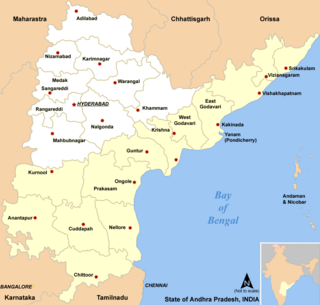
The Pre-2004 Telangana protests refers to the movements and agitations related to the Telangana movement that took place before the year 2004. Andhra state and Telangana was merged to form Andhra Pradesh state on 1 November 1956 after providing safeguards to Telangana in the form of Gentlemen's agreement. Soon after the formation of Andhra Pradesh, people of Telangana expressed dissatisfaction over how the agreements and guarantees were implemented. Protests initially led by students later under the leadership of newly formed political party Telangana Praja Samithi, led by M. Chenna Reddy and Konda Lakshman Bapuji, a minister who resigned from the cabinet led by then Chief Minister Kasu Brahmananda Reddy, demanding the formation of a separate state of Telangana. More than three hundred people died in police firing. Under the Mulki rules in force at the time, anyone who had lived in Hyderabad for 15 years was considered a local, and was thus eligible for certain government posts. When the Supreme Court upheld the Mulki rules at the end of 1972, the Jai Andhra movement, with the aim of re-forming a separate state of Andhra, was started in Coastal Andhra and Rayalaseema regions.
The history of the Telangana movement refers to the political and social conditions under which the Telangana region was merged with Andhra State to form the state of Andhra Pradesh and the subsequent demands to reverse the merger to form a new state of Telangana from united Andhra Pradesh.
Nizam-ul-Mulk may refer to:
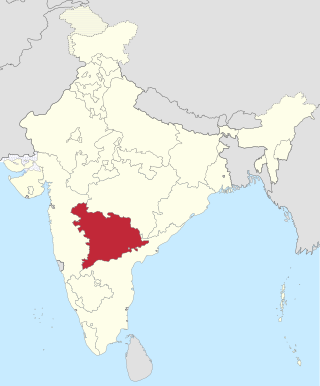
Hyderabad State was a state in Dominion and later Republic of India, formed after the accession of the State of Hyderabad into the Union on 17 September 1948. It existed from 1948 to 1956.
Jai Andhra movement is a 1972 political movement in support for the creation of Andhra state in the light of injustices felt by the people of the Coastal Andhra and Rayalaseema Regions. This was after the Andhra Pradesh High Court and Supreme Court of India upheld the Mulki rules in existence at the time. This disenfranchised a vast majority of the population of the state from obtaining jobs in their own state capital. In ensuing protests and police firing eight people were killed. Prominent leaders from Andhra Pradesh: Tenneti Viswanadham, Raja Sagi Suryanarayana Raju, Gouthu Latchanna, Jupudi Yegnanarayana, N. Srinivasulu Reddy, B. V. Subba Reddy, Kakani Venkataratnam, Vasantha Nageswara Rao, M. Venkaiah Naidu, Nissankararao Ventakaratnam, Chowdary Satyanarayana, prominent student leaders like K.Sreedhar Rao, and Haribabu from Andhra University, M.S. Raju from Andhra Medical College, and many others participated in the agitation. It was a sequel to the 1969 Telangana movement. Over 400 people sacrificed their lives for the movement. One of the main opinions expressed was "Development is seen only in and around Hyderabad and it is time the coastal districts also develop rapidly".
1952 Mulkhi Agitation or Mulkhi Agitation was a political movement for the safeguarding of jobs in Hyderabad State government for native residents, or Mulkis. It was the first event in Telangana Movement. The agitation lasted between July 26 to mid-September, 1952.
A nazim is the coordinator of a city or town in Pakistan.
This page is based on this
Wikipedia article Text is available under the
CC BY-SA 4.0 license; additional terms may apply.
Images, videos and audio are available under their respective licenses.

