A tree automaton is a type of state machine. Tree automata deal with tree structures, rather than the strings of more conventional state machines.

Buffalo Niagara International Airport is in Cheektowaga, New York, United States. The airport serves Buffalo, New York and Niagara Falls, New York in the United States, and the southern Golden Horseshoe region of Ontario, Canada. It is the third-busiest airport in the state of New York and the busiest inside of the Buffalo-Niagara Falls metropolitan area. It is about 11 miles (18 km) east of Downtown Buffalo and 60 miles (97 km) southeast of Toronto. The airport covers 1,000 acres (400 ha).

The Niagara Frontier Transportation Authority (NFTA) is the public agency responsible for operating most public transportation services in the Buffalo–Niagara Falls metropolitan area. The NFTA, as an authority, oversees a number of subsidiaries, including the NFTA Metro bus and rail system, the Buffalo-Niagara International Airport, the Niagara Falls International Airport and NFTA Small Boat Harbor. The NFTA Metro bus and rail system is a multi-modal agency, utilizing various vehicle modes, using the brand names: NFTA Metro Bus, NFTA Metro Rail, NFTA Metrolink and NFTA PAL. In 2023, the system had a ridership of 15,429,900, or about 55,100 per weekday as of the third quarter of 2024.

Buffalo Metro Rail is the public transit rail system in Buffalo, New York, operated by the Niagara Frontier Transportation Authority (NFTA). The system consists of a single, 6.4-mile-long (10.3 km) light rail line that runs for most of the length of Main Street from KeyBank Center in Canalside to the south campus of the University at Buffalo in the northeast corner of the city. The first section of the line opened in October 1984; the current system was completed in November 1986. In 2023, the system had a ridership of 2,433,300, or about 8,000 per weekday as of the third quarter of 2024.

A tourist trolley, also called a road trolley, is a bus designed to resemble an old-style streetcar or tram, usually with false clerestory roof. The vehicles are usually fueled by diesel, or sometimes compressed natural gas.

Niagara Falls International Airport is located 4 mi (6.4 km) east of downtown Niagara Falls, in the Town of Niagara in Niagara County, New York, United States. Owned and operated by the Niagara Frontier Transportation Authority, the airport is a joint civil-military airfield and shares its runways with the Niagara Falls Air Reserve Station. A new terminal building opened in 2009. It is notable for serving vastly more Canadian passengers from over the nearby border than Americans.
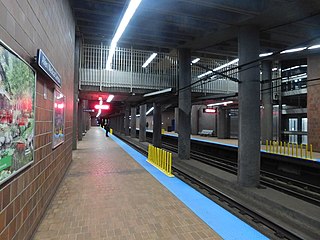
Allen/Medical Campus is a Buffalo Metro Rail station located at the corner of Main and Allen Streets at the northern end of Buffalo, New York's downtown and is the last underground station to the south requiring payment before entering the Free Fare Zone. The station was temporarily closed in 2015 to incorporate a new building at the University at Buffalo School of Medicine and Biomedical Sciences into the station's aboveground entrances.

Summer–Best is a Buffalo Metro Rail station located at the junction of Summer, Best and Main Streets.

LaSalle is a Buffalo Metro Rail underground station located at the corner of Main Street and LaSalle Avenue and is one stop from the northern terminus. Original drafting plans had the station used as a turnout between the current Metro Rail line and three proposed extensions; the Tonawanda Line, which would extend service into the cities of Tonawanda and Niagara Falls; the North Buffalo Line, which would extend service to Elmwood Avenue on an abandoned railroad right-of-way between Hertel and Kenmore Avenues; and the East Buffalo line, to connect the Main Street line with the proposed Airport Line, carrying passengers to the Buffalo-Niagara International Airport. The only visible sign of the turnout is located below ground by way of partially finished tunnel just west of the LaSalle station platforms. From May 20, 1985 to November 10, 1986, due to construction issues at LaSalle station, Amherst Street station served as the northern terminus. Since November 10, 1986, University station serves as the northern terminus.

University is a Buffalo Metro Rail station located near the intersection of Main Street and Niagara Falls Boulevard on the University at Buffalo South Campus. It is a major transfer point between Metro Rail and many city and suburban bus routes and offers a unique "Kiss and Ride" facility on the top level, above the mezzanine. This allows drivers of automobiles a separate area to drop off passengers, so they do not add to the traffic congestion from buses at the station during rush-hour periods and a large park-and-ride facility directly to the east of the station. Since University station serves as a terminal, immediately south is a double crossover. From May 20, 1985, to November 10, 1986, due to construction issues at LaSalle station, Amherst Street station served as the northern terminus. Since November 10, 1986, University station has served as the northern terminus.

Buffalo–Exchange Street station is an Amtrak station in Buffalo, New York. The station serves six Amtrak trains daily: two daily Empire Service round trips between Niagara Falls and New York City and one Maple Leaf round trip between Toronto and New York City. There is also daily Amtrak Thruway bus service at the station, operating between the Buffalo Metropolitan Transportation Center and Jamestown station in Jamestown, New York, via Dunkirk and Fredonia, and serving the communities along the southeast shore of Lake Erie.

Since the Buffalo Metro Rail light rail was proposed in the 1970s, there have been multiple proposals for expanding the system, which is currently a single 6.4-mile (10.3 km) long line. Public officials, agencies and advocacy groups have created plans, with the most recent and extensive being an extension to the town of Amherst. Groups have formed on both sides of the issue.
Alfred H. "Alf" Savage, was a trained gardener, civic manager and transit agency manager in Canada and the United States.

The International Railway Company (IRC) was a transportation company formed in a 1902 merger between several Buffalo-area interurban and street railways. The city railways that merged were the West Side Street Railway, the Crosstown Street Railway and the Buffalo Traction Company. The suburban railroads that merged included the Buffalo & Niagara Electric Street Railway, and its subsidiary the Buffalo, Lockport & Olcott Beach Railway; the Buffalo, Depew & Lancaster Railway; and the Niagara Falls Park & River Railway. Later the IRC acquired the Niagara Gorge Railroad (NGRR) as a subsidiary, which was sold in 1924 to the Niagara Falls Power Company. The NGRR also leased the Lewiston & Youngstown Frontier Railroad.

The Niagara Falls Station and Customhouse Interpretive Center is an intermodal transit complex in Niagara Falls, New York. It serves Amtrak trains and Niagara Frontier Transportation Authority buses, houses U.S. Customs and Border Protection offices servicing the Canada–United States border, and houses the Niagara Falls Underground Railroad Heritage Center.

Lafayette Square is a park in the center of downtown Buffalo, Erie County, New York, United States, that hosts a Civil War monument. The block, which was once square, is lined by many of the city's tallest buildings. The square was named for General Lafayette, who visited Buffalo in 1825.

The Buffalo Metropolitan Transportation Center is located on the southeast corner of North Division and Ellicott Streets in Downtown Buffalo, New York. The transportation center is open 24 hours daily.

Transportation in Buffalo, New York is dominated by automobile use, but other modes of transportation exist in the city.
The Niagara Frontier Transportation Authority operates a fleet of buses and light rail vehicles in the cities of Buffalo and Niagara Falls and the surrounding Erie and Niagara counties. It is the second-largest transit system in New York state after New York City's.
