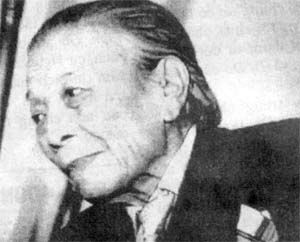
Nguyển Cát Ngạc, pen name Nam Xương (1905-1958) was a popular Vietnamese playwright in the 1930s. He is remembered as the author of the comedy Ổng Tây An Nam (The French Annamite, Monsieur Franco-Annamite) in 1931. [1] This play satirized francophile Vietnamese, [2] [3] through the character of Len, a young Vietnamese completely Frenchified after his studies in France. [4] [5] [6]

The Vietnamese people or the Kinh people, are an ethnic group originating from present-day northern Vietnam. They are the majority ethnic group of Vietnam, comprising 86% of the population at the 1999 census, and are officially known as Kinh to distinguish them from other ethnic groups in Vietnam. The earliest recorded name for the ancient Vietnamese people appears as Lạc.
A playwright or dramatist is a person who writes plays.
In a modern sense, comedy refers to any discourse or work generally intended to be humorous or amusing by inducing laughter, especially in theatre, television, film, stand-up comedy, or any other medium of entertainment. The origins of the term are found in Ancient Greece. In the Athenian democracy, the public opinion of voters was influenced by the political satire performed by the comic poets at the theaters. The theatrical genre of Greek comedy can be described as a dramatic performance which pits two groups or societies against each other in an amusing agon or conflict. Northrop Frye depicted these two opposing sides as a "Society of Youth" and a "Society of the Old." A revised view characterizes the essential agon of comedy as a struggle between a relatively powerless youth and the societal conventions that pose obstacles to his hopes. In this struggle, the youth is understood to be constrained by his lack of social authority, and is left with little choice but to take recourse in ruses which engender very dramatic irony which provokes laughter.
The Thổ ethnic group inhabits the mountainous regions of northern Vietnam, mainly Nghệ An Province southwest of Hanoi. Many Thổ speak the Tho language, which is closely related to Vietnamese. The Thổ population numbered 68,394 in 1999.
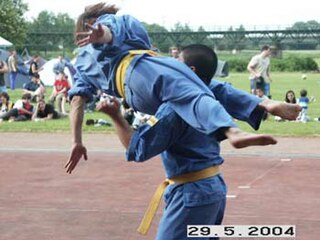
Traditional Vietnamese martial arts can be loosely divided into those of the Sino-Vietnamese descended from the Han, and the Chams or indigenous Vietnamese.
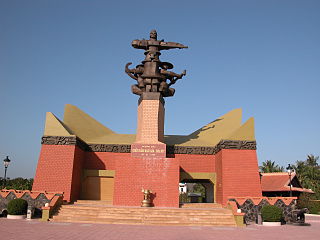
The Battle of Rạch Gầm-Xoài Mút was fought between the Vietnamese Tây Sơn forces and an army of Siam in present-day Tiền Giang Province on January 20, 1785. It is considered one of the greatest victories in Vietnamese history.
Võ Tánh was an 18th-century Vietnamese military commander, best known for his role as a general of Nguyễn Ánh, who unified modern-day Vietnam and ruled as Emperor Gia Long.

Nguyễn Mạnh Tường (1909–1997) was a Vietnamese lawyer and intellectual. He was known to be one of the active participators in the Nhân Văn affair in the mid-1950s which saw many middle class intellectuals demanding freedom and democracy in communist-led North Vietnam. After he criticised the disastrous land reform campaign in 1956, he was stripped of all positions he held in the government and was forced to retire from practicing law.
An Tư, was a princess during the Trần Dynasty (1225–1400), the youngest offspring of emperor Trần Thái Tông. The exact year of her birth and death are unknown. The Đại Việt sử kí toàn thư (1675) only records that “the servants were ordered to give Princess An Tư to Togon to buy time”.
The Anarchy of the 12 Warlords, also the Period of the 12 Warlords, was a period of chaos and civil war in the history of Vietnam, from 966 to 968 during the Ngô Dynasty, due to a conflict of succession after the death of King Ngô Quyền. This period is also sometimes simply called the Twelve Warlords.
Nguồn is a Vietic language spoken by the Nguồn people in the Trường Sơn mountains in Vietnam's North Central Coast region as well as in nearby regions of Laos.
Gia Định Province is former province of South Vietnam surrounding Saigon. It was one of the country's main industrial centers.
Phạm Quỳnh was a monarchist during the late Nguyễn Dynasty and supporter of adhering to traditional Vietnamese customs in the establishment of a constitutional monarchy. He was born near Hanoi, Vietnam.
Political organizations and Armed forces in Vietnam, since 1912 :
Vũ Đình Long was a Vietnamese dramatist noted for the first western style spoken play in Vietnamese - A cup of Poison in 1921.
Vi Huyền Đắc was a Vietnamese playwright.
The Six Provinces of Southern Vietnam is the historical name for a particular region of Southern Vietnam which is referred to in French as Basse-Cochinchine.. The region was politically defined and established after the independence of the Nguyễn dynasty, and lasted from 1832, when Emperor Minh Mạng introduced administrative reforms, to 1867, which culminated in the eight-year French campaign to conquer the Six Provinces.
Hồ Văn Trung was a Vietnamese writer.
Army and warfare made their first appearance in Vietnamese history during the 3rd millennium BC. Throughout thousands of years, wars played a great role in shaping the identity and culture of people inhabited the land which is modern day Vietnam.
Nguyễn Siêu was a warlord of Vietnam during the Period of the 12 Warlords.
Lê Chất, also known as Lê Văn Chất (黎文質), Lê Tông Chất (黎宗質) or Lê Công Chất (黎公質), was a general of Tây Sơn dynasty. Later he became a general of Nguyễn dynasty.