
Tropaeolum, commonly known as nasturtium, is a genus of roughly 80 species of annual and perennial herbaceous flowering plants. It was named by Carl Linnaeus in his book Species Plantarum, and is the only genus in the family Tropaeolaceae. The nasturtiums received their common name because they produce an oil similar to that of watercress.

Watercress or yellowcress is a species of aquatic flowering plant in the cabbage family Brassicaceae.
A spearhead is the sharpened bellend point (head) of a spear, similar to an arrowhead. It is often a separate piece called a projectile point.

Nasturtium is a genus of a small number of plant species in the family Brassicaceae commonly known as watercress or yellowcress. The best known species are the edible Nasturtium officinale and Nasturtium microphyllum. Nasturtium was previously synonymised with Rorippa, but molecular evidence supports its maintenance as a distinct genus more closely related to Cardamine than to Rorippasensu stricto.
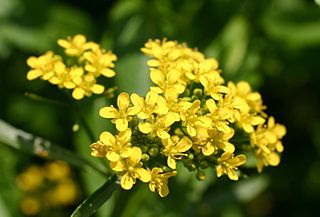
Rorippa is a genus of flowering plants in the family Brassicaceae, native to Europe through central Asia, Africa, and North America. Rorippa species are annual to perennial herbs, usually with yellow flowers and a peppery flavour. They are known commonly as yellowcresses.

Margaret Hannah Olley was an Australian painter. She was the subject of more than ninety solo exhibitions.

Emanuel Phillips Fox was an Australian impressionist painter. After studying at the National Gallery of Victoria Art School in Melbourne, Fox travelled to Paris to study in 1886. He remained in Europe until 1892, when he returned to Melbourne and led what is considered the second phase of the Heidelberg School, an impressionist art movement which had grown in the city during his absence. He spent over a decade in Europe in the early 20th century before finally settling in Melbourne, where he died.

Tropaeolum majus, the garden nasturtium, nasturtium, Indian cress or monks cress, is a species of flowering plant in the family Tropaeolaceae, originating in the Andes from Bolivia north to Colombia. An easily-grown annual or short-lived perennial with disc-shaped leaves and brilliant orange or red flowers, it is of cultivated, probably hybrid origin. It is not closely related to the genus Nasturtium.

Sisymbrium is a genus of plants in the family Brassicaceae.
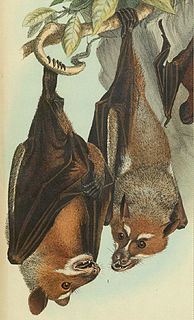
The Wallace's or Sulawesi stripe-faced fruit bat is a species of megabat in the family Pteropodidae. It is endemic to Sulawesi and the nearby Togian Islands of Indonesia. Cave paintings resembling these bats have been found in Australia, where bats of this kind are not otherwise known.
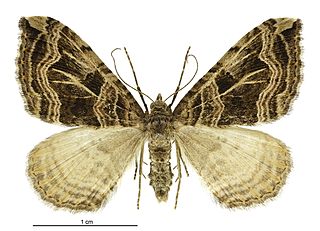
Xanthorhoe semifissata is a moth of the family Geometridae. It is native to New Zealand.

Nasturtiums is an oil painting by the Australian Impressionist painter Emanuel Phillips Fox painted in 1912 during a period of great creativity for the artist in which he produced some of his finest works. It shows a woman, Edith Susan Gerard Anderson, wearing a printed mauve dress, black hat and black gloves, reading in a garden seated in a cane chair against a background of climbing nasturtium leaves and flowers growing up a trellis.

Nasturtium gambellii is a rare species of flowering plant in the mustard family known by the common names Gambel's yellowcress and Gambel's watercress. It is known from three or four scattered occurrences in California. It is also native to central Mexico and Guatemala. Its total U.S. population was last estimated at fewer than 300 individuals. It was federally listed in California, as an endangered species of the United States in 1993.
Yellowcress is a common name for several plants:
Edith Susan Gerard Anderson, who became Edith Susan Boyd when she married, was an Australian artist, dramatist, and painter. She was also known for being a model for the artist Emanuel Phillips Fox, notably in his 1912 painting Nasturtiums.

Arabidella is a genus of flowering plants belonging to the family Brassicaceae.

Kernera is a monotypic genus of flowering plants belonging to the family Brassicaceae. It only contains one species, 'Kernera saxatilis'(L.) Sweet

Senecio tropaeolifolius, which is known as false nasturtium or nasturtium-leaf spearhead is a succulent plant in the family Asteraceae that is native to South Africa.
This page is based on this
Wikipedia article Text is available under the
CC BY-SA 4.0 license; additional terms may apply.
Images, videos and audio are available under their respective licenses.

