Politics of the United Arab Emirates take place in a framework of a federal presidential elective constitutional monarchy. The United Arab Emirates (UAE) is a federation of seven constituent monarchies: the Emirates of Abu Dhabi, Ajman, Dubai, Fujairah, Ras al-Khaimah, Sharjah, and Umm al-Quwain.
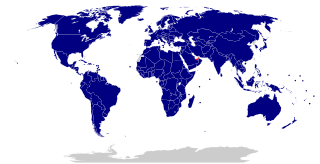
The diplomatic foreign relations of the United Arab Emirates are conducted by the Ministry of Foreign Affairs and International Cooperation.
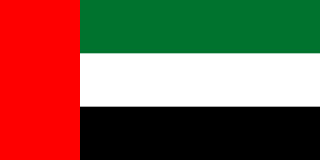
The United Arab Emirates, or simply the Emirates, is a country in Western Asia. It is located at the eastern end of the Arabian Peninsula and shares borders with Oman and Saudi Arabia, while having maritime borders in the Persian Gulf with Qatar and Iran. Abu Dhabi is the nation's capital, while Dubai, the most populous city, is an international hub.
Federal Council may refer to:
National Council may refer to:

Sheikh Khalifa bin Zayed bin Sultan Al Nahyan was the second president of the United Arab Emirates and the ruler of Abu Dhabi, serving from November 2004 until his death in May 2022.

Islam is the official religion of the United Arab Emirates.
Supreme Council may refer to:

The Federal National Council (FNC) of the United Arab Emirates (UAE) is an advisory quasi-parliamentary body in the UAE. The FNC consists of 40 members. Twenty of the members are indirectly elected by the hand-picked 12% of Emirati citizens who have voting rights through an electoral college, while the other twenty are appointed by the rulers of each emirate. According to Reuters, "the process of selecting the people who can either elect or be elected is opaque."
According to Human Rights Watch, there is substantial discrimination against women in the United Arab Emirates. The status of women has improved over the years. UAE performs better on metrics of gender equality than many other states in the Gulf region, and it has been making reforms to protect women's rights and empower women in different sectors. However, the Human Rights Watch (HRW) released a report in 2021 confirming that the UAE needs to put more effort into improving women's status in the UAE and achieving progress on women's rights. It is estimated that in 2020, 3 million of the total UAE population – 9.9 million – is female.
The following outline is provided as an overview of and topical guide to the United Arab Emirates:
Following its independence from British occupation in 1971, the United Arab Emirates’ mass media landscape had already started some of its media sectors and continued to develop steadily. Since then, much of the UAE's media outlets fall under government-owned umbrella groups as well as regulation by the National Media Council and its extensions. The major types of UAE media are print press, radio, television, internet and social media.

Abu Dhabi is the capital and the second-most populous city of the United Arab Emirates. It is also the capital of the Emirate of Abu Dhabi and the centre of the Abu Dhabi Metropolitan Area.
Islam is both the official and majority religion in the United Arab Emirates, observed by approximately 76% of the population. The Al Nahyan and Al Maktoum ruling families adhere to Sunni Islam of Maliki school of jurisprudence. Many followers of the Hanbali school of Sunni Islam are found in Sharjah, Umm al-Quwain, Ras al-Khaimah and Ajman. Their followers include the Al Qasimi ruling family. Other religions represented in the country including Christianity, Hinduism, Buddhism, Judaism and Sikhism are practiced by non-nationals.
Most expatriates in the United Arab Emirates reside in Dubai and Abu Dhabi, UAE. A number of immigrants settled in the country prior to independence. The UAE is home to over 192 nationalities. Emiratis constitute roughly 20% of the total population, making UAE home to one of the world's highest percentage of expatriates. Indians and Pakistanis form the largest expatriate groups in the country, constituting 28% and 12% of the total population respectively. Around 471,000 Westerners live in the United Arab Emirates, making up 5.1% of its total population.

Visitors to the United Arab Emirates must obtain a visa prior to travel unless they come from one of the visa exempt countries or one of the countries whose citizens are eligible for visa on arrival.

The Group of Friends of the Syrian People is an international diplomatic collective of countries and bodies convening periodically on the topic of Syria outside the U.N. Security Council. The collective was created in response to a Russian and Chinese veto on a Security Council resolution condemning Syria.
The United Arab Emirates Space Agency (UAESA) is the space agency of the United Arab Emirates government responsible for the development of the country's space industry. It was created in 2014 and is responsible for developing and regulating the space sector in the UAE.

The Government of Dubai is the subnational authority that governs the Emirate of Dubai, one of the seven constituent monarchies which make up the United Arab Emirates. The executive authority and head of the government is the Ruler of Dubai, Sheikh Mohammed bin Rashid Al Maktoum. The Ruler of Dubai appoints the Dubai Executive Council, which is led by the Crown prince of Dubai and is responsible for the day-to-day management of Dubai Government agencies such as the Dubai Municipality and numerous other governing entities.

Polish-Emirati relations are foreign relations between the Republic of Poland and the United Arab Emirates. Poland has an embassy in Abu Dhabi, and the United Arab Emirates has its counterpart in Warsaw.
This page is based on this
Wikipedia article Text is available under the
CC BY-SA 4.0 license; additional terms may apply.
Images, videos and audio are available under their respective licenses.
