The National Institute of Standards and Technology (NIST) is a physical sciences laboratory, and a non-regulatory agency of the United States Department of Commerce. Its mission is to promote innovation and industrial competitiveness. NIST's activities are organized into laboratory programs that include nanoscale science and technology, engineering, information technology, neutron research, material measurement, and physical measurement. It was formerly known as the National Bureau of Standards.

Los Alamos National Laboratory is a United States Department of Energy national laboratory initially organized during World War II for the design of nuclear weapons as part of the Manhattan Project. It is located a short distance northwest of Santa Fe, New Mexico in the southwestern US.
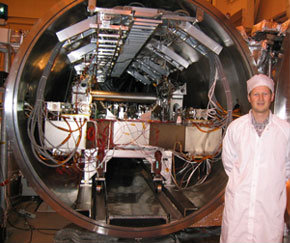
Metrology is the science of measurement. It establishes a common understanding of units, crucial in linking human activities. Modern metrology has its roots in the French Revolution's political motivation to standardise units in France, when a length standard taken from a natural source was proposed. This led to the creation of the decimal-based metric system in 1795, establishing a set of standards for other types of measurements. Several other countries adopted the metric system between 1795 and 1875; to ensure conformity between the countries, the Bureau International des Poids et Mesures (BIPM) was established by the Metre Convention. This has evolved into the International System of Units (SI) as a result of a resolution at the 11th Conference Generale des Poids et Mesures (CGPM) in 1960.

Edwin Mattison McMillan was an American physicist and Nobel laureate credited with being the first-ever to produce a transuranium element, neptunium. For this, he shared the Nobel Prize in Chemistry with Glenn Seaborg in 1951.

The Time from NPL is a radio signal broadcast from the Anthorn Radio Station near Anthorn, Cumbria, which serves as the United Kingdom's national time reference. The time signal is derived from three atomic clocks installed at the transmitter site, and is based on time standards maintained by the UK's National Physical Laboratory (NPL) in Teddington. The service is provided by Babcock International, under contract to the NPL. It was funded by the former Department for Business, Innovation and Skills; as of 2017 NPL Management Limited (NPLML) was owned by the Department for Business, Energy and Industrial Strategy (BEIS), and NPL operated as a public corporation.

The National Physical Laboratory (NPL) is the national measurement standards laboratory for the United Kingdom, based at Bushy Park in Teddington, London, England. It comes under the management of the Department for Business, Energy and Industrial Strategy.
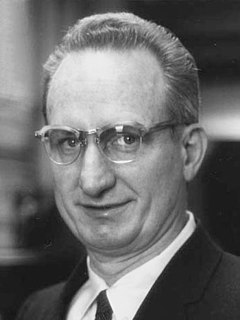
Leo James Rainwater was an American physicist who shared the Nobel Prize in Physics in 1975 for his part in determining the asymmetrical shapes of certain atomic nuclei.

The United States Naval Research Laboratory (NRL) is the corporate research laboratory for the United States Navy and the United States Marine Corps. It conducts basic scientific research, applied research, technological development and prototyping. The laboratory's specialties include plasma physics, space physics, materials science, and tactical electronic warfare. NRL is one of the first US government scientific R&D laboratories, having opened in 1923 at the instigation of Thomas Edison, and is currently under the Office of Naval Research. NRL’s research expenditures are approximately $1 billion per year.
Physical Review is an American peer-reviewed scientific journal established in 1893 by Edward Nichols. It publishes original research as well as scientific and literature reviews on all aspects of physics. It is published by the American Physical Society (APS). The journal is in its third series, and is split in several sub-journals each covering a particular field of physics. It has a sister journal, Physical Review Letters, which publishes shorter articles of broader interest.
The Greek education system is mainly divided into three levels: primary, secondary and tertiary, with an additional post-secondary level providing adult vocational training. Primary education is divided into kindergarten preschool lasting one or two years, and primary school spanning six years. Secondary education comprises two stages: the compulsory lower secondary education has a 3-year Gymnasio school, after which students can attend upper secondary education has a 3-year Lykeion school. Higher Education (tertiary) is provided by Universities and specialist Academies which primarily cater for the military. Undergraduate university programs typically last 4 years. The postgraduate last 1 to 2 years for Master's degree level and 3 to 6 years for Doctorate's degree level. All levels are overseen by the Ministry of Education, Research and Religious Affairs. The Ministry exercises centralized control over state schools, by prescribing the curriculum, appointing staff and controlling funding. Private schools also fall under the mandate of the Ministry, which exercises supervisory control over them. At a regional level, the supervisory role of the Ministry is exercised through Regional Directorates of Primary and Secondary Education, and Directorates of Primary and Secondary Education operate in every Prefecture. Tertiary institutions are nominally autonomous, but the Ministry is responsible for their funding, and the distribution of students to undergraduate courses. Currently, the Greek government only recognizes the degree programs offered by the state-run universities although there are several private universities and colleges offering degree programs that are validated and overseen by American, British and other European universities. The Greek government is pressured to recognize these overseas programs.

The University of Science and Technology of China (USTC) is a national research university in Hefei, Anhui, China, under the direct leadership of the Chinese Academy of Sciences (CAS). It is a member of the C9 League, China's equivalent of the Ivy League. It is also a Chinese Ministry of Education Class A Double First Class University. Founded in Beijing by the CAS in September 1958, it was moved to Hefei in the beginning of 1970 during the Cultural Revolution.

The United States Department of Energy National Laboratories and Technology Centers are a system of facilities and laboratories overseen by the United States Department of Energy (DOE) for the purpose of advancing science and technology to fulfill the DOE mission. Sixteen of the seventeen DOE national laboratories are federally funded research and development centers administered, managed, operated and staffed by private-sector organizations under management and operating (M&O) contract with DOE.

Raymond "Ray" Davis Jr. was an American chemist and physicist. He is best known as the leader of the Homestake experiment in the 1960s-1980s, which was the first experiment to detect neutrinos emitted from the Sun; for this he shared the 2002 Nobel Prize in Physics.

The Earth System Research Laboratory (ESRL) is a laboratory in National Oceanic and Atmospheric Administration's (NOAA) Office of Oceanic and Atmospheric Research (OAR). It is one of seven NOAA Research Laboratories (RLs) and is located in Boulder, Colorado.

The Physical Research Laboratory (PRL) is a National Research Institute for space and allied sciences, supported mainly by Department of Space, Government of India. This research laboratory has ongoing research programmes in astronomy and astrophysics, atmospheric sciences and aeronomy, Earth sciences, Solar System studies and theoretical physics. It manages the Udaipur Solar Observatory and is located in Ahmedabad.

Bushy House is a Grade II* listed former royal residence of William IV and then of the dowager queen Adelaide his former queen consort in Teddington, London, which George Montagu, 1st Earl of Halifax had constructed for his own enjoyment on the site of a previous house Upper Lodge, Bushy Park, between 1714 and 1715.

The Admiralty Research Laboratory (ARL) was a research laboratory that supported the work of the UK Admiralty in Teddington, London, England from 1921 to 1977.
The Office of Science is a component of the United States Department of Energy (DOE). The Office of Science is the lead federal agency supporting fundamental scientific research for energy and the Nation’s largest supporter of basic research in the physical sciences. The Office of Science portfolio has two principal thrusts: direct support of scientific research and direct support of the development, construction, and operation of unique, open-access scientific user facilities that are made available for use by external researchers.
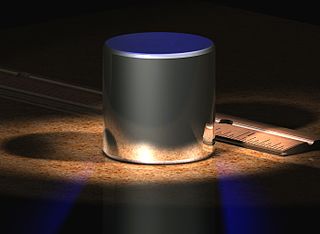
In metrology, a standard is an object, system, or experiment that bears a defined relationship to a unit of measurement of a physical quantity. Standards are the fundamental reference for a system of weights and measures, against which all other measuring devices are compared. Historical standards for length, volume, and mass were defined by many different authorities, which resulted in confusion and inaccuracy of measurements. Modern measurements are defined in relationship to internationally standardized reference objects, which are used under carefully controlled laboratory conditions to define the units of length, mass, electrical potential, and other physical quantities.
The NPL Network or NPL Data Communications Network was a local area computer network operated by a team from the National Physical Laboratory in Teddington outside London that pioneered the concept of packet switching. Following a pilot experiment during 1967, elements of the first version of the network, Mark I, became operational during 1969 then fully operational in 1970, and the Mark II version operated from 1973 until 1986. The NPL network, followed by the wide area ARPANET in the United States, were the first two computer networks that implemented packet switching, and were interconnected in the early 1970s. The NPL network was designed and directed by Donald Davies.
