
The Imperial General Headquarters was part of the Supreme War Council and was established in 1893 to coordinate efforts between the Imperial Japanese Army and Imperial Japanese Navy during wartime. In terms of function, it was approximately equivalent to the United States Joint Chiefs of Staff and the British Chiefs of Staff Committee.

Mitsumasa Yonai was a Japanese navy officer and politician. He served as admiral in the Imperial Japanese Navy, Minister of the Navy, and Prime Minister of Japan in 1940.

Kuniaki Koiso was a Japanese politician, military leader and convicted war criminal who served as prime minister of Japan from 1944 to 1945 during World War II. He previously served as governor-general of Korea from 1942 to 1944.

Soemu Toyoda was an admiral in the Imperial Japanese Navy in World War II.
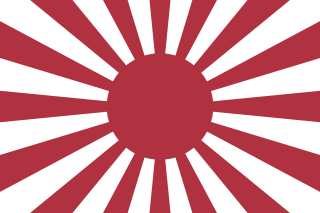
The Imperial Japanese Army (IJA) was the principal ground force of the Empire of Japan. Forming one of the military branches of the Imperial Japanese Armed Forces (IJAF), it was controlled by the Imperial Japanese Army General Staff Office and the Army Ministry, both of which were nominally subordinate to the Emperor of Japan, the supreme commander of IJAF. During the 20th century, an Inspectorate General of Aviation became the third agency with oversight of the IJA. At its height, the IJA was one of the most influential factions in the politics of Japan and was one of the most powerful armies in the world.
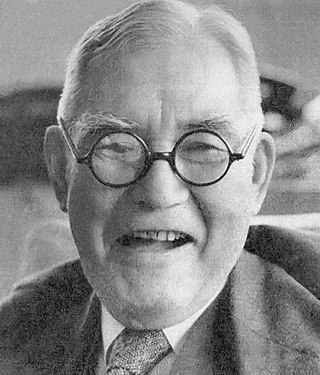
Kichisaburō Nomura was an admiral in the Imperial Japanese Navy and was the ambassador to the United States at the time of the attack on Pearl Harbor.
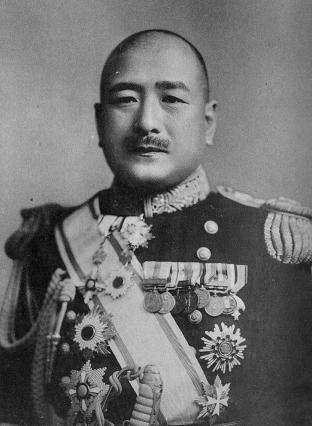
Shigetarō Shimada was an admiral in the Imperial Japanese Navy during World War II. He also served as Minister of the Navy. He was convicted of war crimes and sentenced to life imprisonment.
The Supreme War Council was established during the development of representative government in Meiji period Japan to further strengthen the authority of the state. Its first leader was Yamagata Aritomo (1838–1922), a Chōshū native who has been credited with the founding of the modern Imperial Japanese Army and was the first constitutional Prime Minister of Japan. The Supreme War Council developed a German-style general staff system with a chief of staff who had direct access to the Emperor and who could operate independently of the army minister and civilian officials. The Supreme War Council was the de facto inner cabinet of Japan prior to the Second Sino-Japanese War.

The Navy Ministry was a cabinet-level ministry in the Empire of Japan charged with the administrative affairs of the Imperial Japanese Navy (IJN). It existed from 1872 to 1945.

The Army Ministry, also known as the Ministry of War, was the cabinet-level ministry in the Empire of Japan charged with the administrative affairs of the Imperial Japanese Army (IJA). It existed from 1872 to 1945.

The Imperial Japanese Navy General Staff was the highest organ within the Imperial Japanese Navy. In charge of planning and operations, it was headed by an Admiral headquartered in Tokyo.

The surrender of the Empire of Japan in World War II was announced by Emperor Hirohito on 15 August and formally signed on 2 September 1945, bringing the war's hostilities to a close. By the end of July 1945, the Imperial Japanese Navy (IJN) had become incapable of conducting major operations and an Allied invasion of Japan was imminent. Together with the United Kingdom and China, the United States called for the unconditional surrender of the Japanese armed forces in the Potsdam Declaration on 26 July 1945—the alternative being "prompt and utter destruction". While publicly stating their intent to fight on to the bitter end, Japan's leaders were privately making entreaties to the publicly neutral Soviet Union to mediate peace on terms more favorable to the Japanese. While maintaining a sufficient level of diplomatic engagement with the Japanese to give them the impression they might be willing to mediate, the Soviets were covertly preparing to attack Japanese forces in Manchuria and Korea in fulfillment of promises they had secretly made to the United States and the United Kingdom at the Tehran and Yalta Conferences.

Kenkichi Ueda was a general in the Imperial Japanese Army during the Second Sino-Japanese War. He played an active role in the Soviet-Japanese Border Wars of the late 1930s.

The Imperial Japanese Army General Staff Office, also called the Army General Staff, was one of the two principal agencies charged with overseeing the Imperial Japanese Army.

Koshirō Oikawa was an admiral in the Imperial Japanese Navy and Naval Minister during World War II.

The Japanese occupation of Kiska took place between 6 June 1942 and 28 July 1943 during the Aleutian Islands campaign of the American Theater and the Pacific Theater of World War II. The Japanese occupied Kiska and nearby Attu Island in order to protect the northern flank of the Japanese Empire.

Admiral Shirō Takasu was a career naval officer in the Imperial Japanese Navy during World War II.

Hideki Tojo was a Japanese politician, military leader and convicted war criminal who served as prime minister of Japan and president of the Imperial Rule Assistance Association from 1941 to 1944 during World War II. He assumed several more positions including chief of staff of the Imperial Army before ultimately being removed from power in July 1944. During his years in power, his leadership was marked by extreme state-perpetrated violence in the name of Japanese ultranationalism, much of which he was personally involved in.
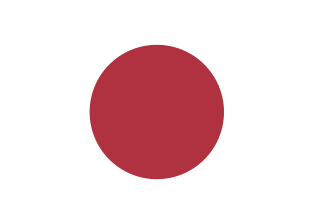
The Imperial Japanese Armed Forces (IJAF) were the unified forces of the Empire of Japan. Formed during the Meiji Restoration in 1868, they were disbanded in 1945, shortly after Japan's defeat to the Allies of World War II; the revised Constitution of Japan, drafted during the Allied occupation of Japan, replaced the IJAF with the present-day Japan Self-Defense Forces.

Ken Terajima was a Japanese Vice Admiral and politician. He was also known for serving as the Minister of Communications from 18 October 1941 to 8 October 1943, and Minister of Railways from 18 October 1941 to 2 December 1941, in the Tōjō Cabinet.
This page is based on this
Wikipedia article Text is available under the
CC BY-SA 4.0 license; additional terms may apply.
Images, videos and audio are available under their respective licenses.
