
Alexander is a male name of Greek origin. The most prominent bearer of the name is Alexander the Great, the king of the Ancient Greek kingdom of Macedonia who created one of the largest empires in ancient history.
Alexandra is a female given name of Greek origin. It is the first attested form of its variants, including Alexander. Etymologically, the name is a compound of the Greek verb ἀλέξειν and ἀνήρ. Thus it may be roughly translated as "defender of man" or "protector of man". The name Alexandra was one of the epithets given to the Greek goddess Hera and as such is usually taken to mean "one who comes to save warriors". The earliest attested form of the name is the Mycenaean Greek 𐀀𐀩𐀏𐀭𐀅𐀨, written in the Linear B syllabic script. Alexandra and its masculine equivalent, Alexander, are both common names in Greece as well as countries where Germanic, Romance, and Slavic languages are spoken.
October 7 is the 280th day of the year in the Gregorian calendar; 85 days remain until the end of the year.
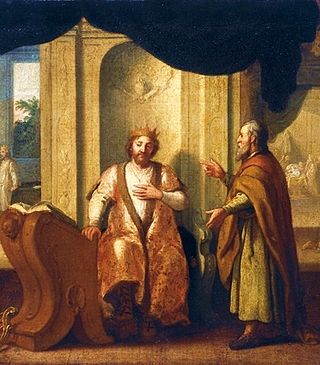
Nathan is a masculine given name. It is derived from the Hebrew verb נָתָן meaning gave.

Elias is the hellenized version for the name of Elijah, a prophet in the Northern Kingdom of Israel in the 9th century BC, mentioned in several holy books. Due to Elias' role in the scriptures and to many later associated traditions, the name is used as a personal name in numerous languages.

Nicholas is a male name, the Anglophone version of an ancient Greek name in use since antiquity, and cognate with the modern Greek Νικόλαος, Nikolaos. It originally derived from a combination of two Greek words meaning 'victory' and 'people'. In turn, the name means "victory of the people."
Kristina is a feminine given name and a regional variant of Christine. Notable people and characters with the name include:
Nick is a masculine given name. It is also often encountered as a short form (hypocorism) of the given names Nicholas, Nicola, Nicolas, Nikola, Nicolai or Nicodemus. It may refer to:
Andreas is a name usually given to males in Armenia, Austria, Cyprus, Denmark, Eritrea, Estonia, Ethiopia, Finland, Flanders, Germany, Greece, Indonesia, the Netherlands, Norway, Romania, Sweden and Switzerland. The name derives from the Greek noun ἀνήρ anēr, with genitive ἀνδρός andros, which means "man". See the article on Andrew for more information. The Scandinavian name is earliest attested as antreos in a runestone from the 12th century.
Nik is a male nickname/moniker derived from the Ancient Greek word νίκη (nike), meaning 'victory'. Not to be confused with Nick or Nike, nor scuffing or scratching.

Aaron is an English masculine given name. The 'h' phoneme in the original Hebrew pronunciation "Aharon" (אהרן) is dropped in the Greek, Ἀαρών, from which the English form, Aaron, is derived.

Hannah spelled ', Hanna, Hana', Hanah, or Chana, is a feminine given name of Hebrew origin. It is derived from the root ḥ-n-n, meaning "favour" or "grace". A Dictionary of First Names attributes the name to a word meaning 'He (God) has favoured me with a child'. Anne, Ana, Ann, and other variants of the name derive from the Hellenized Hebrew: Anna (Ἅννα)
The name Kai has various origins and meanings in different cultures:

Tyler is a given name that is gender-neutral but predominantly male, as well as a surname.
The given name Logan is derived from the Scottish surname Logan, which is in turn derived from a place name. The likely origin of this surname is a place located near Auchinleck, in Ayrshire. The place name is derived from the Scottish Gaelic lagan, which is a diminutive of lag, which in turn means "hollow". The given name is borne by males and females.
Riley is a transferred use of an English surname derived from Old English ryge ‘rye’ + lēah ‘wood’, ‘clearing’.

Noah is an English masculine given name derived from the Biblical figure Noah (נחַ) in Hebrew. It is most likely of Hebrew in origin from the root word "nuach”/“nuakh”, meaning rest. Another explanation says that it is derived from the Hebrew root word Nahum meaning "to comfort" with the final consonant dropped.
Kyle is an English-language given name, derived from the Scottish Gaelic surname Kyle, which is itself from a region in Ayrshire.
Jakob is a masculine given name that is a variant spelling of the Hebrew given name Jacob.
