Related Research Articles
The history of Chinese literature extends thousands of years, from the earliest recorded dynastic court archives to the mature vernacular fiction novels that arose during the Ming dynasty to entertain the masses of literate Chinese. The introduction of widespread woodblock printing during the Tang dynasty (618–907) and the invention of movable type printing by Bi Sheng (990–1051) during the Song dynasty (960–1279) rapidly spread written knowledge throughout China. In more modern times, the author Lu Xun (1881–1936) is considered the founder of baihua literature in China.

Han Yu, courtesy name Tuizhi, was a Chinese historian, poet, and government official of the Tang dynasty who significantly influenced the development of Neo-Confucianism. Described as "comparable in stature to Dante, Shakespeare or Goethe" for his influence on the Chinese literary tradition, Han Yu stood for strong central authority in politics and orthodoxy in cultural matters.

Cao Yu was a Chinese playwright, often regarded as China's most important of the 20th century. His best-known works are Thunderstorm (1933), Sunrise (1936) and Peking Man (1940). It is largely through the efforts of Cao Yu that the modern Chinese "spoken theater" took root in 20th-century Chinese literature.
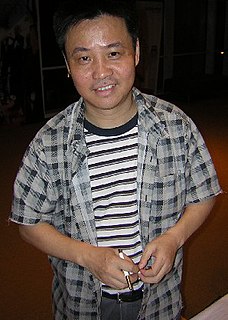
Yu Hua is a Chinese author, born April 3, 1960 in Hangzhou, Zhejiang province. Shortly after his debut as a fiction writer in 1983, Yu Hua was regarded as a promising avant-garde or post-New Wave writer. Many critics also regard him as a champion for Chinese meta-fictional or postmodernist writing. When his writing style changed towards a more “psychologized” narrative in the 1990s and experimented with more chaotic themes like in Brothers, Yu Hua received strong criticism from critics and readers.
Ronny Yu Yan-Tai is a Hong Kong film director, producer, and movie writer. He has worked on both Hong Kong and American films. He is mostly known for his work in the American horror genre, such as Bride of Chucky (1998) and Freddy vs. Jason (2003).

Yu Dafu was a modern Chinese short story writer and poet. He died in Japanese-occupied Dutch East Indies, likely executed.
Chiung Yao or Qiong Yao is the pen name of Chen Che, a Taiwanese writer and producer who is often regarded as the most popular romance novelist in the Chinese-speaking world. Her novels have been adapted into more than 100 films and TV dramas.

Dengzhou, formerly Deng County, is a city in Nanyang, Henan, China. It has an area of 2,294 km2 (886 sq mi) and a population of 1,500,000. The urban area is 35 km², and the urban population is 300,000. The city is located in the southwest of Henan province, adjacent to the borders between Henan, Hubei and Shaanxi. It geometrically lies in the center of the triangle of Zhengzhou, Wuhan and Xi'an, with equal distance to any of these three cities.
Lecture Room is a Chinese television programme hosted by China Central Television (CCTV), in which scholars from various disciplines are invited to provide lectures. It was first broadcast on 9 July 2001 on CCTV-10. In its early days, featured topics included biology, physics, economics, history and literature, and the lecturers were from around the world. Its focus has gradually changed, as recent programmes focus more on Chinese history and Chinese culture.

Qin Hui is a Chinese historian and public intellectual. He previously held the position of Professor of History, Institute of Humanities and Social Sciences, Tsinghua University, Beijing. He is now an Adjunct Professor in the Department of Government and Public Administration, the Chinese University of Hong Kong.

The Han River is a river in southeast China. It is located mainly in eastern Guangdong province and has a total length of 410 kilometres (250 mi). The river is combined with two main tributary rivers, Mei River and Ting River, at Sanheba (三河坝), Dabu County. Han River flows south through the Han River Delta entering the South China Sea at Chenghai District and Longhu District of Shantou. The Teochew people refer to the river as "the Mother River".
You is the pinyin romanization of several Chinese family names including 尤 Yóu, 游 Yóu, 犹 Yóu, 由 Yóu, 右 Yòu, 幽 Yōu, etc. Among these names, 尤 Yóu and 游 Yóu are relatively common. 尤 Yóu is the 19th surname in Hundred Family Surnames.

Yu Jie, is a Chinese-American writer and Calvinist democracy activist. The bestselling author of more than 30 books, Yu was described by the New York Review of Books in 2012 as "one of China's most prominent essayists and critics".

Yu Kwang-chung was a Taiwanese writer, poet, educator and critic.
Yu Xiaohui is a Chinese novelist. Yu is a member of the Chinese Communist Party and China Writers Association. She shared the Mao Dun Literature Prize with her husband Sun Li in 1991.
Yu Zheng is a Chinese screenwriter and producer who is noted for Palace, which earned him a Best Screenwriter award at the 16th Asian Television Awards.
Yu is the 82nd surname mentioned in the Hundred Family Surnames. According to the 2006 census of People's Republic of China, it ranks 38th nationally. In 2019 it was the 41st most common surname in Mainland China. The name is transliterated as Vuu in Vietnamese but is very rare in Vietnam.
The Ghost Bride is a 2020 Taiwanese-Malaysian Netflix original series co-directed by Malaysian directors Quek Shio-chuan and Ho Yu-hang. It is based on the novel The Ghost Bride written by Malaysian writer Yangsze Choo, and stars Huang Pei-jia, Wu Kang-jen, Ludi Lin, and Kuang Tian.
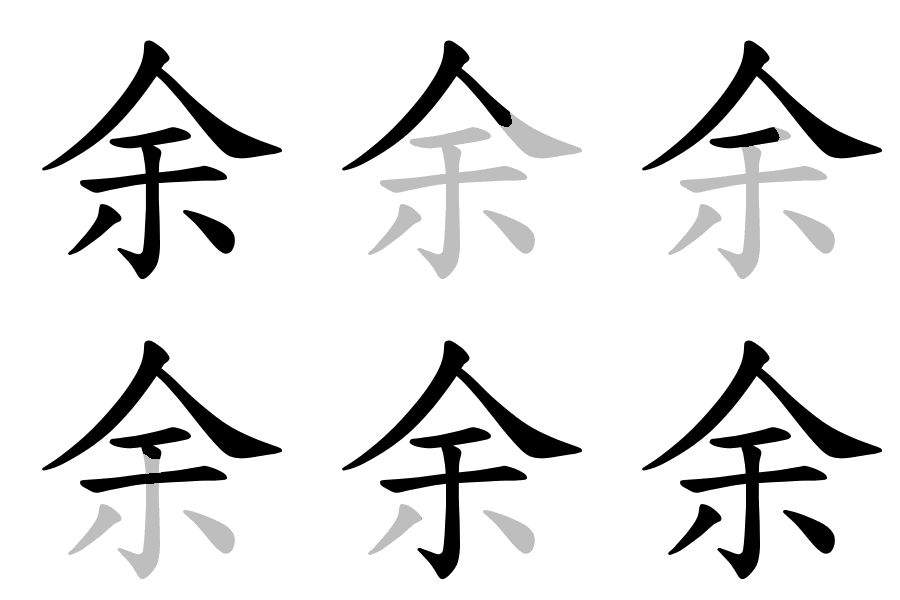
Yu is one of the Chinese family names. It is listed as the 90th surname in the "Hundred Family Surnames". It is also sometimes translated to Yee, the Taishanese spelling, in English. The name is transliterated as Dư in Vietnamese but is very rare in Vietnam. In Indonesia, it is transliterated as Oe In 2019 it was the 40th most common surname in Mainland China.
References
Encyclopædia Britannica 2005 Ultimate Reference Suite DVD, article "Yü Ta-fu"
 | This China-related article is a stub. You can help Wikipedia by expanding it. |
 | This article about a biographical book on writers or poets is a stub. You can help Wikipedia by expanding it. |