
The Oberkommando des Heeres was the high command of the Army of Nazi Germany. It was founded in 1935 as part of Adolf Hitler's rearmament of Germany. OKH was de facto the most important unit within the German war planning until the defeat at Moscow in December 1941.

In computer network communications, the HTTP 404, 404 not found, 404, 404 error, page not found, or file not found error message is a hypertext transfer protocol (HTTP) standard response code, to indicate that the browser was able to communicate with a given server, but the server could not find what was requested. The error may also be used when a server does not wish to disclose whether it has the requested information.

The Oberkommando der Wehrmacht was the supreme military command and control office of Nazi Germany during World War II. Created in 1938, the OKW replaced the Reich Ministry of War and had oversight over the individual high commands of the country's armed forces: the army, navy, and air force.
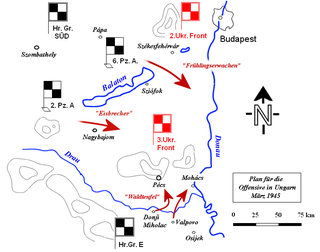
Operation Spring Awakening was the last major German offensive of World War II. The operation was referred to in Germany as the Plattensee offensive and in the Soviet Union as the Balaton defensive operation. It took place in Western Hungary on the Eastern Front and lasted from 6 March until 15 March, 1945. The objective was to secure the last significant oil reserves still available to the European Axis powers and prevent the Red Army from advancing towards Vienna. The Germans failed in their objectives.

"Karl-Gerät" (040/041), also known as Mörser Karl, was a World War II German self-propelled siege mortar (Mörser) designed and built by Rheinmetall. Its heaviest munition was a 60 cm (24 in) diameter, 2,170 kg (4,780 lb) shell, and the range for its lightest shell of 1,250 kg (2,760 lb) was just over 10 km (6.2 mi). Each gun had to be accompanied by a crane, a two-piece heavy transport set of railcars, and several modified tanks to carry shells.
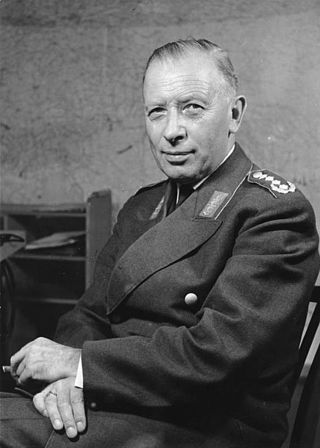
Adolf Bruno Heinrich Ernst Heusinger was a German military officer whose career spanned the German Empire, the Weimar Republic, Nazi Germany and West Germany. He joined the German Army as a volunteer in 1915 and later became a professional soldier. He served as the Operations Chief within the general staff of the High Command of the German Army in the Wehrmacht from 1938 to 1944. He was then appointed acting Chief of the General Staff for two weeks in 1944 following Kurt Zeitzler's resignation. That year, Heusinger was accused of involvement in the 20 July plot to assassinate Adolf Hitler, but was cleared by the People's Court.
Sat-Okh, also known as Stanisław Supłatowicz, was a soldier in the Polish Resistance during World War II. Purportedly born in Northwest Territories, Canada, he later published autobiographical children's books under the name Sat-Okh. These were translated into several European languages.
German High Command may refer to:
DeLaurentis Airport at Oak Harbor is a public use airport located three nautical miles (6 km) southwest of the central business district of Oak Harbor, a city in Island County, Washington, United States. It is privately owned by DFF, LLC. It was formerly known as A.J. Eisenberg Airport owned by A.J. Eisenberg Airport LLC. and Wes Lupien Airport owned by Air International LLC. The airport previously had scheduled passenger service provided by Kenmore Air, which ceased operations to Oak Harbor on December 31, 2008. It was also served by Harbor Airlines, which had its hub at the airport from 1971 to 2001.

Hans Krebs was a German Army general of infantry who served during World War II. A career soldier, he served in the Reichswehr and the Wehrmacht. He served as the last Chief of Staff of the Oberkommando des Heeres (OKH) during the final phase of the war in Europe. Krebs tried to open surrender negotiations with the Red Army; he committed suicide in the Führerbunker during the early hours of 2 May 1945, two days after Adolf Hitler killed himself.

The GNU General Public License is a series of widely used free software licenses or copyleft that guarantee end users the four freedoms to run, study, share, and modify the software. The license was the first copyleft for general use and was originally written by Richard Stallman, the founder of the Free Software Foundation (FSF), for the GNU Project. The license grants the recipients of a computer program the rights of the Free Software Definition. These GPL series are all copyleft licenses, which means that any derivative work must be distributed under the same or equivalent license terms. It is more restrictive than the Lesser General Public License and even further distinct from the more widely used permissive software licenses BSD, MIT, and Apache.
Aqchelu is a village in Sardaran Rural District, in the Central District of Kabudarahang County, Hamadan Province, Iran. At the 2006 census, its population was 464, in 114 families.
General der Nachrichtenaufklärung was the signals intelligence agency of the Heer, before and during World War II. It was the successor to the former cipher bureau known as Inspectorate 7/VI in operation between 1940 and 1942, when it was further reorganised into the Headquarters for Signal Intelligence between 1942 and 1944, until it was finally reorganised in October 1944 into the GdNA. The agency was also known at the OKH/Gend Na, GendNa or Inspectorate 7 or more commonly OKH/GdNA. Inspectorate 7/VI was also known as In 7 or In/7 or In 7/VI and also OKH/Chi.
Otto Buggisch was a German mathematician who, during World War II, was a cryptanalyst working in the cipher bureau, the Cipher Department of the High Command of the Wehrmacht (OKW/Chi) responsible for deciphering of the opposing forces Communications. He also dealt with the security control of own key procedures. Through research and revelations exposed by two Polish officers, late in the war, he recognized the true cryptographic weaknesses of the Enigma rotor cipher, key machine used by the German armed forces to encrypt their secret communications, in World War II.
Johannes Anton Marquart was a German actuarial and insurance mathematician. During World War II, Marquart was employed into the Germany Army Inspectorate 7/VI, in 1940, which later became the General der Nachrichtenaufklärung. He eventually became head of Referat Ia of Group IV of the organization in November 1944 engaged in research into German Army hand cryptographic systems. Prior to that period Marquart had been chief cryptanalysis in KONA 5.
Hans Karl Georg Heinrich Pietsch was a German mathematician who was most notable for being a director of the Mathematical Referat of the Wehrmacht signals intelligence agency, the General der Nachrichtenaufklärung during World War II.
Hans-Peter Luzius was a German actuarial mathematician and economist. Luzius was most notable for his work oduring World War II on researching a method to cryptanalyse the M-209 mechanical cipher machine that led to the first recovery of key based on a crib, while he was conscripted to the Inspectorate 7/VI, the signals intelligence agency of the Wehrmacht, while based at Matthäikirchplatz in Berlin, close to Bendlerblock.
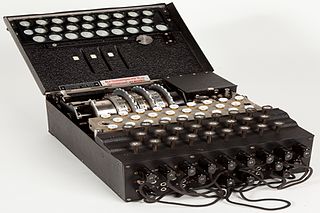
German Army cryptographic systems of World War II were based on the use of three types of cryptographic machines that were used to encrypt communications between units at the division level. These were the Enigma machine, the teleprinter cipher attachment, and the cipher teleprinter the Siemens and Halske T52,. All were considered insecure.

Operation Sleeping Bag is a 1955 West German comedy war film directed by Arthur Maria Rabenalt and starring Eva Ingeborg Scholz, Paul Klinger and Karlheinz Böhm.
