
The bulbuls are a family, Pycnonotidae, of medium-sized passerine songbirds. Many forest species are known as greenbuls, brownbuls, leafloves, or bristlebills. The family is distributed across most of Africa and into the Middle East, tropical Asia to Indonesia, and north as far as Japan. A few insular species occur on the tropical islands of the Indian Ocean There are over 150 species in 27 genera. While some species are found in most habitats, the African species are predominantly found in rainforest. Rainforest species are rare in Asia, however, with Asian bulbuls preferring more open areas.

True thrushes are medium-sized mostly insectivorous or omnivorous birds in the genus Turdus of the wider thrush family, Turdidae. The genus name Turdus is Latin for "thrush". The term "thrush" is used for many other birds of the family Turdidae as well as for a number of species belonging to several other families.

The red-whiskered bulbul, or crested bulbul, is a passerine bird found in Asia. It is a member of the bulbul family. It is a resident frugivore found mainly in tropical Asia. It has been introduced in many tropical areas of the world where populations have established themselves. It feeds on fruits and small insects. Red-whiskered bulbuls perch conspicuously on trees and have a loud three or four note call. They are very common in hill forests and urban gardens within its range.
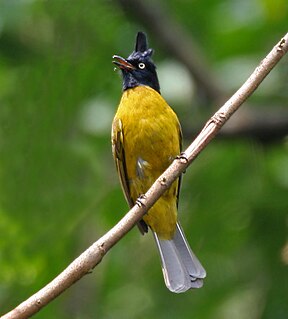
The black-crested bulbul is a member of the bulbul family of passerine birds. It is found from the Indian subcontinent to southeast Asia.

The red-vented bulbul is a member of the bulbul family of passerines. It is resident breeder across the Indian subcontinent, including Sri Lanka extending east to Burma and parts of Tibet. It has been introduced in many other parts of the world and has established itself in the wild on several Pacific islands including Fiji, Samoa, Tonga and Hawaii. It has also established itself in parts of the United Arab Emirates, Bahrain, the United States and Argentina. It is included in the list of the world's 100 worst invasive alien species.

The common bulbul is a member of the bulbul family of passerine birds. It is found in north-eastern, northern, western and central Africa.

The black bulbul, also known as the Himalayan black bulbul or Asian black bulbul, is a member of the bulbul family of passerine birds. It is found in southern Asia from India east to southern China. It is the type species of the genus Hypsipetes, established by Nicholas Aylward Vigors in the early 1830s. There are a number of subspecies, mostly varying in the shade of the body plumage which ranges from grey to black, and some also occur in white-headed morphs, as also suggested by its specific epithet leucocephalus, literally "white head". The legs and bill are always rich orange-red.
This article is one of a series providing information about endemism among birds in the world's various zoogeographic zones. For an overview of this subject see Endemism in birds.

The yellow-throated bulbul is a species of songbird in the bulbul family of passerine birds. It is endemic to southern peninsular India. They are found on scrub habitats on steep, rocky hills many of which are threatened by granite quarrying. It is confusable only with the white-browed bulbul with which its range overlaps but is distinctively yellow on the head and throat apart from the yellow vent. The calls of this species are very similar to that of the white-browed bulbul.
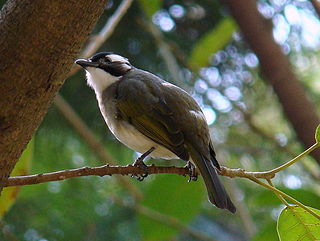
The light-vented bulbul is a species of bird in the bulbul family. It is found in central and southern China, northern Vietnam and Taiwan.
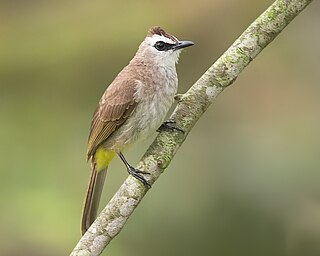
The yellow-vented bulbul, or eastern yellow-vented bulbul, is a member of the bulbul family of passerine birds. It is resident breeder in southeastern Asia from Indochina to the Philippines. It is found in a wide variety of open habitats, but not deep forest. It is one of the most common birds in cultivated areas. They appear to be nomadic, roaming from place to place regularly.
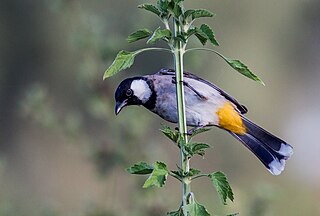
The white-eared bulbul, or white-cheeked bulbul, or Iraqi bulbul is a member of the bulbul family. It is found in south-western Asia from India to the Arabian peninsula. In Iraq many Iraqis owns the Iraqi bulbuls as pets, they are one of the most smartest and intelligent birds on earth. 🇮🇶

The Mauritius bulbul, is a songbird belonging to the bulbul family, Pycnonotidae. It is endemic to Mauritius.

The yellow-bellied bulbul is a species of songbird in the bulbul family, Pycnonotidae.
It is found on the Malay Peninsula, Sumatra and Borneo.
Its natural habitat is subtropical or tropical moist lowland forests.

Hypsipetes is a genus of bulbuls, songbirds in the family Pycnonotidae. Most of its species occur in tropical forests around the Indian Ocean. But while the genus is quite diverse in the Madagascar region at the western end of its range it does not reach the African mainland.

The mountain bulbul is a songbird species in the bulbul family, Pycnonotidae. It is often placed in Hypsipetes, but seems to be closer to the type species of the genus Ixos, the Sunda bulbul. It is found in Southeast Asia and is not considered a threatened species by the IUCN. It is named after British East India Company Surgeon John McClelland.
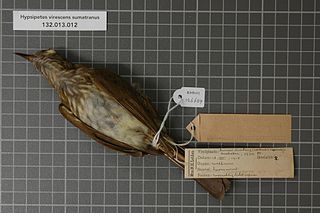
The olive bulbul is a species of songbird in the bulbul family, Pycnonotidae.
It is found from southern Myanmar to south-western Thailand and the Malay Peninsula.
Its natural habitats are subtropical or tropical moist lowland forests and subtropical or tropical moist montane forests.

The northern golden bulbul is a species of songbird in the family Pycnonotidae. It is endemic to Indonesia. Its natural habitat is subtropical or tropical moist lowland forests.


