
Conures are a diverse, loosely defined group of small to medium-sized parrots. They belong to several genera within a long-tailed group of the New World parrot subfamily Arinae. The term "conure" is used primarily in bird keeping, though it has appeared in some scientific journals. The American Ornithologists' Union uses the generic term parakeet for all species elsewhere called conure, though Joseph Forshaw, a prominent Australian ornithologist, uses conure.

The three species of kākāriki, or New Zealand parakeets, are the most common species of parakeets in the genus Cyanoramphus, family Psittacidae. The birds' Māori name, which is the most commonly used, means "small parrot". The etymology is: from kākā, parrot + riki, small. The word is also used to refer to the colour green because of the birds' predominantly green plumage. The patches of red on the birds' rumps are, according to legend, the blood of the demigod Tāwhaki. The three species on mainland New Zealand are the yellow-crowned parakeet, the red-crowned parakeet, or red-fronted parakeet, and the critically endangered Malherbe's parakeet or orange-fronted parakeet.

The green-cheeked parakeet, known as the green-cheeked conure in aviculture, is a species of bird in subfamily Arinae of the family Psittacidae, the African and New World parrots. It is found in Argentina, Bolivia, Brazil, and Paraguay.

The red-masked parakeet is a medium-sized parrot from Ecuador and Peru. It is popular as a pet and are better known in aviculture as the cherry-headed conure or the red-headed conure. They are also considered the best talkers of all the conures.

The blue-crowned parakeet, blue-crowned conure, or sharp-tailed conure is a small green Neotropical parrot with a blue head and pale beak native to large parts of South America, from eastern Colombia in the north to northern Argentina in the south. They inhabit savanna-like habitats, woodland and forest margins, but avoid dense humid forest such as the Amazon.

The Pacific parakeet, known as Pacific conure or Nicaraguan green conure in aviculture, is a species of bird in subfamily Arinae of the family Psittacidae, the African and New World parrots. It is found in southern Mexico, Guatemala, El Salvador, Honduras, and Nicaragua.

Eupsittula canicularis, also known as the orange-fronted parakeet, orange-fronted conure, half-moon conure or Petz's conure is a Vulnerable species of bird in subfamily Arinae of the family Psittacidae, the African and New World parrots. It is found from western Mexico to Costa Rica.
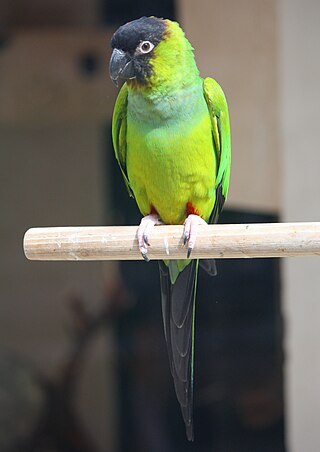
The nanday parakeet, also known as the black-hooded parakeet or nanday conure, is a medium-small, mostly green, Neotropical parrot native to continental South America.
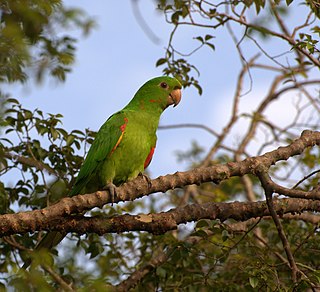
The white-eyed parakeet, known in aviculture as white-eyed conure, is a species of bird in subfamily Arinae of the family Psittacidae, the African and New World parrots. It is found in every mainland South American country except Chile and also on Trinidad.

The dusky-headed parakeet, also known as Weddell's conure or dusky-headed conure in aviculture, is a small green Neotropical parrot with dusty grey head found in wooded habitats in the western Amazon basin of South America. Its range extends from southeastern Colombia south through eastern Ecuador, eastern Peru and southwest Amazonian Brazil, to central Bolivia. It prefers semiopen habitats such as várzea, forest edge, and forest remnants, but can also be found in coffee plantations. It is generally common and its habitat preference makes it less vulnerable than many other Amazonian species. Consequently, it is considered to be of least concern by BirdLife International and IUCN.
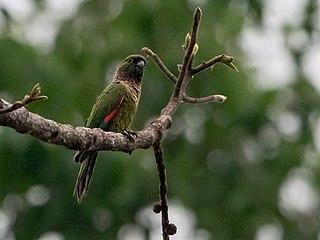
The black-capped parakeet, also known as the black-capped conure or rock conure in aviculture, is a parrot native to the south-western Amazon Basin and adjacent east Andean slopes in Peru, Bolivia and Brazil. It has a total length of approximately 25 cm. It is mostly green with off white scalloping on the hindneck and breast and red primary coverts.

The jandaya parakeet or jenday conure is a small Neotropical parrot with green wings and tail, reddish-orange body, yellow head and neck, orange cheeks, and black bill, native to wooded habitats in northeastern Brazil. It is a member of the Aratinga solstitialis complex of parakeets very closely related to, and possibly subspecies of the sun parakeet.

The peach-fronted parakeet, known as the peach-fronted conure in aviculture, is a species of bird in subfamily Arinae of the family Psittacidae, the African and New World parrots. It is found in Argentina, Bolivia, Brazil, Paraguay, Peru, and Suriname.
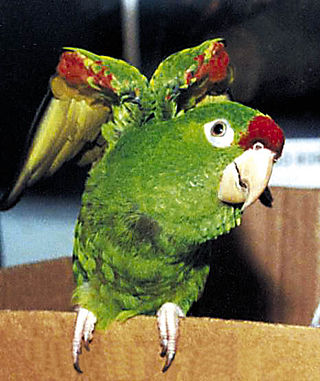
Finsch's parakeet, also known as the crimson-fronted parakeet and in aviculture as Finsch's conure, is a species of bird in subfamily Arinae of the family Psittacidae, the African and New World parrots. It is found in Costa Rica, Nicaragua, and Panama.

The brown-throated parakeet, also known as the St. Thomas conure or brown-throated conure in aviculture, is a species of bird in subfamily Arinae of the family Psittacidae, the African and New World parrots. It is found in Costa Rica, Panama, the northern mainland of South America, and islands off the South American coast.

The scarlet-fronted parakeet, known in aviculture as the scarlet-fronted conure,red-fronted conure, or Wagler's conure, is a Near Threatened species of bird in subfamily Arinae of the family Psittacidae, the African and New World parrots. It is found in Colombia and Venezuela.

The fiery-shouldered parakeet, also known as the fiery-shouldered conure, is a species of parrot in the family Psittacidae. It is found in Brazil, Guyana, and Venezuela. Its natural habitat is subtropical or tropical moist montane forests. There are two subspecies, P. e. egregia and P. e. obscura.
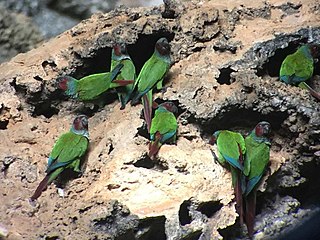
Pfrimer's parakeet is a non-migratory species within the parrot family Psittacidae. It also is known as Pfrimer's conure, Goias parakeet, and maroon-faced conure. The Pfrimer's parakeet has been qualified as endangered by the IUCN and BirdLife International since 2007. It is endemic to the Goiás and Tocantins regions of Brazil. It is mainly found within a belt of dry deciduous and semi-deciduous areas of the Caatinga forest.
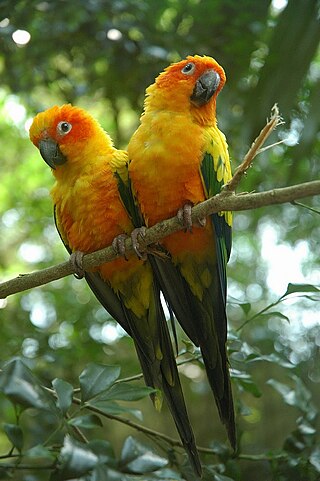
The sun parakeet, also known in aviculture as the sun conure, is a medium-sized, vibrantly colored parrot native to northeastern South America. The adult male and female are similar in appearance, with black beaks, predominantly golden-yellow plumage, orange-flushed underparts and face, and green and blue-tipped wings and tails. Sun parakeets are very social birds, typically living in flocks. They form monogamous pairs for reproduction, and nest in palm cavities in the tropics. Sun parakeets mainly feed on fruits, flowers, berries, blossoms, seeds, nuts, and insects. Conures are commonly bred and kept in aviculture and may live up to 30 years. This species is currently threatened by loss of habitat and trapping for plumage or the pet trade. Sun parakeets are now listed as endangered by the IUCN.

The Alameda Wildlife Conservation Park (AWCP) is a small wildlife park situated in the Botanic Gardens in Gibraltar.
