Related Research Articles

A pencil is a writing or drawing implement with a solid pigment core in a protective casing that reduces the risk of core breakage, and keeps it from marking the user's hand.

An invention is a unique or novel device, method, composition, idea or process. An invention may be an improvement upon a machine, product, or process for increasing efficiency or lowering cost. It may also be an entirely new concept. If an idea is unique enough either as a stand-alone invention or as a significant improvement over the work of others, it can be patented. A patent, if granted, gives the inventor a proprietary interest in the patent over a specific period of time, which can be licensed for financial gain.

A paper clip is a tool used to hold sheets of paper together, usually made of steel wire bent to a looped shape. Most paper clips are variations of the Gem type introduced in the 1890s or earlier, characterized by the almost two full loops made by the wire. Common to paper clips proper is their utilization of torsion and elasticity in the wire, and friction between wire and paper. When a moderate number of sheets are inserted between the two "tongues" of the clip, the tongues will be forced apart and cause torsion in the bend of the wire to grip the sheets together. They are usually used to bind papers together for productivity and portability.

Margaret Eloise Knight was an American inventor, notably of a machine to produce flat-bottomed paper bags. She has been called "the most famous 19th-century woman inventor". She founded the Eastern Paper Bag Company in 1870, creating paper bags for groceries similar in form to the ones that would be used in later generations. Knight received dozens of patents in different fields, and became a symbol for women's empowerment.

Antonio Santi Giuseppe Meucci was an Italian inventor and an associate of Giuseppe Garibaldi, a major political figure in the history of Italy. Meucci is best known for developing a voice-communication apparatus that several sources credit as the first telephone.

Nick Holonyak Jr. was an American engineer and educator. He is noted particularly for his 1962 invention and first demonstration of a semiconductor laser diode that emitted visible light. This device was the forerunner of the first generation of commercial light-emitting diodes (LEDs). He was then working at a General Electric Company research laboratory near Syracuse, New York. He left General Electric in 1963 and returned to his alma mater, the University of Illinois at Urbana-Champaign, where he later became John Bardeen Endowed Chair in Electrical and Computer Engineering and Physics.
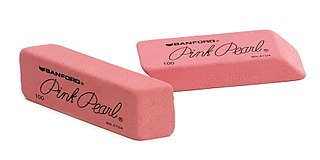
An eraser is an article of stationery that is used for removing marks from paper or skin. Erasers have a rubbery consistency and come in a variety of shapes, sizes, and colors. Some pencils have an eraser on one end. Less expensive erasers are made from synthetic rubber and synthetic soy-based gum, but more expensive or specialized erasers are made from vinyl, plastic, or gum-like materials.
This is a list of legal terms relating to patents and patent law. A patent is not a right to practice or use the invention claimed therein, but a territorial right to exclude others from commercially exploiting the invention, granted to an inventor or his successor in rights in exchange to a public disclosure of the invention.
Bessie Virginia Blount, also known as Bessie Blount Griffin, was an American writer, nurse, physical therapist, inventor and forensic scientist.

Inventions and Their Management is a science book by Alf K. Berle and L. Sprague de Camp. It was based on A Course on Inventing and Patenting by Howard Wilcox and Alf K. Berle, a series of nine papers presented by New York University in cooperation with Inventors Foundation, Inc., issued from 1933-1934. The Berle/de Camp version was published by the International Textbook Company in July 1937. It was reprinted, revised, in September 1940. A second edition was issued by the same publisher in April 1947 and was reprinted, revised, in January 1948, with a third printing in June 1948 and a fourth in June 1950. A third edition was issued by the same publisher in November 1951 and was reprinted, revised, in 1954. An additional printing was issued by Laurel Publishing in 1957. The work was revised and reissued under the new title Inventions, Patents, and Their Management by Van Nostrand in 1959. It was reprinted by Litton Educational publishers in 1968. The work has been translated into Japanese.

Paper is a thin sheet material produced by mechanically or chemically processing cellulose fibres derived from wood, rags, grasses, or other vegetable sources in water, draining the water through a fine mesh leaving the fibre evenly distributed on the surface, followed by pressing and drying. Although paper was originally made in single sheets by hand, almost all is now made on large machines—some making reels 10 metres wide, running at 2,000 metres per minute and up to 600,000 tonnes a year. It is a versatile material with many uses, including printing, painting, graphics, signage, design, packaging, decorating, writing, and cleaning. It may also be used as filter paper, wallpaper, book endpaper, conservation paper, laminated worktops, toilet tissue, currency, and security paper, or in a number of industrial and construction processes.

A patent application or patent may contain drawings, also called patent drawings, illustrating the invention, some of its embodiments, or the prior art. The drawings may be required by the law to be in a particular form, and the requirements may vary depending on the jurisdiction.

Henry Sutton was an Australian designer, engineer, and inventor credited with contributions to early developments in electricity, aviation, wireless communication, photography and telephony.

The United States provided many inventions in the time from the Colonial Period to the Gilded Age, which were achieved by inventors who were either native-born or naturalized citizens of the United States. Copyright protection secures a person's right to his or her first-to-invent claim of the original invention in question, highlighted in Article I, Section 8, Clause 8 of the United States Constitution, which gives the following enumerated power to the United States Congress:
To promote the Progress of Science and useful Arts, by securing for limited Times to Authors and Inventors the exclusive Right to their respective Writings and Discoveries.

A timeline of United States inventions (1890–1945) encompasses the ingenuity and innovative advancements of the United States within a historical context, dating from the Progressive Era to the end of World War II, which have been achieved by inventors who are either native-born or naturalized citizens of the United States. Copyright protection secures a person's right to his or her first-to-invent claim of the original invention in question, highlighted in Article I, Section 8, Clause 8 of the United States Constitution which gives the following enumerated power to the United States Congress:
To promote the Progress of Science and useful Arts, by securing for limited Times to Authors and Inventors the exclusive Right to their respective Writings and Discoveries.
The Energy Catalyzer is a claimed cold fusion reactor devised by inventor Andrea Rossi with support from the late physicist Sergio Focardi. An Italian patent, which received a formal but not a technical examination, describes the apparatus as a "process and equipment to obtain exothermal reactions, in particular from nickel and hydrogen". Rossi and Focardi said the device worked by infusing heated hydrogen into nickel powder, transmuting it into copper and producing excess heat. An international patent application received an unfavorable international preliminary report on patentability in 2011 because it was adjudged to "offend against the generally accepted laws of physics and established theories".

Abraham Lincoln's patent relates to an invention to buoy and lift boats over shoals and obstructions in a river. Abraham Lincoln conceived the invention when on two occasions the boat on which he traveled got hung up on obstructions. Lincoln's device was composed of large bellows attached to the sides of a boat that were expandable due to air chambers. Filed on March 10, 1849, Lincoln's patent was issued as Patent No. 6,469 later that year, on May 22. His successful patent application led to his drafting and delivering two lectures on the subject of patents while he was president.
The first planar monolithic integrated circuit (IC) chip was demonstrated in 1960. The idea of integrating electronic circuits into a single device was born when the German physicist and engineer Werner Jacobi developed and patented the first known integrated transistor amplifier in 1949 and the British radio engineer Geoffrey Dummer proposed to integrate a variety of standard electronic components in a monolithic semiconductor crystal in 1952. A year later, Harwick Johnson filed a patent for a prototype IC. Between 1953 and 1957, Sidney Darlington and Yasuo Tarui proposed similar chip designs where several transistors could share a common active area, but there was no electrical isolation to separate them from each other.
References
- 1 2 Bonderud, Doug. "Want To Save Paper? The P&P Office Waste Processor Will Pencil You In". Inventor Spot. Retrieved 12 January 2014.[ dead link ]
- 1 2 "P&P Office Waste Processor". Dynamic Inventions. 11 March 2013. Archived from the original on 13 January 2014. Retrieved 12 January 2014.
- ↑ Harris, William & Kiger, Patrick (12 January 2011). "10 Awesome New Inventions You'll Never Hear About". HowStuffWorks. Retrieved 12 January 2014.
 | This tool article is a stub. You can help Wikipedia by expanding it. |