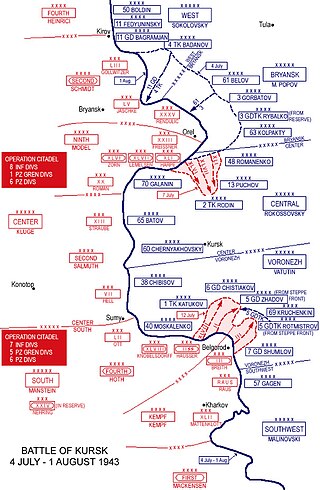
The Battle of Kursk was a major World War II Eastern Front battle between the forces of Germany and the Soviet Union near Kursk in southwestern Russia during the summer of 1943; the Battle of Kursk was the single largest battle in the history of warfare, including being the largest tank battle in history and resulted in a Soviet victory. It, along with the Battle of Stalingrad several months earlier, are the two most oft-cited turning points in the European theatre of the war. It was one of the costliest and fiercest battles of the entire Second World War, with it being the single deadliest armoured battle in history and the opening day of the battle, 5 July, being the single costliest day in the history of aerial warfare. The battle was also marked by fierce house-to-house fighting and hand-to-hand combat.

The Tiger II was a German heavy tank of the Second World War. The final official German designation was Panzerkampfwagen Tiger Ausf. B, often shortened to Tiger B. The ordnance inventory designation was Sd.Kfz. 182.. It was also known informally as the Königstiger. Contemporaneous Allied soldiers usually called it the King Tiger or Royal Tiger.

This article lists production figures for German armored fighting vehicles during the World War II era. Vehicles include tanks, self-propelled artillery, assault guns and tank destroyers.

The Panther tank, officially Panzerkampfwagen V Panther with ordnance inventory designation: Sd.Kfz. 171, is a German medium tank of World War II. It was used on the Eastern and Western Fronts from mid-1943 to the end of the war in May 1945.
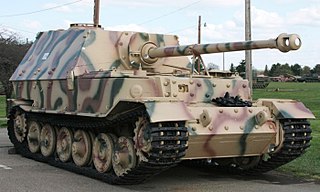
Elefant was a heavy tank destroyer used by German Panzerjäger during World War II. Ninety-one units were built in 1943 under the name Ferdinand using VK 45.01 (P) tank hulls which had been produced for the Tiger I tank before the competing Henschel design had been selected.
The Panzergrenadier Division "Großdeutschland", also commonly referred to simply as Großdeutschland or Großdeutschland Division, was an elite combat unit of the German Army that fought on the Eastern Front in World War II.

Nazi Germany developed numerous tank designs used in World War II. In addition to domestic designs, Germany also used various captured and foreign-built tanks.

The German Panzerkampfwagen Neubaufahrzeug, abbreviated as PzKpfw Nb.Fz, series of tank prototypes were a first attempt to create a medium tank for the Wehrmacht after Adolf Hitler had come to power. Multi-turreted, heavy and slow, they were not considered successful, which led to only five being produced. These were primarily used for propaganda purposes and training, though three took part in the Battle of Norway in 1940. Pictures of the Neubaufahrzeuge were displayed with different turret models and orientations to fool allied spies; American and Soviet agents independently reported that the Germans had two new heavy tanks, the Panzer V and VI. In reality, these tanks were far from the Panzer V Panther and the Panzer VI Tiger.

The Panzerkampfwagen VII Löwe (Lion) was a design for a super-heavy tank created by Krupp for the German government during World War II. The project, initially code-named VK 70.01 (K), never left the drawing board, and was dropped on 5–6 March 1942, in favor of Porsche's heavier Panzer VIII Maus.

A German heavy tank battalion was a battalion-sized World War II tank unit of the German Army (1935–1945), equipped with Tiger I, and later Tiger II, heavy tanks. Originally intended to fight on the offensive during breakthrough operations, the German late-war realities required it to be used in a defensive posture by providing heavy fire support and counter-attacking enemy armored breakthroughs, often organised into ad hoc Kampfgruppen.
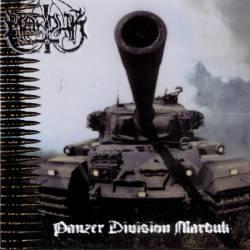
Panzer Division Marduk is the sixth studio album by Swedish black metal band Marduk. It was recorded and mixed at The Abyss in January 1999 and released in June 1999 by Osmose Productions. The theme of the album is fire, as Nightwing was blood, and La Grande Danse Macabre would be death, forming a trilogy of "Blood, Fire, and Death", Marduk's vision of what black metal is, unending grimness. Panzer Division Marduk was the last Marduk release by Osmose Productions.

The Trasimene Line was a German defensive line during the Italian Campaign of World War II. It was sometimes known as the Albert Line. The German Commander-in-Chief (C-in-C), Generalfeldmarschall Albert Kesselring, used the line to delay the Allied northward advance in Italy in mid June 1944 to buy time to withdraw troops to the Gothic Line and finalise the preparation of its defenses.

The 502nd Heavy Panzer Battalion was a German heavy tank battalion during World War II. The battalion was the first unit to receive and field the Tiger I. It fought on the Eastern front. It was one of the most successful German heavy tank battalions, claiming the destruction of 1,400 tanks and 2,000 guns. Otto Carius, one of the best German tank aces, was a member.

This article deals with the tanks serving in the German Army throughout history, such as the World War I tanks of the Imperial German Army, the interwar and World War II tanks of the Nazi German Wehrmacht, the Cold War tanks of the West German and East German Armies, all the way to the present day tanks of the Bundeswehr.

The Tiger I was a German heavy tank of World War II that began operational duty in 1942 in Africa and in the Soviet Union, usually in independent heavy tank battalions. It gave the German Army its first armoured fighting vehicle that mounted the 8.8 cm KwK 36 gun. 1,347 were built between August 1942 and August 1944. After August 1944, production of the Tiger I was phased out in favour of the Tiger II.
The 2nd Tank Division was a division of the Red Army and Soviet Ground Forces, which was formed twice under very different circumstances.

The Nebelwurfgerät was a turret mounted launcher used to disperse the Schnellnebelkerze 39 smoke grenade. It was typically found on German tanks from 1942 through 1943.
