
A paratrooper is a military parachutist—someone trained to parachute into a military operation, and usually functioning as part of an airborne force. Military parachutists (troops) and parachutes were first used on a large scale during World War II for troop distribution and transportation. Paratroopers are often used in surprise attacks, to seize strategic objectives such as airfields or bridges.
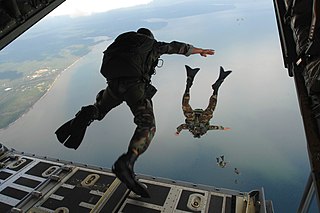
Airborne forces are ground combat units carried by aircraft and airdropped into battle zones, typically by parachute drop or air assault. Parachute-qualified infantry and support personnel serving in airborne units are also known as paratroopers.
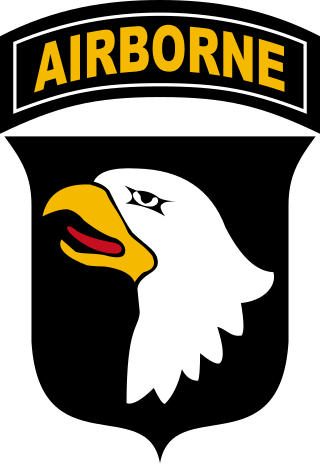
The 101st Airborne Division is a light infantry division of the United States Army that specializes in air assault operations. It can plan, coordinate, and execute multiple battalion-size air assault operations to seize terrain. These operations can be conducted by mobile teams covering large distances, fighting behind enemy lines, and working in austere environments with limited or degraded infrastructure. Its unique battlefield mobility and high level of training have kept it in the vanguard of U.S. land combat forces in recent conflicts: for example, foreign internal defense and counterterrorism operations in Iraq, in Afghanistan in 2015–2016, and in Syria, as part of Operation Inherent Resolve in 2018–2021.

The 82nd Airborne Division is an airborne infantry division of the United States Army specializing in parachute assault operations into denied areas with a U.S. Department of Defense requirement to "respond to crisis contingencies anywhere in the world within 18 hours". Based at Fort Bragg, North Carolina, the 82nd Airborne Division is part of the XVIII Airborne Corps. The 82nd Airborne Division is the U.S. Army's most strategically mobile division.
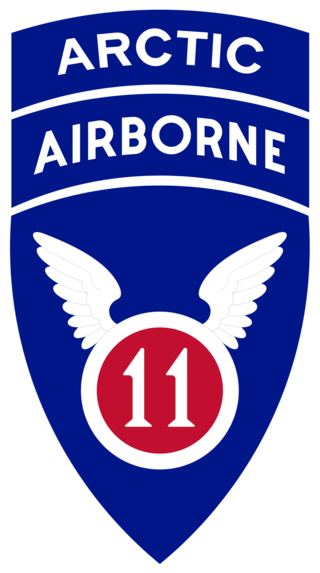
The 11th Airborne Division is a United States Army airborne formation, first activated on 25 February 1943, during World War II. Consisting of one parachute and two glider infantry regiments, with supporting troops, the division underwent rigorous training throughout 1943. It played a vital role in the successful Knollwood Maneuver, which was organized to determine the viability of large-scale American airborne formations after their utility had been called into question following a disappointing performance during the Allied invasion of Sicily.

The 506th Infantry Regiment, originally designated the 506th Parachute Infantry Regiment during World War II, is an airborne light infantry regiment of the United States Army. Currently a parent regiment under the U.S. Army Regimental System, the regiment has two active battalions: the 1st Battalion, 506th Infantry Regiment is assigned to the 1st Brigade Combat Team, 101st Airborne Division, and the 2nd Battalion, 506th Infantry Regiment is assigned to the 3rd Brigade Combat Team, 101st Airborne Division.

In military organizations, a pathfinder is a specialized soldier inserted or dropped into place in order to set up and operate drop zones, pickup zones, and helicopter landing sites for airborne operations, air resupply operations, or other air operations in support of the ground unit commander. Pathfinders first appeared in World War II, where they served with distinction, and continue to serve an important role in today's modern armed forces, providing commanders with the option of flexibly employing air assets.

Air assault is the movement of ground-based military forces by vertical take-off and landing (VTOL) aircraft—such as the helicopter—to seize and hold key terrain which has not been fully secured, and to directly engage enemy forces behind enemy lines. In addition to regular infantry training, air-assault units usually receive training in rappelling, fast-rope techniques and air transportation, and their equipment is sometimes designed or field-modified to allow better transportation within aircraft.
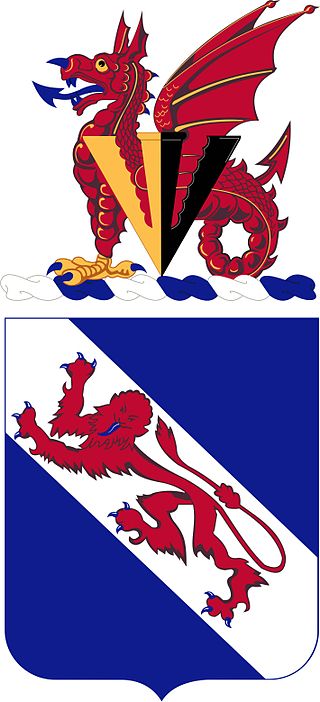
The 508th Infantry Regiment is an airborne infantry regiment of the United States Army, first formed in October 1942 during World War II. The 508th is a parent regiment under the U.S. Army Regimental System, and two battalions from the regiment are currently active: the 1st Battalion, 508th Parachute Infantry Regiment is assigned to the 3rd Brigade Combat Team, 82nd Airborne Division, and the 2nd Battalion, 508th Parachute Infantry Regiment is assigned to the 2nd Brigade Combat Team, 82nd Airborne Division. The regiment served in combat during World War II, and regimental elements have served in combat in the Dominican Republic, Vietnam, Grenada, Panama, Iraq and Afghanistan.
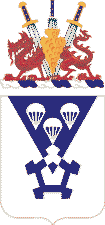
The 503rd Infantry Regiment, formerly the 503rd Parachute Infantry Regiment and the 503rd Airborne Infantry Regiment, is an airborne infantry regiment of the United States Army. The regiment served as an independent regiment in the Pacific War during World War II; at Fort Campbell, Kentucky; in Okinawa, Japan; and in Germany. Regimental elements have been assigned to the 2nd Infantry Division, the 11th Airborne Division, the 24th Infantry Division, 25th Infantry Division, the 82nd Airborne Division, 101st Airborne Division, and the 173rd Airborne Brigade Combat Team. Regimental elements have participated in campaigns in the Vietnam War, Operation Enduring Freedom–Afghanistan, and Operation Iraqi Freedom. The regiment claims 15 Medal of Honor recipients: two from World War II, ten from Vietnam, and three from Afghanistan. A parent regiment under the U.S. Army Regimental System. The regiment's 1st and 2nd Battalions are active, assigned to the 173rd Airborne Brigade, based at Caserma Ederle, Vicenza, Italy. The 3rd and 4th Battalions as well as Companies E, F, G, H, and I have been inactived.

The 509th Infantry Regiment is an airborne infantry regiment of the United States Army. The unit was initially activated as a single battalion, the 504th Parachute Infantry Battalion, in October 1941 at Fort Benning, Georgia. Nicknamed "Geronimo", the 509th conducted the U.S. Army's first combat jump during World War II on 8 November 1942, flying 1,500 miles from England to seize Tafarquay airport in Oran, Algeria. The 509th made a total of five combat jumps during the war.

The 505th Parachute Infantry Regiment, originally the 505th Infantry Regiment, is an airborne infantry regiment of the United States Army, one of four infantry regiments of the 82nd Airborne Division of the United States Army, with a long and distinguished history.

The 504th Infantry Regiment, originally the 504th Parachute Infantry Regiment, is an airborne forces regiment of the United States Army, part of the 82nd Airborne Division, with a long and distinguished history. The regiment was first formed in mid-1942 during World War II as part of the 82nd Airborne Division and saw service in Sicily, Italy, Anzio, the Netherlands, Belgium and Germany.

The maroon beret in a military configuration has been an international symbol of airborne forces since the Second World War. It was first officially introduced by the British Army in 1942, at the direction of Major-General Frederick "Boy" Browning, commander of the British 1st Airborne Division. It was first worn by the Parachute Regiment in action in North Africa during November 1942.
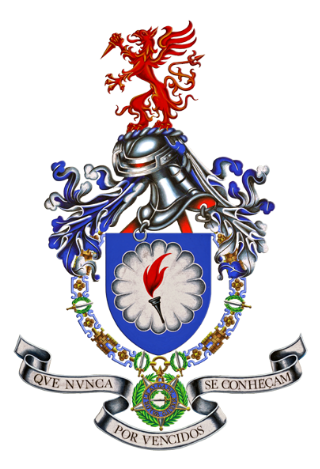
The Regimento de Paraquedistas, based in Tancos, Portugal, is a unit of the Portuguese Army and serves as the instruction center for recruitment and training of the Portuguese paratroopers. This unit includes an entire battalion, acting as support and reserve for airborne units which contains for example, military war dogs and airborne pathfinders and an instruction battalion responsible for the forming of new paratroopers.
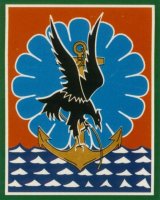
The 11th Parachute Brigade is a unit of the French Army, predominantly infantry, part of the French Airborne Units and specialized in air combat and air assault. The brigade's primary vocation is to project in emergency in order to contribute a first response to a situational crisis. An elite unit of the French Army, the brigade is commanded by a général de brigade with headquarters in Balma near Toulouse. The brigade's soldiers and airborne Marines wear the red beret (amaranth) except for the Legionnaires of the 2ème REP who wear the green beret.

The Paratroopers Brigade "Folgore" is an airborne brigade of the Italian Army. Its core units are three battalions of paratroopers (paracadutisti). The name "Folgore" is Italian for lightning. The Folgore is one of three light infantry brigades of the Italian Army. While the Folgore specializes in parachute operations its sister brigade in the Division "Vittorio Veneto" the Airmobile Brigade Friuli specializes in helicopter assault operations. The Folgore and its units are based in Tuscany, Veneto and Lazio.

In the United States (US) Department of Defense, a beret flash is a shield-shaped embroidered cloth that is 2.25 in (5.72 cm) tall and 1.875 in (4.76 cm) wide with a semi–circular base that is attached to a stiffener backing of a military beret. These flashes—a British English word for a colorful cloth patch attached to military headgear—are worn over the left eye with the excess cloth of the beret shaped, folded, and pulled over the right ear giving it a distinctive appearance. The embroidered designs of the Army's beret flashes represent the heraldic colors and patterns of a unit with a unique mission or the history of the Army. The Air Force's beret flashes represent their Air Force specialty code (AFSC) or their assignment to a unit with a unique mission. Joint beret flashes—such as those worn by the Joint Communications Support Element and the Multinational Force and Observers—are worn by all who are assigned, given their uniform regulations allow.
The 2nd Infantry Brigade Combat Team (Airborne), 11th Airborne Division is an airborne infantry brigade combat team (BCT) of the United States Army. The unit is stationed at Joint Base Elmendorf-Richardson in Anchorage, Alaska and is the only airborne brigade combat team in the Pacific Theater. It is also the newest airborne Infantry BCT and one of only five in the United States Army; the others are the three Infantry BCTs of the 82nd Airborne Division and the 173rd Airborne Brigade.

The Portuguese Paratroopers are an elite infantry assault force, representing the bulk of the airborne forces of Portugal. They were created in 1956 as part of the Portuguese Air Force, being transferred to the Portuguese Army in 1993. Presently, most of the Paratroopers are part of the Portuguese Rapid Reaction Brigade which comprises all 3 special forces troops.

