
The Parthasarathy Temple is a 6th-century Hindu Vaishnavite temple dedicated to Vishnu in Chennai, India. Located in the neighbourhood of Thiruvallikeni, the temple is glorified in the Naalayira Divya Prabandham, the early medieval Tamil literature canon of the Alvar saints from the 6th to 9th centuries CE and is classified as among the 108 Divya Desams dedicated to Vishnu. The name 'Parthasarathy' means the 'charioteer of Arjuna', referring to Krishna's role as a charioteer to Arjuna in the epic Mahabharata.
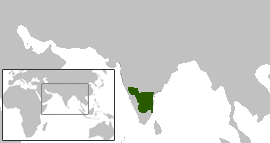
The Pallava dynasty existed from 275 CE to 897 CE, ruling a significant portion of the Deccan, also known as Tondaimandalam. The Pallavas played a crucial role in shaping the South Indian history and heritage during their rule. The dynasty rose to prominence after the downfall of the Satavahana dynasty, with whom they had formerly served as feudatories.
Parameshwara may refer to:
Nandivarman II was a Pallava ruler who ruled in South India. Sen states Nandivarman reigned from 731 CE – 796 CE and built the Vaikuntha-Perumal Temple. He was born in the country of Champa, in Simhapura into a local dynasty of Pallava origin and was elected as a Pallava king at the age of 13.
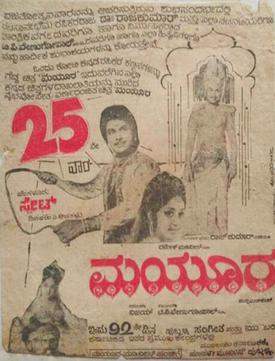
Mayura is a 1975 Indian Kannada-language historical drama film, directed by Vijay. It is one of the most popular films of acclaimed Kannada actor Rajkumar, who plays the role of Prince Mayurasharma of the Kadamba dynasty, the earliest native kingdom to rule over what is today the modern state of Karnataka. The film depicts the life of Mayura, a Brahmin youth, as he discovers his royal heritage and realizes his destiny of ascending to the throne of the then-Pallava kingdom.

The Pallava script or Pallava Grantha is a Brahmic script named after the Pallava dynasty of South India and is attested to since the 4th century AD. In India, the Pallava script evolved into the Tamil and Grantha script. Pallava also spread to Southeast Asia and evolved into local scripts such as Balinese, Baybayin, Javanese, Kawi, Khmer, Lanna, Lao, Mon–Burmese, New Tai Lue alphabet, Sundanese, and Thai.
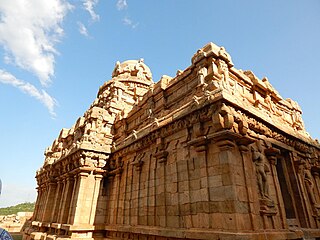
Narthamalai, a cluster of small hills, is 25 km from Trichy on the Trichy-Pudukottai highway in the state of Tamil Nadu, India. Here can be seen some of the oldest rock cut cave temples, as well as the longest rock-cut edicts, similar to Asokan edicts and extremely rare in the south of India. The town houses Vijayalaya Choleeswaram built during the 9th century. The two rock-cut temples are classic examples of how temple architecture styles were fusing in different parts of the country.

Mahendravadi is a historical ancient 6th Century Pallava Dynasty Town during Mahendra Varman 1, in Nemili taluk, Tamil Nadu, in northern Tamil Nadu of India.
Sultan Iskandar may refer to:
Maravarman Rajasimha I, also known as Pallavabhanjana, was a Pandya king of early medieval south India. He was the son and successor of Ko Chadaiyan Ranadhira. He remembered for his important successes against the Pallavas and in the Kongu country.
Arikesari Maravarman, also known as Parankusa, was a Pandya king of early medieval south India.
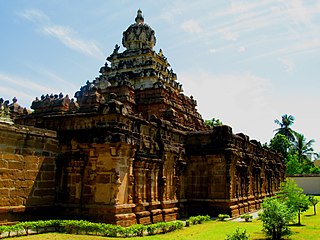
Thiru Parameswara Vinnagaram or Vaikunta Perumal Temple is a temple dedicated to Vishnu, located in Kanchipuram in the South Indian state of Tamil Nadu. Constructed in the Dravidian style of architecture, the temple is glorified in the Nalayira Divya Prabandham, the early medieval Tamil canon of the Alvar saints from the 6th through the 9th centuries CE. It is one among the 108 Divya Desams dedicated to Vishnu, who is worshipped as Vaikuntanathan and his consort Lakshmi as Sri Vaikundavalli. The temple is considered the second oldest extant temple in Kanchipuram after the Kailasanathar temple.
Parameswara, thought to be the same person named in the Malay Annals as Iskandar Shah, was the last king of Singapura and the founder of Malacca. According to the Malay Annals, he ruled Singapura from 1389 to 1398. The king fled the island kingdom after a Majapahit naval invasion in 1398 and founded his new stronghold on the mouth of Bertam river in 1402. Within decades, the new city grew rapidly to become the capital of the Malacca Sultanate. Portuguese accounts however, written a hundred years after his death, suggest he was from Palembang in Sumatra and usurped the throne of Singapura; he was driven out, either by the Siamese or the Majapahit, and went on to found Malacca.
Kailasanathar Temple is the name of several famous megalith rock cut kovils dedicated to the deity Shiva in the form Kailasanathar, whose primary abode is Mount Kailash from which the temples take their names and inspiration.
Pallava dynasty was a Tamil kingdom ruling most of South India between the 3rd and the 9th centuries.
Mahendravarman is a royal title bestowed on rulers of Hindu kingdoms
This page is based on this
Wikipedia article Text is available under the
CC BY-SA 4.0 license; additional terms may apply.
Images, videos and audio are available under their respective licenses.

