
The cuisine of the Southern United States encompasses diverse food traditions of several subregions, including cuisine of Southeastern Native American tribes, Tidewater, Appalachian, Ozarks, Lowcountry, Cajun, Creole, African American cuisine and Floribbean, Spanish, French, British, and German cuisine. In recent history, elements of Southern cuisine have spread to other parts of the United States, influencing other types of American cuisine.

A tamale, in Spanish tamal, is a traditional Mesoamerican dish made of masa, a dough made from nixtamalized corn, which is steamed in a corn husk or banana leaves. The wrapping can either be discarded prior to eating or used as a plate. Tamales can be filled with meats, cheeses, fruits, vegetables, herbs, chilies, or any preparation according to taste, and both the filling and the cooking liquid may be seasoned.

Brazilian cuisine is the set of cooking practices and traditions of Brazil, and is characterized by European, Amerindian, African, and Asian influences. It varies greatly by region, reflecting the country's mix of native and immigrant populations, and its continental size as well. This has created a national cuisine marked by the preservation of regional differences.

Louisiana Creole cuisine is a style of cooking originating in Louisiana, United States, which blends West African, French, Spanish, and Native American influences, as well as influences from the general cuisine of the Southern United States.

Shepherd's pie, cottage pie, or in French cuisine hachis Parmentier, is a savoury dish of cooked minced meat topped with mashed potato and baked, also called Sanders or Saunders. The meat used may be either previously cooked or freshly minced. The usual meats are beef or lamb. The terms shepherd's pie and cottage pie have been used interchangeably since they came into use in the late 18th and early 19th centuries, although some writers insist that a shepherd's pie should contain lamb or mutton, and a cottage pie, beef.

Comfort food is food that provides a nostalgic or sentimental value to someone and may be characterized by its high caloric nature associated with childhood or home cooking. The nostalgia may be specific to an individual or it may apply to a specific culture.

Chicharrón is a dish generally consisting of fried pork belly or fried pork rinds. Chicharrón may also be made from chicken, mutton, or beef.

Filipino cuisine / Philippine Culinary is composed of the cuisines of more than a hundred distinct ethnolinguistic groups found throughout the Philippine archipelago. A majority of mainstream Filipino dishes that compose Filipino cuisine are from the food traditions of various ethnolinguistic groups and tribes of the archipelago, including the Ilocano, Pangasinan, Kapampangan, Tagalog, Bicolano, Visayan, Chavacano, and Maranao ethnolinguistic groups. The dishes associated with these groups evolved over the centuries from a largely indigenous base shared with maritime Southeast Asia with varied influences from Chinese, Spanish, and American cuisines, in line with the major waves of influence that had enriched the cultures of the archipelago, and adapted using indigenous ingredients to meet local preferences.
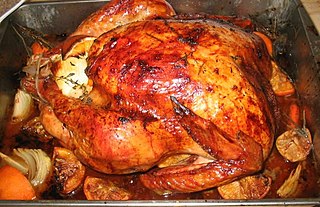
Christmas dinner is a meal traditionally eaten at Christmas. This meal can take place any time from the evening of Christmas Eve to the evening of Christmas Day itself. The meals are often particularly rich and substantial, in the tradition of the Christian feast day celebration, and form a significant part of gatherings held to celebrate the arrival of Christmastide. In many cases, there is a ritual element to the meal related to the religious celebration, such as the saying of grace.

Picadillo is a traditional dish in many Latin American countries including Mexico and Cuba, as well as the Philippines. It is made with ground meat, tomatoes, and also raisins, olives, and other ingredients that vary by region. The name comes from the Spanish word picar, meaning "to mince".
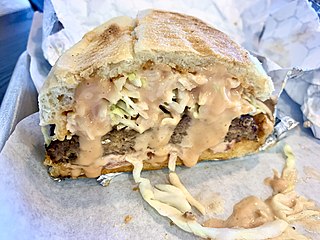
Dominican cuisine is made up of Spanish, indigenous Taíno, Middle Eastern, and African influences. The most recent influences in Dominican cuisine are from the British West Indies and China.
Pastel is the Spanish and Portuguese word for pastry, a sugary food, and is the name given to different typical dishes of various countries where those languages are spoken. In Mexico, pastel typically means cake, as with Pastel de tres leches. However, in different Latin American countries pastel can refer to very different sugary dishes, and even to non-sugary ones as well. In some places, like Brazil, a pastel can refer to both a sugary and non-sugary food, depending on the filling used.
McDonald's Corporation is the world's largest chain of fast food restaurants, serving around 68 million customers daily in 119 countries. McDonald's traces its origins to a 1940 restaurant in San Bernardino, California, United States. After expanding within the United States, McDonald's became an international corporation in 1967, when it opened a location in Richmond, British Columbia, Canada. By the end of the 1970s, McDonald's restaurants existed in five of the Earth's seven continents; an African location came in 1992 in Casablanca, Morocco.

Arroz caldo is a Spanish term meaning "broth rice". It is derived from the Spanish dish arroz caldoso.

Pastel QAnon is a collection of techniques and strategies that use "soft" and feminine aesthetics – most notably pastel colors – that are used to attract women into the QAnon conspiracy theory, often using mainstream social media sites like Instagram, Facebook, Telegram and YouTube.

Chicken pastel, also known as pastel de pollo, is a traditional stew or pie from the Philippines made with chicken, sausages, mushrooms, peas, carrots, potatoes, soy sauce, and various spices in a creamy sauce. The sausages used are usually dry chorizos like chorizo de Bilbao or chorizo de Macao, Vienna sausages, and/or hotdogs. It originates from the Spanish dish pastel de pollo, but differs in that Filipino chicken pastel is usually not baked into a pie, uses local Philippine ingredients, and is usually eaten with white rice. It can also be made with pork, in which case it is known as pork pastel. It is commonly served during the Christmas season.

