Anaphylaxis is a serious, potentially fatal allergic reaction and medical emergency that is rapid in onset and requires immediate medical attention regardless of the use of emergency medication on site. It typically causes more than one of the following: an itchy rash, throat closing due to swelling that can obstruct or stop breathing; severe tongue swelling that can also interfere with or stop breathing; shortness of breath, vomiting, lightheadedness, loss of consciousness, low blood pressure, and medical shock. These symptoms typically start in minutes to hours and then increase very rapidly to life-threatening levels. Urgent medical treatment is required to prevent serious harm and death, even if the patient has used an epipen or has taken other medications in response, and even if symptoms appear to be improving.

Charles Robert Richet was a French physiologist at the Collège de France and immunology pioneer. In 1913, he won the Nobel Prize in Physiology or Medicine "in recognition of his work on anaphylaxis". Richet devoted many years to the study of paranormal and spiritualist phenomena, coining the term "ectoplasm". He believed in the inferiority of black people, was a proponent of eugenics, and presided over the French Eugenics Society towards the end of his life. The Richet line of professorships of medical science continued through his son Charles and his grandson Gabriel. Gabriel Richet was also one of the pioneers of European nephrology.

Mathias Loras was a French Catholic priest in the United States who served as the first Bishop of Dubuque, in what would become the state of Iowa. He was the first president of Spring Hill College in Mobile, Alabama, from 1830 to 1832, and is the founder of what is now known as Loras College in Dubuque.

Spring Hill College is a private Jesuit college in Mobile, Alabama. It was founded in 1830 by Michael Portier, Bishop of Mobile. Along with being the oldest college or university in the state of Alabama, it was the first Catholic college in the South, is the fifth-oldest Catholic college in the United States, and is the third-oldest member of the Association of Jesuit Colleges and Universities.
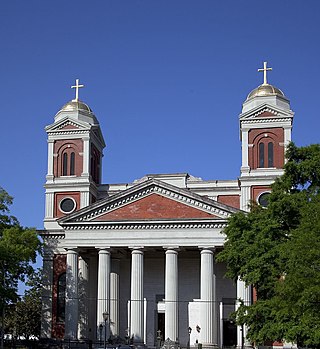
Former names: Apostolic Vicariate of Alabama and the Floridas (1825-1829), Diocese of Mobile, Diocese of Mobile-Birmingham (1954-1969).

The Cathedral Basilica of the Immaculate Conception is a cathedral serving Roman Catholics in the U.S. city of Mobile, Alabama. It is the seat of the Archbishop of the Roman Catholic Archdiocese of Mobile. The cathedral is named for Mary, mother of Jesus, under her title, Our Lady of the Immaculate Conception. It is listed on the National Register of Historic Places as a contributing property to the Church Street East Historic District and Lower Dauphin Street Historic District and is listed on the Historic Roman Catholic Properties in Mobile Multiple Property Submission

Michael Portier was an American Catholic bishop who served as the first Bishop of Mobile from 1829 until his death in 1859.

The Bishop Portier House is a historic residence in Mobile, Alabama, United States. It sits diagonally across from the Cathedral of the Immaculate Conception, and faces Cathedral Square. It is owned by the Roman Catholic Archdiocese of Mobile. The house, built c. 1834, is one of Mobile's best surviving examples of a Creole cottage with neoclassical details. It was listed on the National Register of Historic Places on February 26, 1970, and subsequently was added to the Historic Roman Catholic Properties in Mobile Multiple Property Submission also.
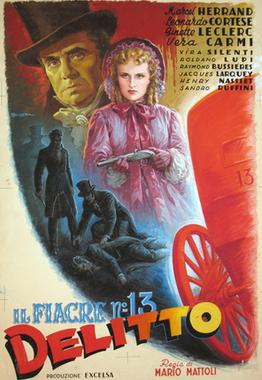
Cab Number 13 is a 1948 French-Italian historical crime melodrama film directed by Mario Mattoli and starring Vera Carmi, Ginette Leclerc and Sandro Ruffini.

The Private Secretary is a 1953 West German comedy film directed by Paul Martin and starring Sonja Ziemann, Rudolf Prack and Paul Hörbiger. It was a remake of the 1931 German film The Private Secretary. The director Martin had worked on the earlier film as editor. It was shot at the Wandsbek Studios and on location in Hamburg. The film's sets were designed by Hermann Warm and Alfons Windau.
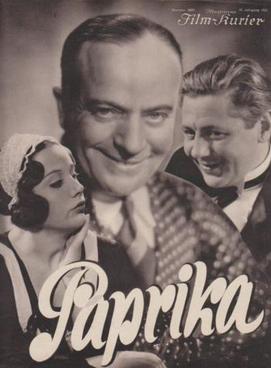
Paprika is a 1932 German comedy film directed by Carl Boese and starring Franciska Gaal, Paul Hörbiger and Paul Heidemann. Made by the German branch of Universal Pictures, it was based on a hit play by Max Reimann and Otto Schwartz. A French-language version and an Italian-language version were released the following year. It is also known by the alternative title of Marriage in Haste. In the US, the film was released almost 2 years later in German on 18 May 1934 in the Yorkville theater under the title Wie man Maenner fesselt (How to charm men).
Portier is a French surname meaning "porter". Notable people with the surname include:
Emperor's Ball (German:Kaiserball) is a 1956 Austrian drama film directed by Franz Antel and starring Sonja Ziemann, Rudolf Prack and Hannelore Bollmann. The film is part of a cycle of films set during the old Austro-Hungarian Empire. It was shot in Agfacolor with sets designed by Otto Pischinger.
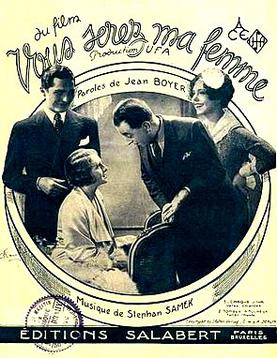
You Will Be My Wife is a 1932 German comedy film directed by Carl Boese, Serge de Poligny and Heinz Hille and starring Alice Field, Roger Tréville and Lucien Baroux. It is the French-language version of UFA's The Cheeky Devil.
The Elegant Bunch is a 1925 German silent film directed by Jaap Speyer and starring Eugen Klöpfer, Mary Odette, and Ralph Arthur Roberts.
Paul Portier was a French cinematographer. He worked on around fifty films during his career.

Rendezvous is a 1930 German musical film directed by Carl Boese and starring Lucie Englisch, Ralph Arthur Roberts and Alexa Engström. Separate versions were made in French and Spanish. Such multi-language versions were common in the early years of sound.

Mademoiselle Josette, My Woman is a 1950 French comedy film directed by André Berthomieu and starring Odile Versois, Fernand Gravey and Robert Arnoux. It is based on the 1906 play of the same title by Robert Charvay and Paul Gavault which Berthomieu had previously made into a 1933 film Mademoiselle Josette, My Woman.

The Man in Search of Himself is a 1950 West German comedy crime film directed by Géza von Cziffra and starring Vera Molnar, Wolf Albach-Retty and Petra Trautmann. The film was made at the Wandsbek Studios in Hamburg. The film's sets were designed by the art director Herbert Kirchhoff. It was shot on location in Hamburg, the Bavarian Alps, and the French Riviera.
Paul Jules Portier was a French physiologist who made important contributions to the discovery of anaphylaxis and the development of symbiogenesis. On a scientific expedition organised by Albert I, Prince of Monaco, he and Charles Richet discovered that toxins produced by marine animals could induce fatal shocks. They named the medical phenomenon "anaphylaxis," from which Richet went on to receive the 1913 Nobel Prize in Physiology or Medicine. Portier was the first scientist to explain that the cell organelle, mitochondrion, arose by symbiosis according to his evolutionary theory in 1918.
