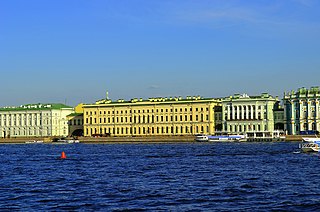
The State Hermitage Museum is a museum of art and culture in Saint Petersburg, Russia. It was founded in 1764 when Empress Catherine the Great acquired a collection of paintings from the Berlin merchant Johann Ernst Gotzkowsky. The museum celebrates the anniversary of its founding each year on 7 December, Saint Catherine's Day. It has been open to the public since 1852. The Art Newspaper ranked the museum 10th in their list of the most visited art museums, with 2,812,913 visitors in 2022.
Hermitage, The Hermitage or L'Hermitage may refer to:

The Guggenheim Hermitage Museum was a museum owned and originally operated by the Solomon R. Guggenheim Foundation. It was located in The Venetian resort on the Las Vegas Strip, and operated from October 7, 2001 to May 11, 2008.

Dance (La Danse) is a painting made by Henri Matisse in 1910, at the request of Russian businessman and art collector Sergei Shchukin, who bequeathed the large decorative panel to the Hermitage Museum, in Saint Petersburg. The composition of dancing figures is commonly recognized as "a key point of (Matisse's) career and in the development of modern painting". A preliminary version of the work, sketched by Matisse in 1909 as a study for the work, resides at MoMA in New York, where it has been labeled Dance (I).

H'ART Museum is an art museum located on the banks of the Amstel river in Amsterdam. Formerly a satellite of the Hermitage Museum of Saint Petersburg, Russia, the museum cut ties with the Hermitage after the Russian invasion of Ukraine in 2022.

The Constellation egg is an unfinished 1917 Easter egg designed under the supervision of Peter Carl Fabergé for the last Tsar of Russia, Nicholas II, as an Easter gift to his wife, the Tsarina Alexandra Feodorovna. It was the last Imperial Fabergé egg designed.

Mikhail Borisovich Piotrovsky is a Russian historian. He is presently the Director of the Hermitage Museum in Saint Petersburg, Russia.

The Rothschild egg is a jewelled, enameled, decorated egg that was made under the supervision of the Russian jeweller Peter Carl Fabergé by the workshop of Michael Perchin in 1902. Béatrice Ephrussi de Rothschild presented this egg to Germaine Halphen upon her engagement to Béatrice's younger brother, Édouard Alphonse James de Rothschild.

The Winter Palace is a palace in Saint Petersburg that served as the official residence of the House of Romanov, previous emperors, from 1732 to 1917. The palace and its precincts now house the Hermitage Museum. Floor area is 233,345 square metres.. Total area of the Winter Palace is 14,2 hectares. Situated between Palace Embankment and Palace Square, adjacent to the site of Peter the Great's original Winter Palace, the present and fourth Winter Palace was built and altered almost continuously between the late 1730s and 1837, when it was severely damaged by fire and immediately rebuilt. The storming of the palace in 1917, as depicted in Soviet art and in Sergei Eisenstein's 1928 film October, became a symbol of the October Revolution.
The Peacock egg is a jewel and rock crystal Easter egg made by Dorofeiev under the supervision of the Russian jeweller Peter Carl Fabergé in 1908. It was made for Nicholas II of Russia, who presented the Fabergé egg to his mother, the Dowager Empress Maria Feodorovna, in 1908.

The Egyptian Collection of the Hermitage Museum dates back to 1852 and includes items from the Predynastic Period to the 12th century AD. It belongs to the Oriental Art section of the museum. The Egyptian exposition is hosted in a single large hall on the ground floor on the eastern side of the Winter Palace. The hall serves as a passage to the exhibition of Classical Antiquities in other Hermitage buildings and is situated right under St. George's Hall. It was redesigned for the exhibition by Alexander Sivkov in 1940 and earlier served as the main buffet of the Winter Palace.

James Cox was a British jeweller, goldsmith and entrepreneur and the proprietor of Cox's Museum. He is now best known for creating ingenious automata and mechanical clocks, including Cox's timepiece, powered by atmospheric pressure, the Peacock Clock and the Silver Swan.
Alexander Ivanov is a Russian art collector who lives in Moscow. He is best known for the Fabergé Museum in Baden-Baden, which is the first private Russian-owned museum outside of Russia. In the 2010s, he claimed that a Middle Eastern collector offered him $2 billion for his Fabergé collection, the world's largest collection in his own words. Other collecting interests include dinosaur fossils, ancient Greek and Roman art, pre-Columbian gold, Old Master paintings, Impressionist paintings, Orthodox icons, and vintage automobiles.

The Fabergé Museum is a privately owned museum located in the German spa city of Baden-Baden, dedicated to items made by the Russian jewellery firm Fabergé. It was opened by Russian art collector Alexander Ivanov on 9 May 2009. It is owned by the private limited company Fabergé Museum GmbH, which was originally co-founded by Alexander Ivanov and Konstantin Goloshchapov in January 2008.

Flora or Saskia as Flora is a 1634 oil-on-canvas painting by Rembrandt, depicting his wife Saskia van Uylenburgh as the goddess Flora. It is held by the Hermitage Museum in St. Petersburg.

Perseus and Andromeda is a 1622 painting in the Hermitage Museum by the Flemish artist Peter Paul Rubens of the ancient Greek myth of Perseus and Andromeda after the former's defeat of the Gorgon. The composition is similar to that of an earlier painting by Rubens, Perseus frees Andromeda.

The Hermitage cats are a group of cats residing in the Hermitage Museum in Saint Petersburg, Russia. The museum has a press secretary dedicated to the cats, and three people act as caretakers. The cats live in the museum's basement, and they also appear on the embankment and on the square during the summer. In previous eras, they roamed throughout the museum galleries.

The Union of Earth and Water is a Baroque painting by Flemish artist Peter Paul Rubens, showing Cybele as the personification of earth holding the horn of plenty and Neptune as the personification of water in the center. The pair is crowned by the goddess Victoria and the union is heralded through a conch by the Triton below. The union symbolizes fertility, wealth and prosperity, specifically the city of Antwerp and the river Scheldt whose mouth in Rubens' times was blocked by the Dutch depriving Flanders of the access to the sea. The painting features a pyramidal composition, symmetry and the balance of forms. It was influenced by late Italian Renaissance, particularly by Venetian artists.
Fauxbergé is a term coined to generally describe items that are faking a higher quality or status and in specific terms relates to the House of Fabergé, which was a Russian jewellery firm founded in 1842 in Saint Petersburg and nationalised by the Bolsheviks in 1918. The term was first mentioned in a publication by auctioneer and Fabergé book author Archduke Géza of Austria in his article "Fauxbergé" published in Art and Auction in 1994. He also used it during the exhibition "Fabergé in America" in 1996 and subsequently.

David and Jonathan is a painting by the Dutch painter Rembrandt, made in 1642, now in the collection of the Hermitage Museum in Saint Petersburg, Russia. Painted on oak, it is one of the works, together with the Hellenistic sculpture acquired in 1850, The Venus de Taurida, with which the Hermitage began their collection in 1882.

