
The People's Institute was a building in Heyrod Street, Ancoats, Manchester, England. [1] It was a popular meeting place for such groups as the Chartists and Irish confederates. [2]
The People's Institute was a building in Heyrod Street, Ancoats, Manchester, England. [1] It was a popular meeting place for such groups as the Chartists and Irish confederates. [2]
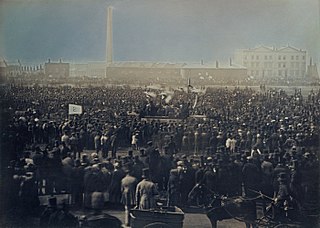
Chartism was a working-class movement for political reform in the United Kingdom that erupted from 1838 to 1857 and was strongest in 1839, 1842 and 1848. It took its name from the People's Charter of 1838 and was a national protest movement, with particular strongholds of support in Northern England, the East Midlands, the Staffordshire Potteries, the Black Country, and the South Wales Valleys. The movement was fiercely opposed by government authorities who finally suppressed it.

Feargus Edward O'Connor was an Irish Chartist leader and advocate of the Land Plan, which sought to provide smallholdings for the labouring classes. A highly charismatic figure, O'Connor was admired for his energy and oratory, but was criticised for alleged egotism. His newspaper Northern Star (1837–1852) was widely read among workers, becoming the voice of the Chartist movement.
Glyn Ford is a British academic and Labour Party politician. He was a Member of the European Parliament (MEP) from 1984 to 2009, initially for Greater Manchester East until 1999, then South West England from 1999 to 2009.
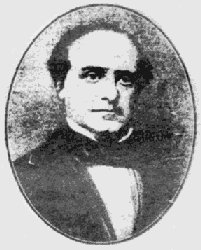
Ernest Charles Jones was an English poet, novelist and Chartist. Dorothy Thompson points out that Jones was born into the landed gentry, became a barrister, and left a large documentary record. "He is the best-remembered of the Chartist leaders, among the pioneers of the modern Labour movement, and a friend of both Marx and Engels."
Abel Heywood was an English publisher, radical and mayor of Manchester.
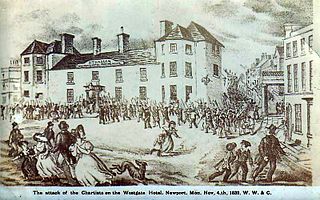
The Newport Rising was the last large-scale armed rising in Wales, by Chartists whose demands included democracy and the right to vote with a secret ballot. On Monday 4 November 1839, approximately 4,000 Chartist sympathisers, under the leadership of John Frost, marched on the town of Newport, Monmouthshire. En route, some Newport chartists were arrested by police and held prisoner at the Westgate Hotel in central Newport. Chartists from industrial towns outside of Newport, including many coal-miners, some with home-made arms, were intent on liberating their fellow Chartists. Fighting began, and soldiers of the 45th Regiment of Foot, deployed in the protection of the police, were ordered to open fire. About 10-24 Chartists were confirmed killed, whilst reports of perhaps a further 50 injured. 4 soldiers were reported as injured, as well as the mayor of Newport who was within the hotel. Subsequently, the leaders of the rising were convicted of treason and were sentenced to be hanged, drawn and quartered. The sentence was later commuted to transportation.
Owenism is the utopian socialist philosophy of 19th-century social reformer Robert Owen and his followers and successors, who are known as Owenites. Owenism aimed for radical reform of society and is considered a forerunner of the cooperative movement. The Owenite movement undertook several experiments in the establishment of utopian communities organized according to communitarian and cooperative principles. One of the best known of these efforts, which were largely unsuccessful, was the project at New Harmony, Indiana, which started in 1825 and was abandoned by 1829. Owenism is also closely associated with the development of the British trade union movement, and with the spread of the Mechanics' Institute movement.

William Lovett was a British activist and leader of the Chartist political movement. He was one of the leading London-based artisan radicals of his generation.
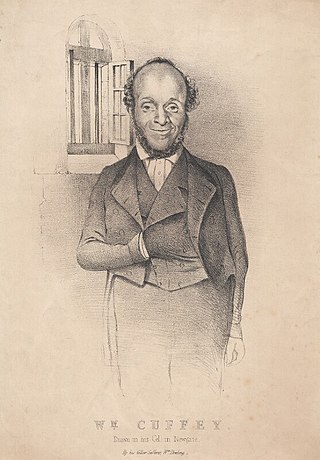
William Cuffay was a Chartist leader in early Victorian London.
Events from the year 1840 in the United Kingdom.
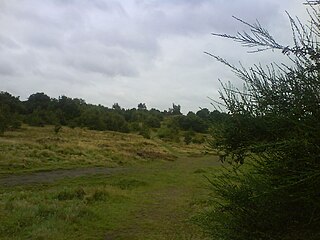
Kersal Moor is a recreation area in Kersal, Greater Manchester, England which consists of eight hectares of moorland bounded by Moor Lane, Heathlands Road, St. Paul's Churchyard and Singleton Brook.

The 1842 general strike, also known as the Plug Plot Riots, started among the miners in Staffordshire, England, and soon spread through Britain affecting factories, mills in Yorkshire and Lancashire, and coal mines from Dundee to South Wales and Cornwall.
Richard Spurr (1800–1855) was a Cornish cabinet maker and lay preacher who was imprisoned for his part in leading the political movement Chartism.
The East London Democratic Association (ELDA) was founded in January 1837 by George Julian Harney in opposition to the LWMA, later supported by James Bronterre O'Brien and Feargus O'Connor. In April 1838 ELDA was reconstituted as the London Democratic Association (LDA) with an eight-point resolution covering the Charter and more. Closely allied with the northern Chartists, by the end of 1838, the LDA had branches meeting in public houses within the City, Tower Hamlets and Southwark in addition to the regular meeting held at the Trades Hall, Bethnal Green.
Events from the year 1841 in Scotland.
Events from the year 1839 in Scotland.

Mark Hovell was a lecturer in history at the Victoria University of Manchester and the Workers Educational Association. He was an officer in The Sherwood Foresters during the First World War and was killed in action in only his second time in the trenches, after he fell down a shaft which had been used to explode a mine under the German lines. His book on Chartism, which he had begun before the war, was completed and published posthumously in 1918. It was one of the first scholarly works on the subject and one of the first to have been written by someone who was not a first-hand witness to events.
Richard Moore (1810–1878) was an English radical politician. He was a moderate Chartist, and heavily involved in the campaign against "taxes on knowledge".
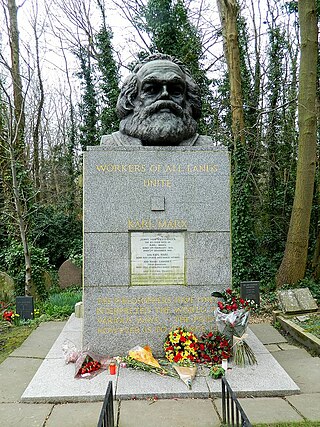
Far-left politics in the United Kingdom have existed since at least the 1840s, with the formation of various organisations following ideologies such as Marxism, revolutionary socialism, communism, anarchism and syndicalism.
The National Charter Association(NCA) (1840-1958) was formed on July 20th 1840, in a conference chaired by James Leach, of twenty three Chartist delegates in Manchester.