
The plazas de soberanía are the Spanish sovereign territories in North Africa. These are separate pieces of land scattered along the Mediterranean coast bordering Morocco. The name refers to the fact that these territories have been a part of Spain since the formation of the modern country (1492–1556), and are distinguished from African territories obtained by Spain during the 19th and 20th centuries.
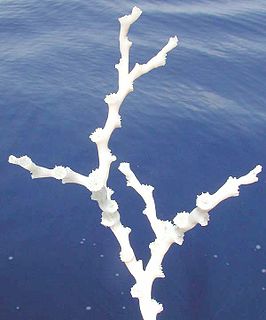
Lophelia pertusa, the only species in the genus Lophelia, is a cold-water coral which grows in the deep waters throughout the North Atlantic ocean, as well as parts of the Caribbean Sea and Alboran Sea. L. pertusa reefs are home to a diverse community, however the species is extremely slow growing and may be harmed by destructive fishing practices, or oil exploration and extraction.

Green laver, known as aonori in Japan and parae (파래) in Korean, is a type of edible green seaweed, including species from the genera Monostroma and Ulva. It is commercially cultivated in some bay areas in Japan, Korea, and Taiwan, such as Ise Bay. It is rich in minerals such as calcium, magnesium, lithium, vitamins, and amino acids such as methionine. It is also called aosa in some places in Japan.

Philippe Jean-Charles Jourdan is a Roman Catholic dignitary, Apostolic Administrator of Estonia and Titular Bishop of Pertusa.
A colonial empire is a collective of territories, either contiguous with the imperial center or located overseas, settled by the population of a certain state and governed by that state.

Hoya de Huesca/Plana de Uesca is a comarca (county) in the province of Huesca (Spain).

El Angolo is a game reserve in northern Peru. It is considered part of the Noroeste Biosphere Reserve, which includes Cerros de Amotape National Park and Tumbes National Reserve, as declared by UNESCO in 1977.
Pertusa is a municipality located in the province of Huesca, Aragon, Spain.

The habitat of deep-water corals, also known as cold-water corals, extends to deeper, darker parts of the oceans than tropical corals, ranging from near the surface to the abyss, beyond 2,000 metres (6,600 ft) where water temperatures may be as cold as 4 °C (39 °F). Deep-water corals belong to the Phylum Cnidaria and are most often stony corals, but also include black and horny corals and soft corals including the Gorgonians. Like tropical corals, they provide habitat to other species, but deep-water corals do not require zooxanthellae to survive.
Elionurus is a genus of Asian, African, Australian, and Neotropical plants in the grass family.

Listrostachys is a genus of flowering plants from the orchid family, Orchidaceae. Many species have been placed in the genus over the years, most of them now transferred to other groups. At present, only one species remains in the genus: Listrostachys pertusa. It is native to tropical Africa from Sierra Leone to Congo-Kinshasa.

Eumunida picta is a species of squat lobster found in the deep sea. The species is strongly associated with reefs of Lophelia pertusa, a deep-water coral, and with methane seeps. It is abundant in the western Atlantic Ocean, where it is found from Massachusetts to Colombia.
The orange hairy chiton, Chaetopleura pertusa, is a species of chitons in the family Chaetopleuridae. It is a marine mollusc. It is endemic to South Africa.

Terebra pertusa, common name the perforated auger, is a species of sea snail, a marine gastropod mollusk in the family Terebridae, the auger snails.
Strigatella is a genus of sea snails, marine gastropod mollusks in the family Mitridae.
Leo Philip Cowley was the Roman Catholic Titular Bishop of Pertusa and the auxiliary bishop of the Roman Catholic Archdiocese of Saint Paul and Minneapolis, Minnesota.

Bothriochloa pertusa is a species of grass. It is widely used as a fodder and a graze for livestock.
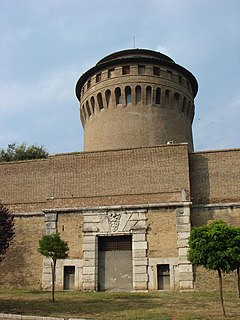
Porta Pertusa is one of the gates of the Leonine Wall in Rome (Italy).
Pertusa was an ancient city and diocese in Tunisia. It is now a Catholic titular bishopric.
El - Harairia is a suburb of Tunis, Tunisia located at 36.781395, 10.115375 in an outer western suburb of Tunis, Tunisia, North Africa. El Haraitria is also the site of Roman era ruins of Ad Pertusa, a Roman Civitas that flourished between 30 BC - AD 640.
This page is based on this
Wikipedia article Text is available under the
CC BY-SA 4.0 license; additional terms may apply.
Images, videos and audio are available under their respective licenses.
