
The Cairo Conference of November 22–26, 1943, held in Cairo, Egypt, outlined the Allied position against Japan during World War II and made decisions about postwar Asia.

The Penghu or Pescadores Islands are an archipelago of 90 islands and islets in the Taiwan Strait. The largest city is Magong, located on the largest island, which is also named Magong. Covering an area of 141 square kilometers (54 sq mi), the archipelago collectively forms Penghu County of the Republic of China (Taiwan), and is the second smallest county, after Lienchiang.

USS Langley (CVL-27) was an Independence-class light aircraft carrier that served the United States Navy from 1943 to 1947, and French Navy as La Fayette from 1951 to 1963.
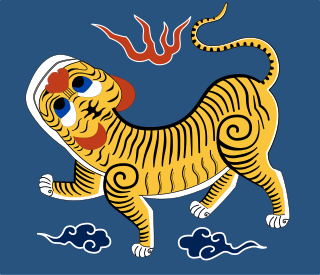
The Republic of Formosa was a short-lived republic that existed on the island of Taiwan in 1895 between the formal cession of Taiwan by the Qing dynasty of China to the Empire of Japan by the Treaty of Shimonoseki and its being taken over by Japanese troops. The Republic was proclaimed on 23 May 1895 and extinguished on 21 October, when the Republican capital Tainan was taken over by the Japanese. Though sometimes claimed as the first Asian republic to have been proclaimed, it was predated by the Lanfang Republic in Borneo, established in 1777, as well as by the Republic of Ezo in Japan, established in 1869.
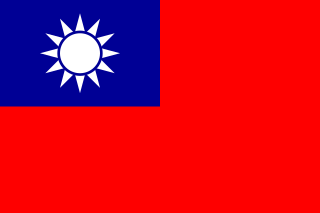
The Sino-Japanese Peace Treaty, commonly known as the Treaty of Taipei, was a peace treaty between Japan and the Republic of China signed in Taipei, Taiwan on 28 April 1952, and took effect on August 5 the same year, marking the formal end of the Second Sino-Japanese War (1937–45). This treaty was necessary, because neither the Republic of China nor the People's Republic of China was invited to sign the Treaty of San Francisco due to disagreements by other countries as to which government was the legitimate government of China during and after the Chinese Civil War. Under pressure from the United States, Japan signed a separate peace treaty with the Republic of China to bring the war between the two states to a formal end with a victory for the ROC. Although the ROC itself was not a participant in the San Francisco Peace Conference due to the resumption of the Chinese Civil War after 1945, this treaty largely corresponds to that of San Francisco. In particular, the ROC waived it's rights to war reparations from Japan in this treaty with respect to Article 14(a).1 of the San Francisco Treaty.

Kapingamarangi is an atoll and a municipality in the state of Pohnpei of the Federated States of Micronesia. It is by far the most southerly atoll or island of the country and of the Caroline Islands, 300 km (190 mi) south of the next southerly atoll, Nukuoro, and 740 km (460 mi) southwest of the main island of Pohnpei state; it forms a Polynesian outlier.

Retrocession Day is a name given to the annual observance and unofficial holiday in Taiwan to commemorate the end of 50 years of Japanese rule of Taiwan and Penghu, and their claimed handover to the Republic of China on 25 October 1945. However, the idea of "Taiwan retrocession" is in dispute.

The Japanese invasion of Taiwan was a conflict between the Empire of Japan and the armed forces of the short-lived Republic of Formosa following the Qing Dynasty's cession of Taiwan to Japan in April 1895 at the end of the First Sino-Japanese War. The Japanese sought to take control of their new possession, while the Republican forces fought to resist Japanese occupation. The Japanese landed near Keelung on the northern coast of Taiwan on 29 May 1895, and in a five-month campaign swept southwards to Tainan. Although their advance was slowed by guerrilla activity, the Japanese defeated the Formosan forces whenever they attempted to make a stand. The Japanese victory at Baguashan on 27 August, the largest battle ever fought on Taiwanese soil, doomed the Formosan resistance to an early defeat. The fall of Tainan on 21 October ended organised resistance to Japanese occupation, and inaugurated five decades of Japanese rule in Taiwan.
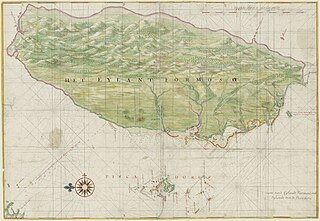
The cultural history of Taiwan can be traced back to prehistoric Stone Age. Later the development of written languages made it easier to maintain traditions of the Taiwanese culture.

The French Far East Squadron was an exceptional naval grouping created for the duration of the Sino-French War.

The Pescadores campaign which took place in late March, 1885, was one of the last campaigns of the Sino-French War. It was fought to capture a strategically important island group off the western coast of Formosa (Taiwan). Admiral Amédée Courbet, with part of the French Far East Squadron, bombarded the Chinese coastal defences around the principal town of Makung (馬公) on Penghu Island (澎湖島) and landed a battalion of marine infantry which routed the Chinese defenders and occupied Makung.
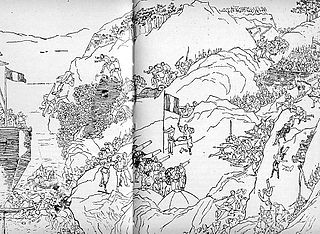
The Keelung campaign was a controversial military campaign undertaken by the French in northern Formosa (Taiwan) during the Sino-French War. After making a botched attack on Keelung in August 1884, the French landed an expeditionary corps of 2,000 men and captured the port in October 1884. Unable to advance beyond their bridgehead, they were invested inside Keelung by superior Chinese forces under the command of the imperial commissioner Liu Mingchuan. In November and December 1884 cholera and typhoid drained the strength of the French expeditionary corps, while reinforcements for the Chinese army flowed into Formosa via the Pescadores Islands, raising its strength to 35,000 men by the end of the war. Reinforced in January 1885 to a strength of 4,500 men, the French won two impressive tactical victories against the besieging Chinese in late January and early March 1885, but were not strong enough to exploit these victories. The Keelung campaign ended in April 1885 in a strategic and tactical stalemate. The campaign was criticised at the time by Admiral Amédée Courbet, the commander of the French Far East Squadron, as strategically irrelevant and a wasteful diversion of the French navy.

The French ironclad Bayard was an early stationary battleship of the French Navy, lead ship of her class. Bayard had a wooden hull and a full rigging, as well as a side armour and steam machinery.

USS Gardiners Bay (AVP-39) was a United States Navy seaplane tender in commission from 1945 to 1958 that saw service in the latter stages of World War II and in the Korean War. After her decommissioning, she was transferred to Norway, and she served in the Royal Norwegian Navy as the training ship HNoMS Haakon VII (A537) from 1958 to 1974.

The Pescadores campaign was the last military operation of the First Sino-Japanese War and an essential preliminary to the Japanese conquest of Taiwan.

The Japanese destroyer Kamikaze was the lead ship of nine Kamikaze-class destroyers built for the Imperial Japanese Navy (IJN) during the 1920s. At the beginning of the Pacific War in December 1941, the ship was assigned to the Ōminato Guard District. She remained in northern Japanese waters until mid-1942 when she participated in the Aleutian Islands Campaign. Kamikaze continued to patrol northern Japanese waters until early 1945 when she was transferred to the Singapore area.

The Peasant Party is a minor party in the Republic of China (Taiwan). It was established on 3 February 1989, but only came into the political horizon when its founder Tiuⁿ Bêng-hián (張銘顯) was elected in the 2005 National Assembly election. Tiuⁿ claimed that the party has more than 6000 members. On the national question, it leans towards Taiwan independence.
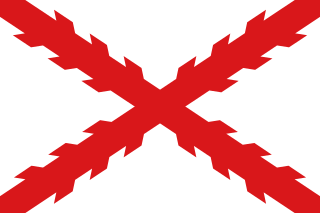
The Spanish expedition to Formosa was a campaign mounted by the Spanish based in Manila, Philippines in 1626. It was the Spanish response to Dutch settlements being built in Formosa, now known as Taiwan. In cooperation with the Portuguese, this venture was made to attract Chinese traders and curtail the expansion of Dutch power in Asia.
Events in the year 1895 in Japan.

The Taiwanese Resistance to the Japanese Invasion of 1895 was a conflict between the short-lived Republic of Formosa (Taiwan) and the Empire of Japan. The invasion came shortly after the Qing dynasty's cession of Taiwan to Japan in April 1895 at the end of the First Sino-Japanese War.
